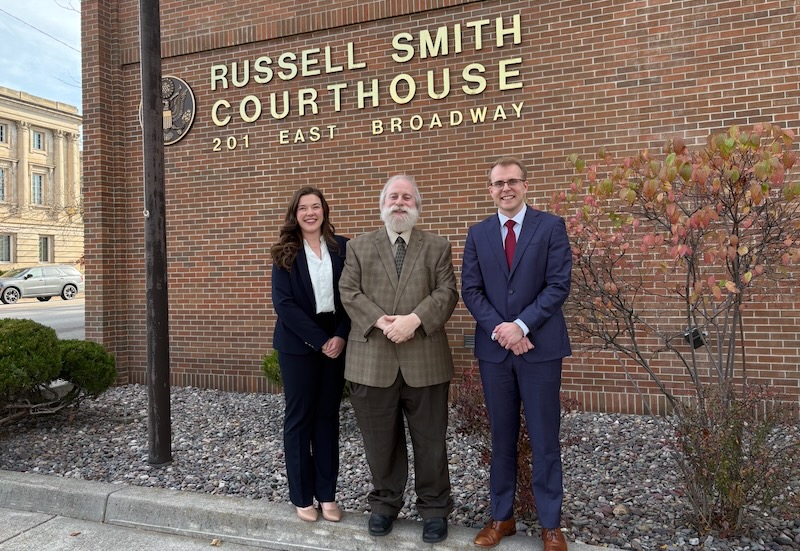
Third-year University of St. Thomas School of Law students Miranda Sharp and Zachary Liebl asked the United States Court of Appeals for the Ninth Circuit to find the federal government can be held negligent for an unsafe road-design that contributed to their client’s injuries in a car crash.
Working in the Appellate Clinic, led by Professor Gregory Sisk, the students argued that the United States should not be excused from liability for a dangerous curve on a government-constructed rural highway by claiming public policy immunity.
“This case was important because our client deserves her day in court,” Sharp said. “The discretionary function exception should not shield the federal government from ordinary negligence when no meaningful public policy decision is involved. This case presented an opportunity to challenge the expansion of that exception.”
“Depending on the outcome, it could create favorable precedent for future cases,” Liebl added.
The case, Sadie Gumusyazici v. United States, highlights a special defense that the federal government regularly raises to defeat civil lawsuits seeking recovery for personal injuries caused by official negligence. In this instance, the government failed to install a guardrail and placed a hazardous utility pole at a curve on an Idaho highway on tribal land, resulting in severe injuries to the passenger in a traveling car. Rather than regarding this as simple question of civil engineering for public safety, the United States insists that it is immune under the “discretionary function exception” to the Federal Tort Claims Act. The St. Thomas Appellate Clinic team countered that this case is about ordinary highway safety measures, not insulated policy judgments.
The team of Sharp, Liebl, and Sisk dedicated nearly a year to the case, beginning with an opening brief drafted last spring, continuing with a reply brief filed in August, and then preparing for oral argument at the Russell Smith Courthouse in Missoula, Montana in October.
During the oral argument, a panel of three federal judges questioned both Liebl and Sharp extensively. The judges pressed the students on the specific facts of the highway's condition, whether the government’s failure to install a guardrail constituted negligence, and whether the decision fell under policy choices that courts should not second-guess.
“While I was certainly nervous before and during the argument, I felt well-prepared to present our arguments and answer the court’s questions,” Liebl said. “It was exciting to come before the court and argue after many months of preparation.”
Both students felt that their experience in the Appellate Clinic provided them with valuable practical experience that will benefit them in their careers.
“Through the clinic, I learned how to frame appellate issues effectively while still telling the client's story,” Sharp said. “I also valued the opportunity to practice oral argument with practicing attorneys each week, receive feedback, and continually develop my advocacy skills. It was an experience that strengthened both my legal skills and my appreciation for the responsibility we have as advocates.”
The Appellate Clinic is a year-long course of study in written and oral advocacy, appellate courts, appellate jurisdiction, and the rules of appellate procedure. Clinical students represent a client pro bono under faculty supervision, briefing and arguing appellate cases on their behalf.
This is the 15th year of pro bono work by the Appellate Clinic, which has established a record of prevailing in more than 75 percent of the appeals it has taken.
A decision in Sadie Gumusyazici v. United States is expected in the next few months.