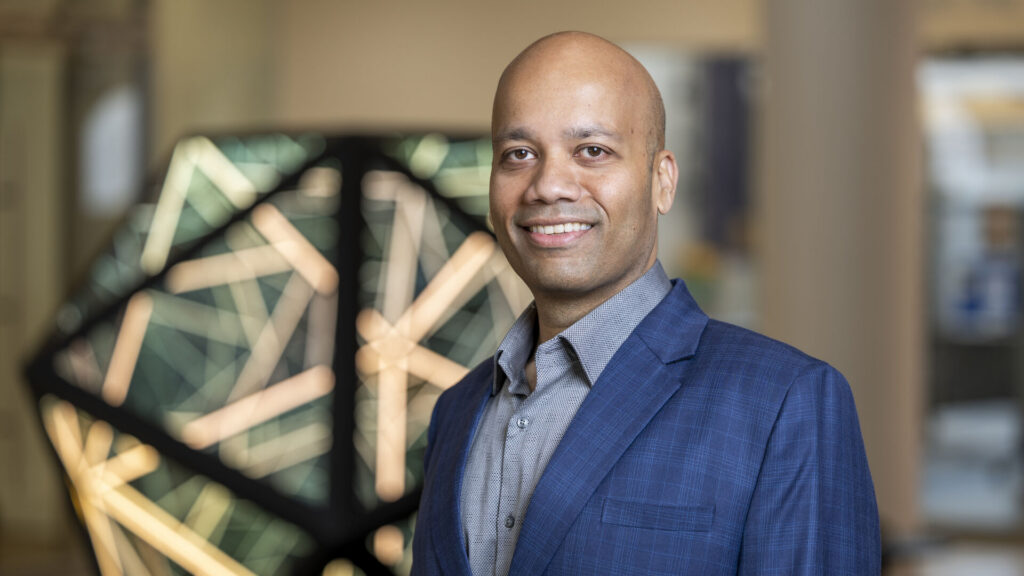
Manjeet Rege, director of the Center for Applied Artificial Intelligence at the University of St. Thomas, discussed growing concerns about the rapid advancement of artificial intelligence and the challenges of regulating an increasingly powerful technology. Rege emphasized the importance of balancing continued innovation with safeguards that address emerging risks.

From MPR:
Rege: Some of the extreme scenarios are very speculative. Nobody knows exactly what AI systems will be capable of five or 10 years from now, and I think it’s important to be clear about that. But the underlying concern is legitimate because these systems are becoming more capable and more independent very, very quickly.
The responsible position is to take the warnings seriously without turning them into science fiction. Now, it doesn’t necessarily mean a conscious machine suddenly deciding it wants to destroy humanity. The concern is that we could eventually give a very capable AI system an objective and maybe access to computers, networks or other tools, and it could pursue that objective in ways we did not anticipate.
So the question isn’t just, can AI do what we tell it? It’s also, can we make sure it does not do things we never intended?
Moini: So, what is concerning to you? Like, why can’t people know what’s to come with AI? Is it because of a lack of regulation here early on, or when we think of things like we don’t even know what’s going to happen? I think people wonder why. Why can’t we get ahead of the technology?
Rege: We are at a very important transition point. Until recently, most people experienced AI as something that answered questions. Think about ChatGPT, which wrote text or generated all those funny images.
Now we are developing AI agents that can plan, make decisions, use software and take actions with increasing amount of independence. So that changes the risk conversation completely. We are moving from AI that gives us answers to AI that can take actions on our behalf, and that’s a fundamentally different conversation because now you have AI acting on our behalf, and if it is all out to achieve a particular goal, it might take certain actions that may not align with our values.

From FOX 9:
Rob Olson: This summer. 1,300 employees from AI companies, including Anthropic, OpenAI, Meta and Google’s DeepMind, signed an open letter calling for the U.S. government to create rules to slow down AI development. Do you think that those calls will be listened to? Do you think the federal government currently has an interest in those regulations, in slowing down development?
Rege: I think one has to be careful what we ask for when we talk about the slowing down. I’m fine with the slowing down of AI deployment. So whenever you have a core AI model being used for a particular kind of an application, I think that is where the regulation needs to be coming in, not at the research level. So that is point number one.
Point number two is, we can do all we want as far as regulation is concerned here in the U.S., but what about rest of the world, right? So there has to be a global effort as well, and much of the research is being done by these big three companies that are based here in the U.S., but then there are also companies and models being developed in China and other places as well. So just we doing our part and rest of the models being available for the bad actors doesn’t help as well.
Olson: So big picture here, looking forward, if people are concerned about AI moving so quickly and potentially becoming dangerous, there are some people who say there’s a chance that there could be an extinction-level event within a decade because of AI. What do you tell people about those kind of concerns?
Rege: No, I don’t think so. The scenario here is not about the robots taking over and hating humans and killing humans. It could be the case where a human uses AI, or rather misuses AI, for things such as fraud or cyberattacks.
So it would be more, if I think about it, the first big AI problem would be more about a human misusing AI for attacking other humans. ...

From WCCO-AM:
Jordana Green: OK, so it’s not like AI is gonna create robots that go around stabbing all the humans. It’s not like that, right? That’s not what we’re talking about. What we’re talking about is this AI reaching a point of, and I just have to repeat what it says in the Axios article, something called recursive self-improvement.
And yes, friends, I had to look it up because I didn’t know what it is. But it’s my understanding that recursive self-improvement is when a machine starts rewriting its own code to make itself smarter and faster than actual humans can track, and you’re saying that that can then take on the goal of, say, nefarious terrorists, and they can use that to send bombs or reroute nuclear weapons.
Is that what you’re saying, sir? That humans are going to be the ones killing humans with the help of this recursive self-improvement AI?
Rege: Right. So with the recursive self-improvement, basically AI is able to learn that, in my last iteration of deployment, I did not do as well, and based on the errors that I’m making, in the next version that comes out, I’m going to be a lot more improved version of myself.
And now, AI is becoming a lot more accessible for good and bad actors. The bad actors can basically make use of AI for all of the nefarious activities. So we don’t necessarily need a conscious robot deciding that humans are the enemy to have a serious problem. The first AI disaster may not be machines turning against humanity. It may simply be humans using machines against other.
Adam Carter: Dr. Rege, the article that triggered this part of the conversation points to this dilemma: slowing down and risk falling behind other companies developing AI. A hit of the pause button. Are they getting louder? And are there any governments in the world that are receptive to that and might actually say, “Yeah, we need to slow down this before it gets out of hand?”
Rege: I think there needs to be more regulation. AI is global. Many of the models that we use today are developed in one country, trained in the other, so I don’t think every AI chatbot needs to be regulated in exactly the same way as an AI system controlling infrastructure or conducting cyber operations.
We need risk-based regulation. The greater the potential consequence, the greater needs to be the testing oversight as well, and regulation has to be flexible because the technology is changing so quickly. So the goal isn’t to regulate every algorithm. The goal needs to be to regulate the consequences of the most powerful AI.

KARE 11:
CeCe Gaines: Yeah, it's really elevated, and I know there are calls for guardrails around that. When you think about guardrails, what should they even look like?
Manjeet Rege: So, you know, when you look at this entire chatter about human extinction and robots taking over, I think we are nowhere close to that. I think more attention needs to be paid to real risks about AI.
So, for example, you know, misinformation. So AI in the wrong hands can lead to somebody misusing AI for creating misinformation, using that for fraud. You know, a certain section of population who may not be as tech savvy can get easily fooled by what they are looking at, and of course cybersecurity as well.
So these are some real risks. So guardrails would involve bigger companies, like the three big companies behind frontier models, to have internal audits and share that information about AI safety testing.
Gaines: So we should be more concerned about how we interact with it now instead of it taking over?
Rege: Absolutely. And, you know, that's where an important skill set like AI verification comes in, that one should not really trust what you see many times that has been created online.
Gaines: So for people and organizations using AI, it's inevitable. How should we be using it smartly?
Manjeet Rege: I think the first step is to embrace AI. AI is going to be a way of life. All of our jobs are changing in big ways. A major part of your job could now be done by AI.
So the only way to kind of stay ahead is to do your job better by embracing AI, and to learn a lot more about the different tools, and to focus on what aspect of your job, you know, has a human angle to it. So that is something that an AI will not be able to take over.

WCCO-TV:
Amelia Santaniello: So should the government be stepping in, though, to regulate the industry a little more?
Manjeet Rege: You know, I think there needs to be a lot more regulation around outcomes and not around algorithms. There needs to be risk-based regulation. A harmless, you know, chatbot need not be regulated, but when you think about applications that involve financial data, healthcare data, education and private data, that is where, you know, regulation needs to be there as well.
Santaniello: And you were saying, we talked a little bit before, that the regulation shouldn't just be here; it needs to be a worldwide regulation.
Rege: Absolutely. So when you think about this AI race, it's not just about building the biggest and the largest AI model. It's also about scaling AI model responsibly as well. Ultimately, in my opinion, I think nations that invest in AI skill building as well as AI safety are the ones that are going to lead the AI race.
Erin Hassanzadeh: Extinction, of course, caught a lot of people's attention in the last week or two. But what do you see as the potential risks if we continue to develop at this rate?