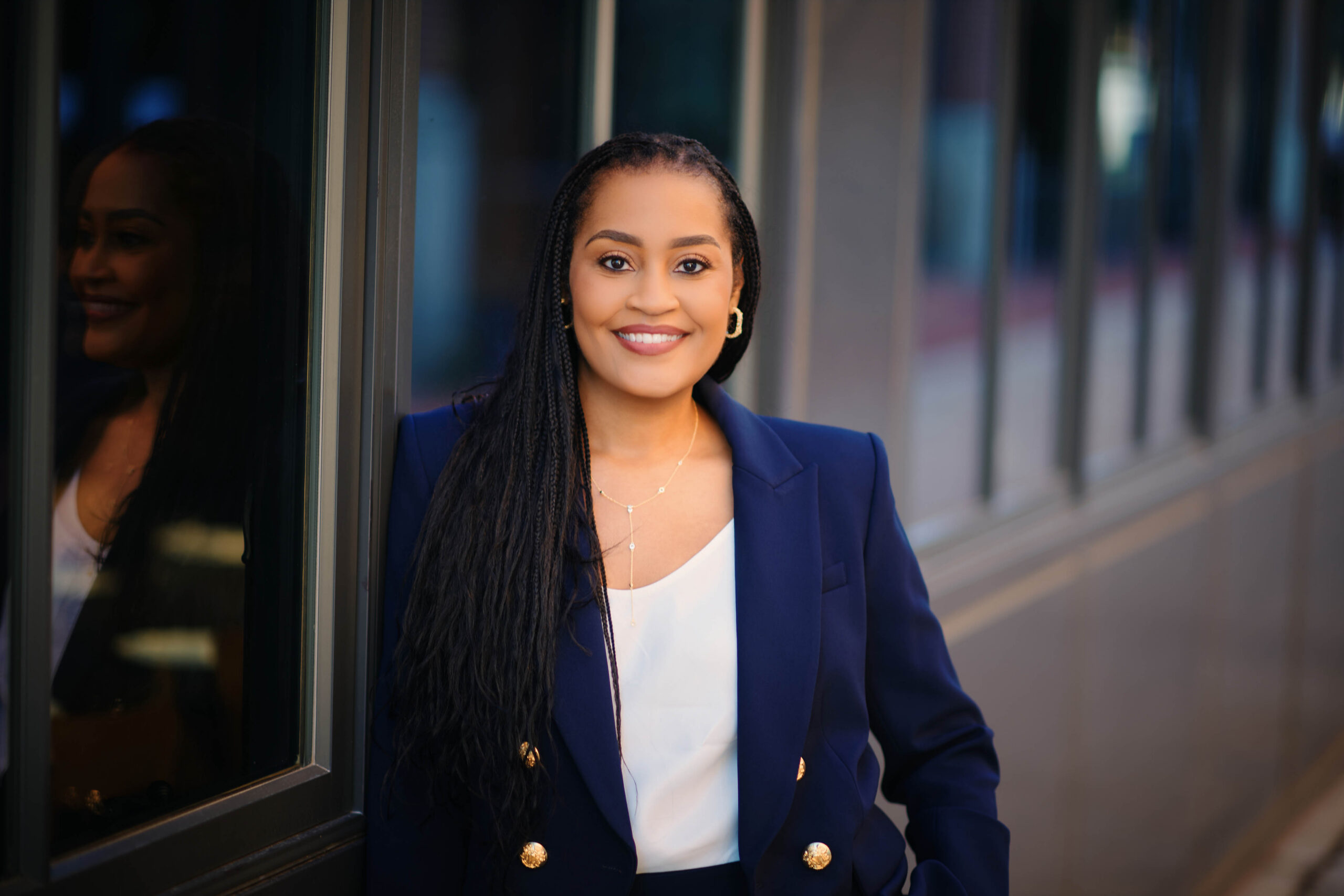
Through what has so far been an incredibly diverse career, Lara Marion ’07 J.D. seems to always find herself “at the intersection of something.”
Just where she likes to be.
That’s because being right in the center of things like industry and policy, or industry and academia allows her to do what she loves doing best: being a connector of people. It was a skill she helped hone through learning how to make a case at the St. Thomas School of Law.
“I'm always right in the center, not really in any of the full bubbles,” she said. “It's really cool. You get to learn a lot of interesting things.”
That ability to connect people and ideas has shaped a purpose-driven career that has taken Marion from Minnesota to Washington, D.C. and now North Carolina, and through roles working as an advocate within the legislature, government agencies, public interest organizations and nonprofits that aim to further the interests of aging adults or the telecommunications, public safety and technology industries.
The roots of that journey stretch back to her childhood.
Growing up in a suburb of Minneapolis, Marion watched her mother, M. Jacqueline Regis, build a career first as a prosecutor and later as a judge in Hennepin County. While the law itself interested her, she found herself more intrigued by the circumstances surrounding the cases and human behavior.
“I wanted to know, why is this person going to jail?” Marion said. “And it was specific. Why this person? What is it about their lives? And then, what are the patterns overall that we see that sort of send people down these paths that they get in trouble with the criminal justice system?”
At Spelman College in Georgia, Marion studied political science and took several sociology courses that deepened her interest in how society, culture and institutions shape people’s choices and opportunities. Influences such as then-Minnesota Supreme Court Justice Alan Page helped add a social justice lens and sharpened her interest in inequities and inequalities within public and private systems. They also helped her confirm her next step of going to law school.
Marion says the University of St. Thomas School of Law was the right fit because of its focus on social justice and its emphasis on developing lawyers as servant leaders.
“My professors had different styles, but there’s this thread of service, servant leadership and social justice you can see and pull from,” Marion said. “I learned at St. Thomas that social justice takes on different forms, classes, colors, races, political parties, religions. It’s really about finding ways to work within different systems and pull out that social justice element to get to the heart of, let’s do the right thing here for everybody. That’s something I’ve tried to do throughout my career.”
While she briefly considered becoming a prosecutor, Marion found herself increasingly drawn to public policy and advocacy work.

After graduating in 2007, Marion moved to Washington, D.C., where she joined the staff of Congressman Keith Ellison. She later worked for Congressman G.K. Butterfield, gaining firsthand experience in the legislative process and learning how policy can influence communities and systems on a broad scale.
Those roles also introduced her to a variety of issue areas and perspectives. More importantly, they helped her discover where her strengths lay—not necessarily as the person writing policy, but as someone who could bring people together around it.
“I love to connect. I love patterns and I love systems, and I like to see things in that way,” she said. “And I love connecting people, too. It's just cool to see how everything is interconnected.”
Over the next two decades, Marion held leadership and advocacy roles with the Lawyers’ Committee for Civil Rights Under Law, the National Cable & Telecommunications Association, the North Carolina Department of Public Safety, AARP and Amazon Leo, among other organizations. While the subject matter changed, the core of the work remained remarkably consistent: helping diverse groups understand one another, build consensus and solve problems.
“I’ve always loved building coalitions,” she said. “For instance, partnering with different types of people and organizations to pull together literature to send to policymakers to help them understand a consumer issue or a specific technical point.”
Coalition-building requires more than expertise. It requires empathy, communication and the ability to understand how different audiences see the world. Marion credits her legal education with helping her develop those skills.
“In talking to different groups, you have to put yourself in their shoes and think about how they’re going to receive what you’re saying,” she said. “The way that I talk to a think tank is not the way that I’m going to talk to a chamber of commerce about the same issue. St. Thomas really taught me how to make a case, and that’s what you’re doing. You’re making a case to all these different folks. They’re not your jury, but you want them to advocate with you. You have to pull them into the story and explain why they should care.”
For Marion, meaningful work has never been defined by a title or organization. Instead, it has been about finding opportunities to contribute to causes that matter and helping people work together toward solutions.
“If it doesn’t mean something more than the paycheck, then it’s not really worth doing,” she said. “There’s a lot of things you can do out there to pay the bills. But I think your body of work really has to be meaningful.”
That philosophy extends beyond her professional roles. Marion serves on the board of the Telecommunications Policy Research Conference, helping foster collaboration among academics, policymakers and industry leaders. She also serves on the board of Davidson Day School, investing time in a community she deeply values.
Looking back, Marion describes her professional journey as a “windy” one. Yet despite the many turns, there are consistent themes: a drive to understand and improve systems, a commitment to service and a talent for connecting people around ideas that matter.
“I still love systems and problem solving,” she said. “I love connections and connecting people, but there is also a through line of servant leadership. And that has really driven me through my whole career.”