When University of St. Thomas Professor Mike Klein ’90, ’98 MA, ’09 Ed.D. lost his father to cancer in 2001, he turned to building a cedar-strip canoe to process his grief. But when the unfinished canoe cracked during storage, Klein abandoned his plans to take it onto the water. Nearly 25 years later, the canoe found a new purpose.
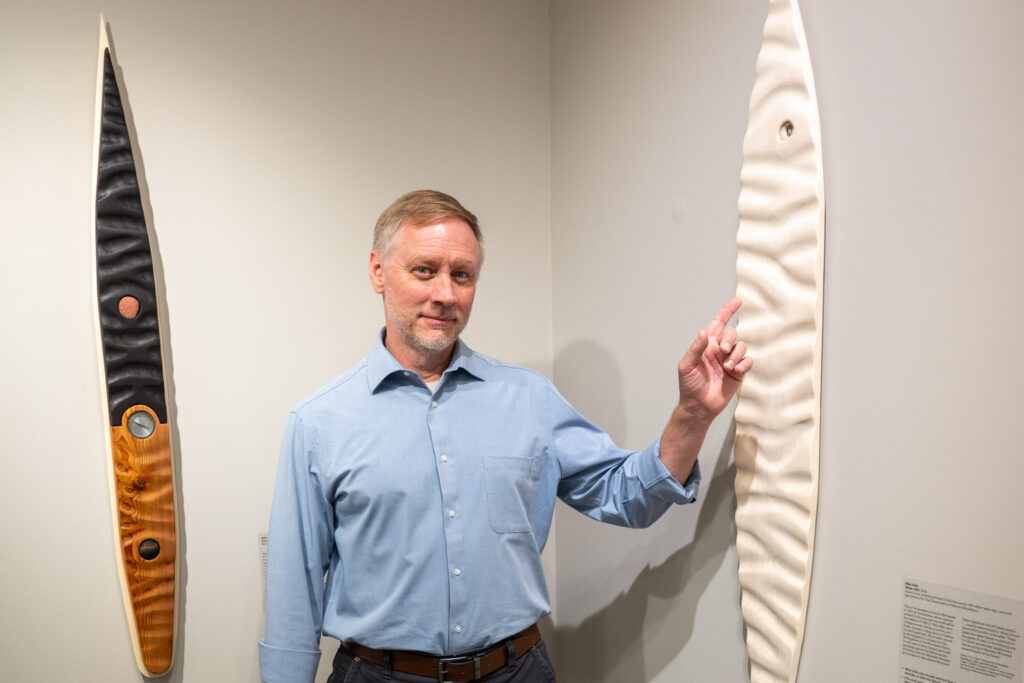
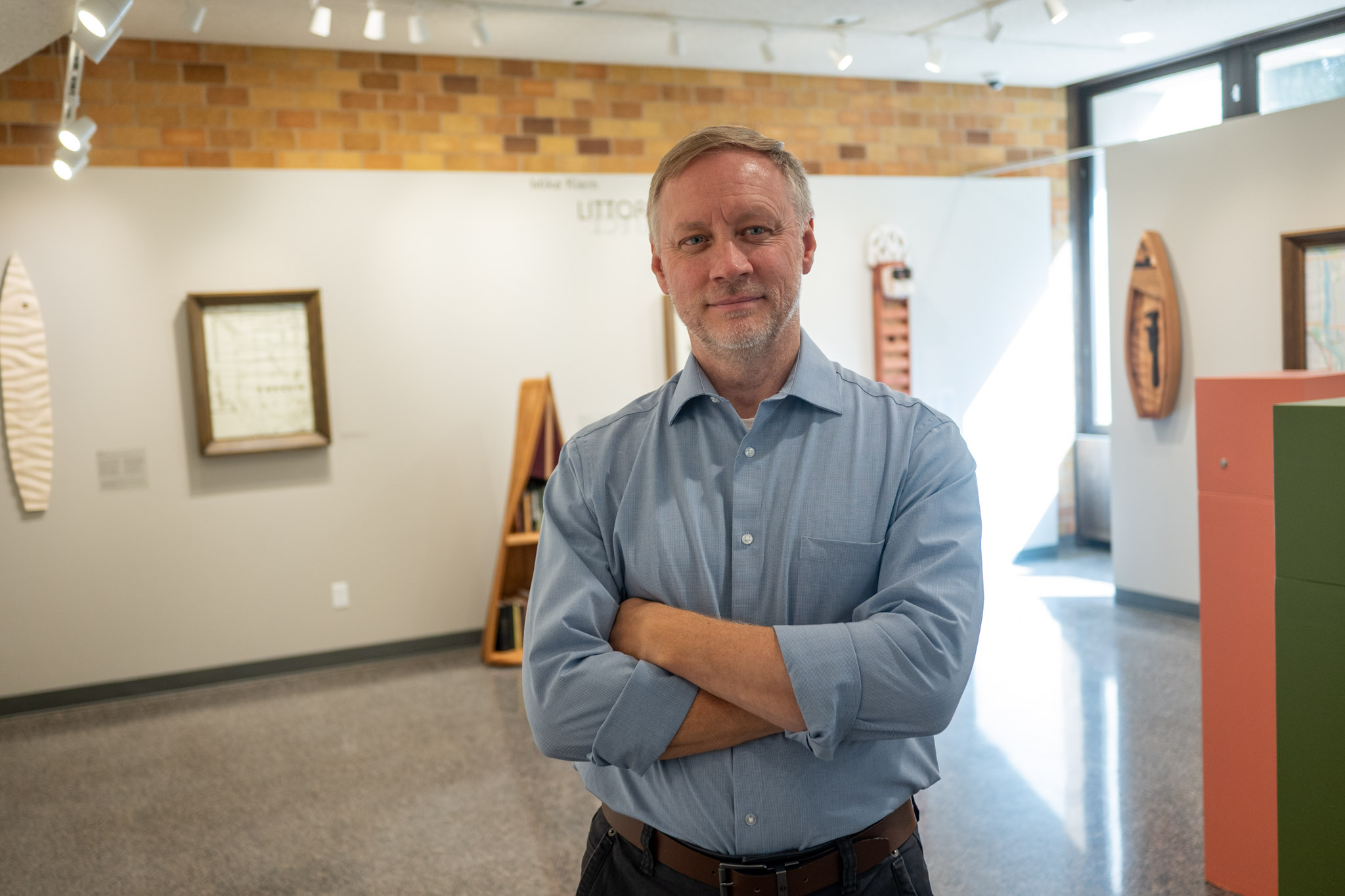
Klein transformed part of it into a bookcase for his debut solo art exhibition, “Littorally,” which is displayed in the Sustainability Arts Gallery on the first floor of the O'Shaughnessy Education Center. The sculpture, titled “Auto Bibliography,” holds books that shaped his relationship with water. The literature ranges from religious texts and poetry to Indigenous perspectives on the environment.
Klein, a professor of justice and peace studies and chair of the Department of Justice and Society Studies in the College of Arts and Sciences, uses art to explore the intersection of identity, culture and nature.
“Much of the art I create is about trying to address or process things that I can't quite do linearly,” Klein said. “The boat, to me, is an expression of those three things and where they intersect.”
Klein’s art is not separate from his academic work. He uses creative practice in his teaching and research to examine how people form relationships, understand social and environmental challenges and imagine ways to respond. His new research examines how art, craft and community-based education can strengthen democratic life.
In the spring, he will teach JPST 225 Making Art for Social Justice. “Although it is not new this year, I will take a new focus on water as the subject of our art making and learning,” he said.
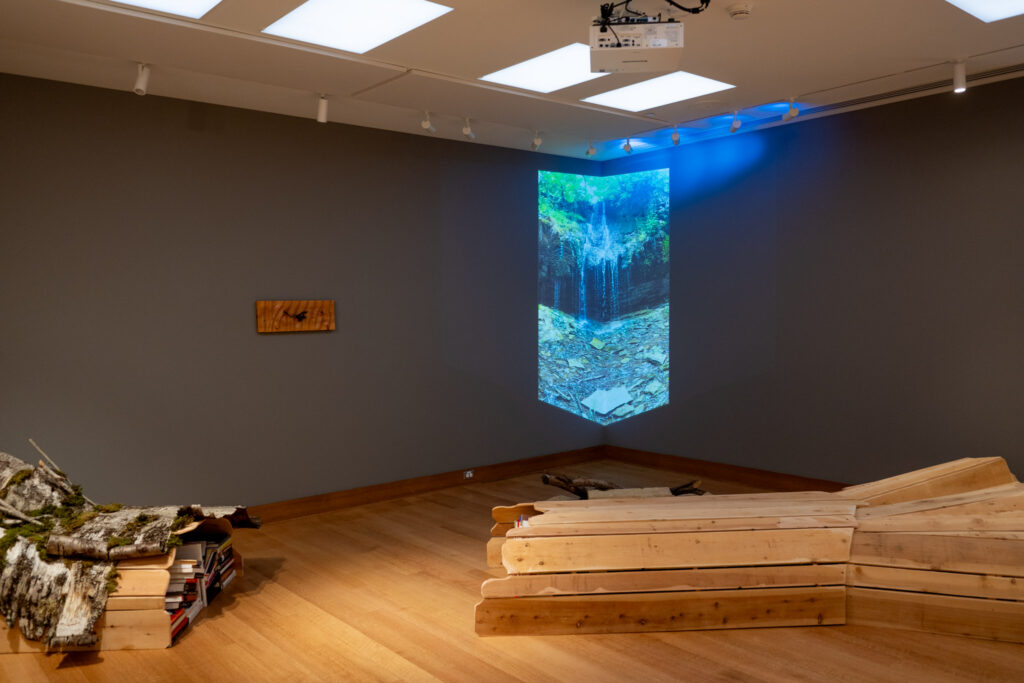
"Littorally" currently serves as a teaching tool across several disciplines, including history, theology and Klein’s course on Leadership for Social Justice. The exhibition also includes “Littorally Reflect” in the John P. Monahan Gallery on south campus, examining ancestral ties to the water and land.
“This area of land is known by Dakota people as Mnisina, ‘blanket of water,’” Klein said. “This metaphor of a littoral waterway that was altered, renamed, and buried might help us uncover stories that have been literally neglected or erased.”
Bria Schmitz '28, an actuarial science major in Klein's qualitative methods course who visited the Sustainability Arts Gallery for a class assignment, said examining the artwork challenged her to separate observations from interpretations.
“I found myself getting lost in my own theories about the piece instead of being able to fully describe what I was seeing,” Schmitz said.
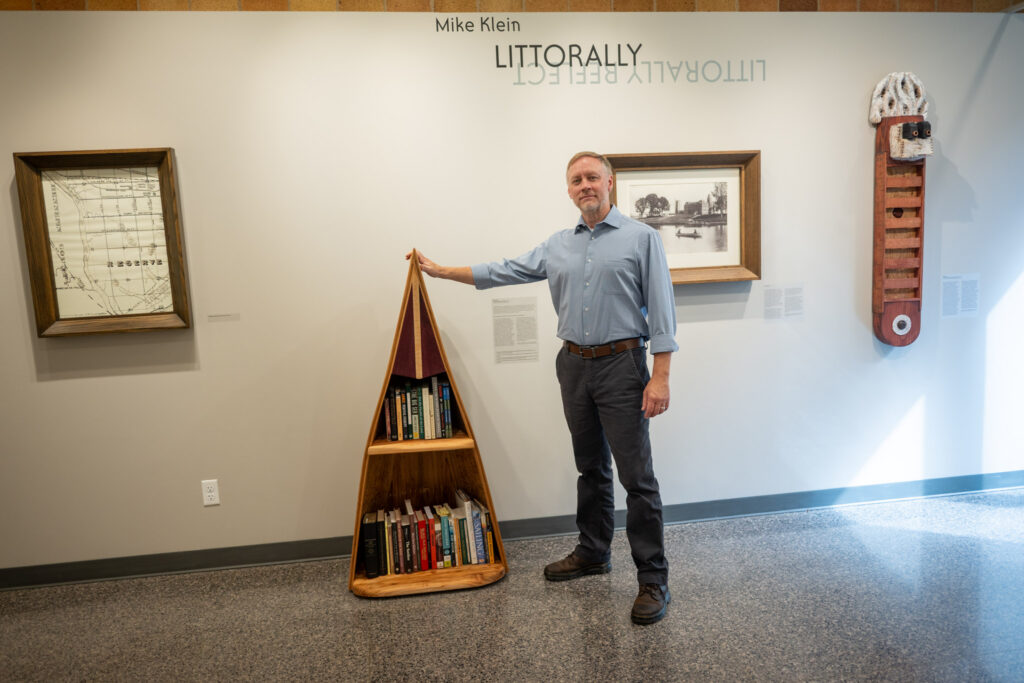
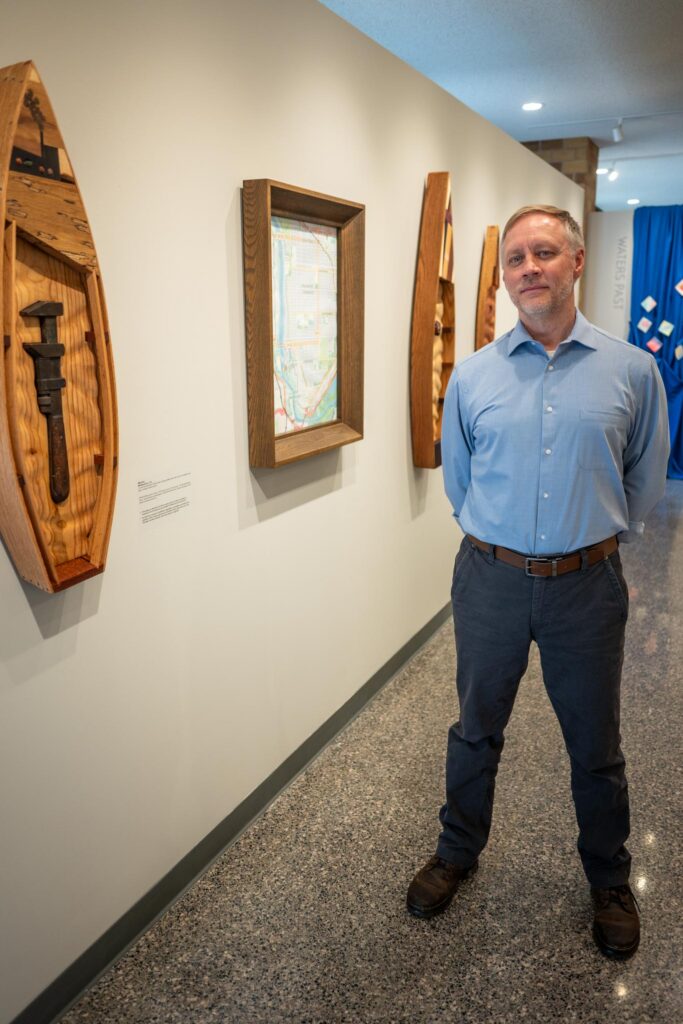
Klein’s exhibition includes hand-carved wooden sculptures, historical maps and interactive activities where he invites visitors to examine their relationship with water, confront its complicated history and consider their responsibility to protect it.
“The exhibit did change my perspective of water because of the insight it gave me into how other people view it,” Schmitz said.
Connecting the past to the present
Klein developed his relationship with water during trips to the Boundary Waters with his father.
“Much of my work as a peace studies professor [and] my activism in community really stems back to early experiences with my family,” he said.
Family roots become both metaphor and material throughout the exhibition, which incorporates 16 varieties of natural wood, including maple, oak, birch and aspen sourced in Minnesota when possible. He primarily uses linseed oil instead of paints, stains and toxic finishes to reduce the environmental impact of his materials.
For instance, his sculpture “Monkeywrench,” which is inspired by Edward Abbey's 1975 novel The Monkey Wrench Gang, raises questions about how far people should go to protect water. Two threats to water, Klein said, are data centers, which use excessive amounts of fresh water to cool the servers, and agriculture runoff.
In Minnesota, the issue is prevalent as nearly 75% of the state’s population rely on groundwater for their drinking water while programs are failing to reduce nitrate pollution caused by agriculture runoff, according to the Natural Resources Defense Council.
“By provoking a deeper understanding and connection to water, hopefully more people will understand the weight of what it would be like without it and thus the importance of protecting it,” said Claire Bymers ’28, president of the undergraduate Sustainability Club.
Bymers attended the exhibit’s opening night with fellow club members and learned about the history of water beneath the St. Thomas campus, including the former Lake Mennith.
One historical map in the exhibition shows a stream running beneath campus, connecting the university's landscape to Shadow Falls and the Mississippi River.
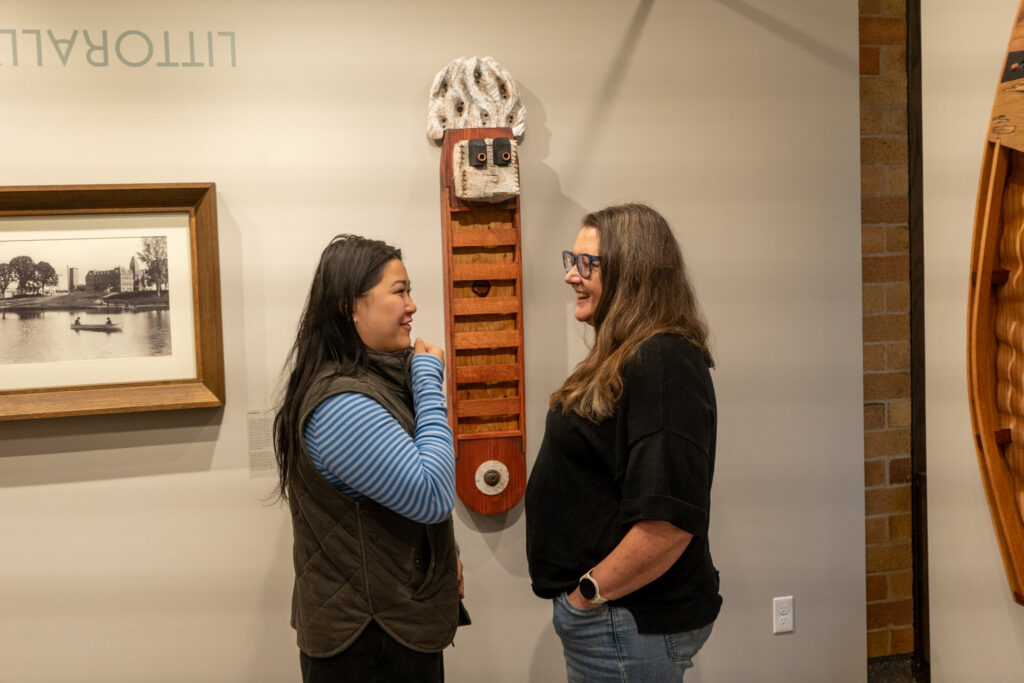
“Dr. Klein's [exhibition] is a great way to encourage viewers to think about how pervasive and integral water is and has been in life,” said Bymers, who is a double major in economics and data analytics.
“‘Littorally’ is one of those exhibits that makes you think more about something that seems mundane to everyday life,” said Susan Mbu '28, a double major in biology and justice and peace studies.
An invitation to reflect
With “Littorally Reflect” in the Monahan Gallery, guests can sit on a fallen tree, browse books and watch footage of a waterfall while listening to the sounds of nature.
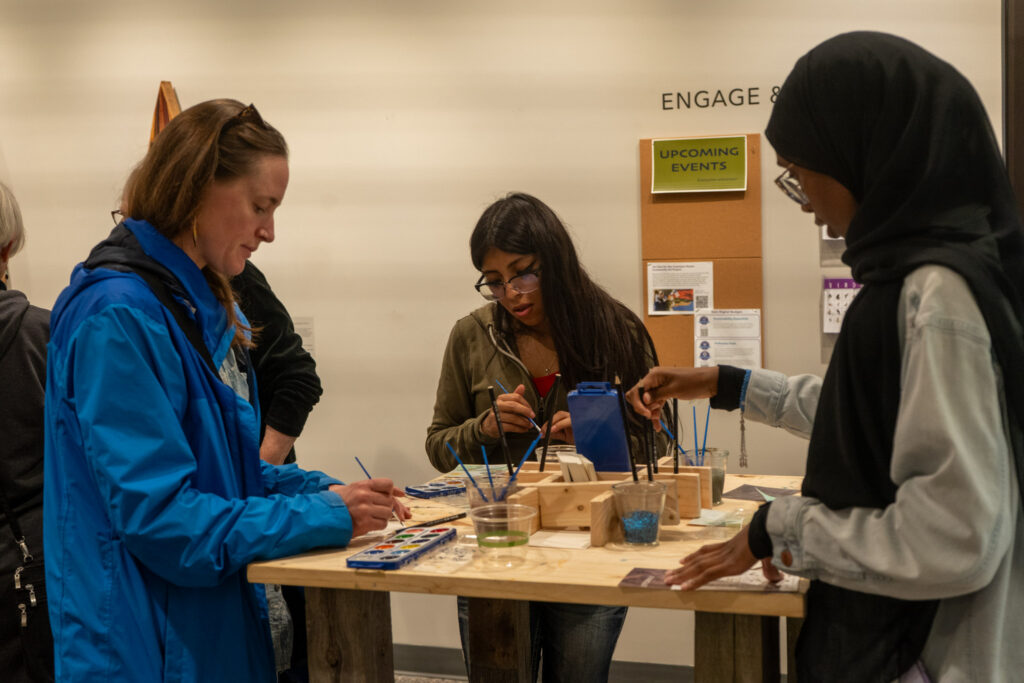
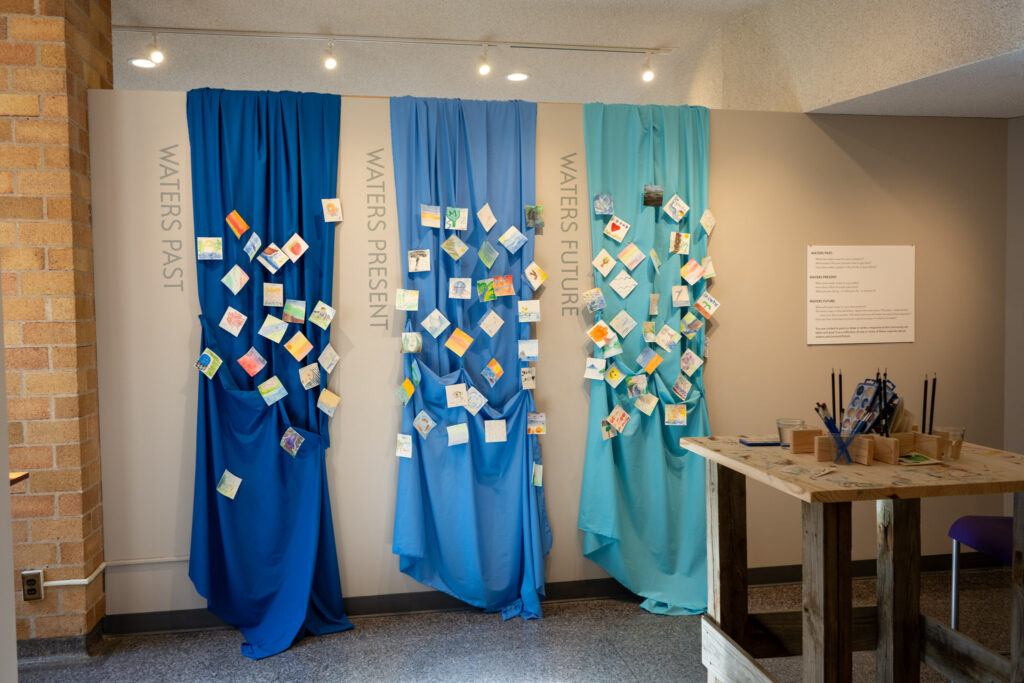
In the Sustainability Arts Gallery, visitors can create their own watercolor artwork and display it on one of three curtains labeled “Waters Past,” “Waters Present” and “Waters Future.”
Students have already contributed pieces reflecting their families' histories, their present relationships with water and their hopes and concerns for the future.
“The responses were relatively constant across time periods and showed how our reliance on water as a species will never really change,” Schmitz said.
Klein's sculpture “Seed,” which concludes the sequence of his artwork, offers a metaphor for that relationship. Just as a seed draws nourishment from its roots to support new growth, Klein hopes people will draw lessons from the past to shape a better future.
He sees the visitors' artwork as a continuation of that process, transforming the exhibition into a conversation that extends beyond his own sculptures.
“We're inviting people to be able to come to the exhibit and make their own art,” Klein said, “to contribute to the exhibit and add to our dialog about the meaning of water in our lives.”
Klein will discuss the exhibition during an artist talk Nov. 12 from 6-7:30 p.m. in Owens Science Hall Auditorium. The “Littorally” project will be on view through Dec. 18, 2026.