Not long ago, Quantell Crawford ’20, ’23 MA faced a difficult choice: give up his job to complete unpaid student teaching or walk away from becoming a teacher altogether.
For many would-be educators who can’t afford time away from a paying job, that's where the path ends. Crawford found a different way forward through the St. Paul Urban Teacher Residency program, an innovative approach the University of St. Thomas and its partners have refined and expanded over the past decade to pay future educators as they learn and practice.
The residency is one of several programs developed by the School of Education with St. Paul Public Schools, Minneapolis Public Schools and local charter networks. Over 15 months, residents combine graduate coursework with more than 1,200 hours of paid classroom experience alongside expert mentors, preparing them to lead classrooms with confidence from day one. This summer, St. Thomas expanded its offering by launching an undergraduate residency program.
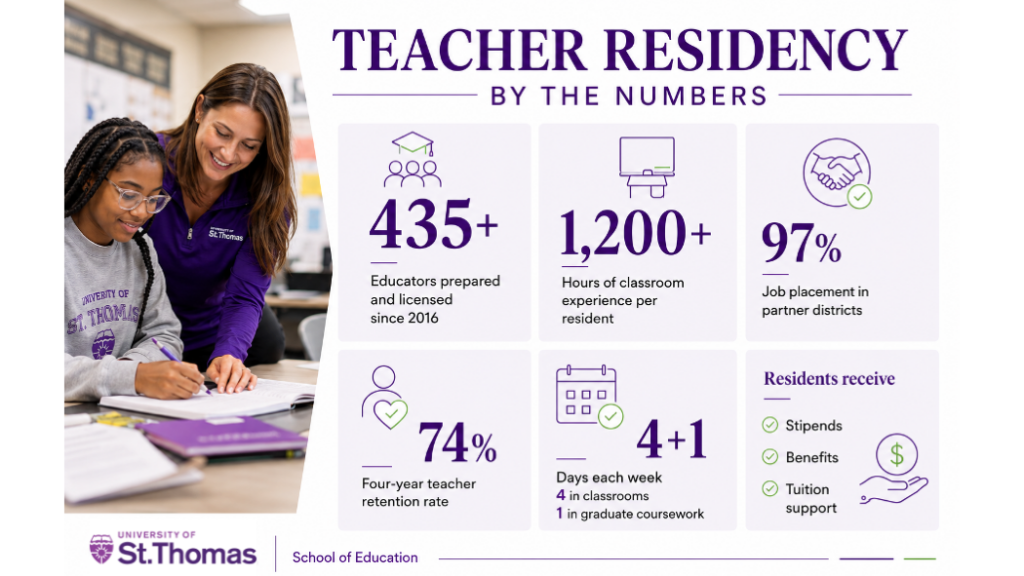
Since 2016, the School of Education has helped students like Crawford, one of more than 435 educators, earn licensure, gain classroom experience and begin successful teaching careers across Minnesota. Graduates are hired at high rates (up to 97% in some programs), and they stay in the profession. In Minnesota, roughly one-third of teachers leave the classroom within their first five years. In contrast, 74% of St. Thomas graduates are still teaching in public schools after four years.
Research on residency programs nationally and at St. Thomas shows graduates enter classrooms better prepared, and they earn stronger ratings from principals.
“I couldn’t afford to quit my job for unpaid student teaching,” said Crawford, who is now a special education teacher at Hazel Park Preparatory Academy in St. Paul – the same school where he completed his residency. “The residency changed everything. I was learning and earning at the same time, getting to know my school, my students and my colleagues.”
Designed to remove barriers for school staff, paraprofessionals and community members, the residency programs have become a nationally recognized example of practice-based teacher preparation, and they continue to grow with the new undergraduate residency program. Supported by the I.A. O'Shaughnessy Foundation, the undergraduate offering expands a successful approach to include future teachers who have not yet earned bachelor’s degrees.
Removing barriers, expanding opportunity
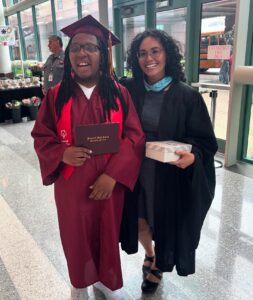
The master’s level program opens the door to teaching for paraprofessionals, staff and individuals already committed to their school communities by removing financial barriers. Residents receive stipends, benefits, tuition support and mentorship through partner districts.
Christine Denoman '19 MA, now a special education teacher at Roosevelt High School in Minneapolis, said the residency made it possible to earn a master's degree while raising a child and working.
“These residency partnerships were designed to meet a very real and urgent need in our K-12 systems – to prepare highly effective teachers while expanding access to the profession for those already deeply connected to our schools and communities,” said Dr. Amy Smith, dean of the School of Education.
Strong outcomes for schools and students

Those outcomes are reflected in graduates like Mahmoud Elgendy '23 MA, now a special education teacher and mentor at Quantum STEAM Academy in St. Paul. He describes the Charter Schools Residency Program as personal, uplifting and rooted in mission. “It’s a hope and a tool for underserved students,” he said. “The instructors didn’t underestimate our knowledge. They built on it and prepared us to carry this work forward.”
Because residents prepare in the schools where they will teach, they enter the profession with established relationships and meaningful real-world experience, ready to meet the specific needs of their communities and strengthen their schools from within.
Investing in future educators
Nearly a decade of success has earned national recognition. Since 2016, the National Center for Teacher Residencies has twice visited St. Thomas, highlighting its district partnerships as leading examples for strengthening the educator workforce.
“We are proud of the national recognition these residency partnerships have received,” Smith said. “It affirms that what we’re doing here is meaningful – and that it’s working.”
Residency programs depend on strong partnerships and long-term investment. Philanthropic support has played a critical role in growing this work, helping fund resident salaries, mentorship and tuition assistance.
Longtime support from organizations that include the Otto Bremer Foundation, the Minneapolis Foundation and the National Center for Teacher Residencies (NCTR) has helped build and strengthen St. Thomas’ graduate residency programs over the past decade. The I.A. O'Shaughnessy Foundation has played a leading role in supporting the launch of the new undergraduate residency initiative, helping extend these opportunities to aspiring educators earlier in their academic journeys.
“We are deeply grateful to the foundations and partners who continue to invest in this work,” Smith said. “Their leadership and generosity are helping talented, committed individuals become teachers in the communities that need them most.”