
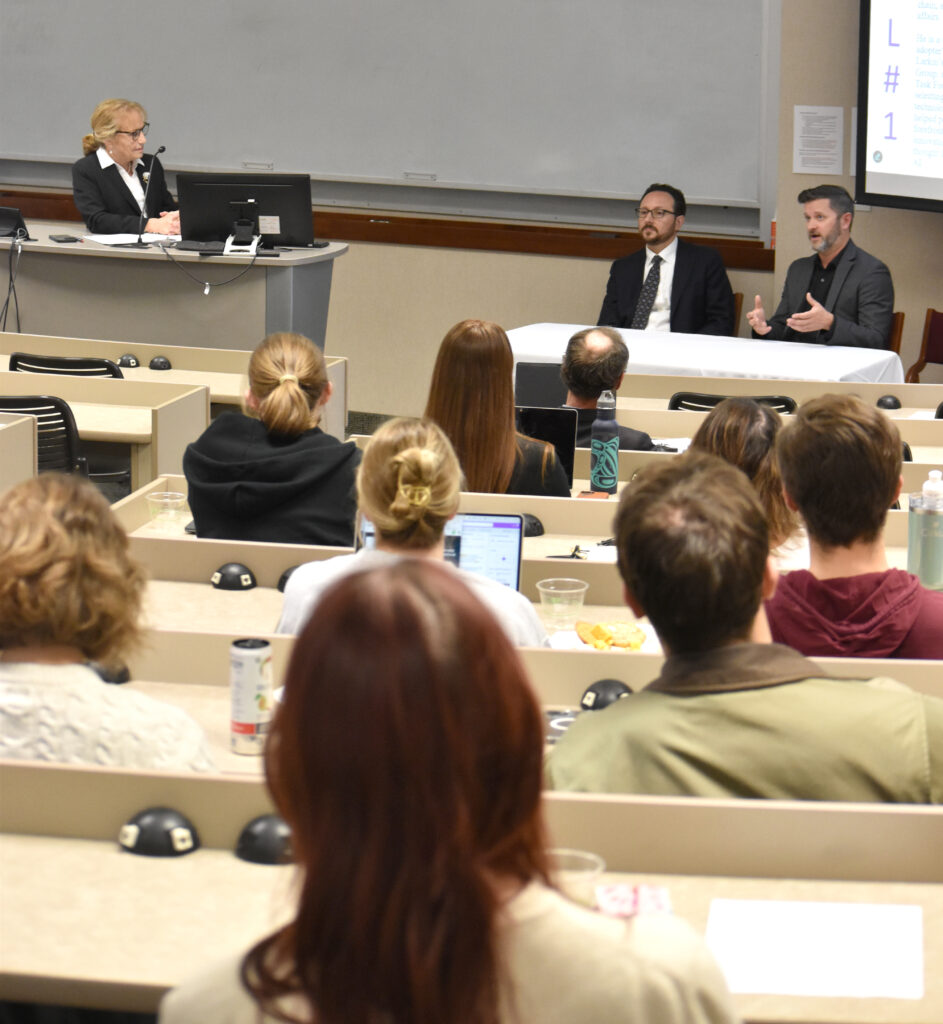
Generative artificial intelligence (AI) is reshaping nearly every profession, including law. To explore its evolving impact, the University of St. Thomas School of Law hosted a panel discussion titled Training Tomorrow’s Lawyers: AI and the New Apprenticeship. The panel brought together local judges, attorneys and technologists to discuss how AI is changing the legal profession, particularly its effect on the development of new lawyers.
“Gen AI is ubiquitous,” said Judge Susan Richard Nelson, U.S. District Court for the District of Minnesota, who moderated the discussion. “It creates an urgency that we prioritize these discussions in law schools, law firms, government, corporate legal departments and the courts.”
Legal education has historically extended beyond law school and into a lawyer’s first years as an attorney. New practitioners build their capabilities and knowledge under the guidance of senior lawyers and through tasks such as repetitive drafting and research.
AI is challenging that structure by automating many of the foundational, skill-building functions of a junior lawyer. AI tools can write briefs, memos, contracts and distill large amounts of information in seconds.
While some may assume this will lead to the elimination of the legal jobs, the attorneys and technologists who spoke at St. Thomas Law believe that won’t necessarily be the case and that the impact of AI on the legal profession will likely be more transformative than destructive, especially for young professionals.

AI can’t replace trust or judgment
Damien Riehl, lawyer and technologist who is currently chairing the Minnesota State Bar Association’s AI Committee, said that lawyers need to define and articulate their value.
Damien RiehlWe think that we, as lawyers, provide clients with widgets. That is, motions, briefs, pleadings, but really, we don’t sell widgets. We sell trust.”
“We think that we, as lawyers, provide clients with widgets. That is, motions, briefs, pleadings, but really, we don’t sell widgets. We sell trust,” he said. “So, as we think about what large language models can do for us, they can give us widgets. But it can’t give you trust.”
Riehl went on to talk about a lawyer’s role as an adviser who provides experience and seasoned judgment to a client or business leader.
“Judgment can’t come from (cases, statutes and regulations),” he said. “What judgment comes from is the chambers meetings ... and the settlement agreements, where you say, the settlement went south when this thing happened. That kind of hard-won experience is not in the cases, the statutes, and the regulations, therefore not in the large language model.”
A shift from production to strategy
Matt Resch, an attorney at Larkin Hoffman, shared a similar perspective and discussed how AI tools have shifted attorneys’ time away from producing legal documents to strategic thinking. AI can produce first drafts and synthesize research, allowing attorneys more time to collaborate internally and problem-solve with clients.
“What we’ve seen is that the work has shifted,” Resch said. “Whereas before, we’re under deadline ... you’ve got to get work product out by a certain time. What we see now is that we’re able to spend more time having conversations ... on the actual exchange of ideas.”
Jamie Snelson, a shareholder and executive vice president at Fredrikson and Byron, said clients increasingly expect faster solutions due to AI. Yet rather than reducing billable work, legal demand is going up because clients are becoming more productive using AI in their businesses.
Riehl connected Snelson’s experience to Jevons paradox – the idea that when the cost of a resource drops, people often use more of it, not less.
“If today, every time I call my lawyer, it’s $1,000. Forget it. If it shrinks to maybe $100, I’m going to call more often and spend more in the aggregate,” Riehl said. “One potential future is that we actually have more legal work because we’ve shrunk the unit cost of any particular question.”
He was quick to reiterate, however, the importance of lawyers continually reinforcing their value to clients as counselors and problem-solvers who help a business reach its goals – not just producers of documents. Riehl pointed to the example of a Fortune 500 company that recently reported saving millions of dollars in legal fees by using AI tools internally. Lawyers, he said, would be remiss not to recognize that AI is now a competitor for certain types of work – and to focus on the strategic judgment it cannot replace.
Developing judgment and building knowledge in new lawyers
Panelists agreed that for a lawyer to develop expertise in their area of the law, develop good judgment and provide sound counsel, there was no substitute for time and practice.
“There are some things that law students should be doing,” Minnesota Supreme Court Justice Karl Procaccini said. “Not because doing it by hand is going to be valuable to a client 10 years into your practice, but because you need to understand how it works.”
Procaccini, who is helping integrate AI tools within the Minnesota Judicial Branch, said he feels a tension regarding the use of AI tools among his law clerks. He wants them to gain technology skills that will serve them throughout their career, but he also wants them to develop foundational skills in a traditional way so they can use AI effectively and avoid the pitfalls that come with overreliance.
“It may well be that the AI is right 95% of the time, but if you haven't done it yourself – and done the work to develop those critical thinking skills – you’re going to have no idea (when it’s wrong),” Procaccini said. “And that 5% is what’s really going to destroy your legal career.”
He added that law schools, firms and other employers play a critical role in helping new professionals learn to use AI tools shrewdly, safely and ethically – and not as a shortcut.
Evaluation, iteration and the human in the loop
Several speakers stressed that new lawyers must become adept at identifying errors and gaps in AI-generated work.
Dave Corbett ’08 J.D., a product manager at Thomson Reuters, referred to it as keeping a “human in the loop” when using an AI tool. He contends, however, that attorneys can develop their evaluative skills through iteration within an AI platform.
“The ability to understand what is good or what is not good should be developed using these tools,” Corbett said. “We can actually have AI produce something that is imperfect, and then you can review that and figure out and mark up what’s imperfect about it, and then do it again ... Iteration is central to everything ... you have to be able to think about a question in a few different ways and then take the results and put them together to come to a more solid answer.”
Corbett says that lawyers have always worked with imperfect sources – cases can be overruled, statutes amended. AI is simply the newest imperfect tool.
New opportunities for young lawyers
Panelists encouraged students to embrace AI as a path to professional advancement. Just as earlier generations gained an edge by mastering computers or Microsoft Office, today’s young lawyers can stand out by learning to effectively use AI tools.
“When I started practicing, I could do certain technological things and I got a seat at tables,” Resch said. “I had an additional technical skill that other attorneys around me didn’t have.
Resch also noted that, with AI, today’s young professionals have a new feedback and coaching tool at their fingertips.
“If you want to talk to a large language model and have a conversation, you can do that without having a conversation with a partner or your judge and feeling like you don’t know what you’re talking about,” he said. “You can actually trial conversations with opposing counsel, or have an argument in front of court, and get real-time responses from the LLM.”
Procaccini agreed: “Embrace the technology, learn these platforms. Use it ethically ... but use it, and realize that it’s flawed, and learn from it.”
What remains timeless
While panelists compelled law students to learn to use AI proficiently and law schools to integrate it into the curriculum, they also emphasized that some skills will always define great lawyers, such curiosity, persuasive writing, strong oral advocacy and critical thinking.
“There’s more that’s similar now than different,” Snelson said.
Riehl urged, in an AI-age, St. Thomas Law to continue to focus on its mission: to form ethical lawyers.
“St. Thomas has historically done a great job with being able to say, we at St. Thomas crank out people that are trustworthy, that have thoughtful ways to think through things, and in the end ... if I were to suggest to law schools, the most important thing to do is to build people of high integrity,” he said.