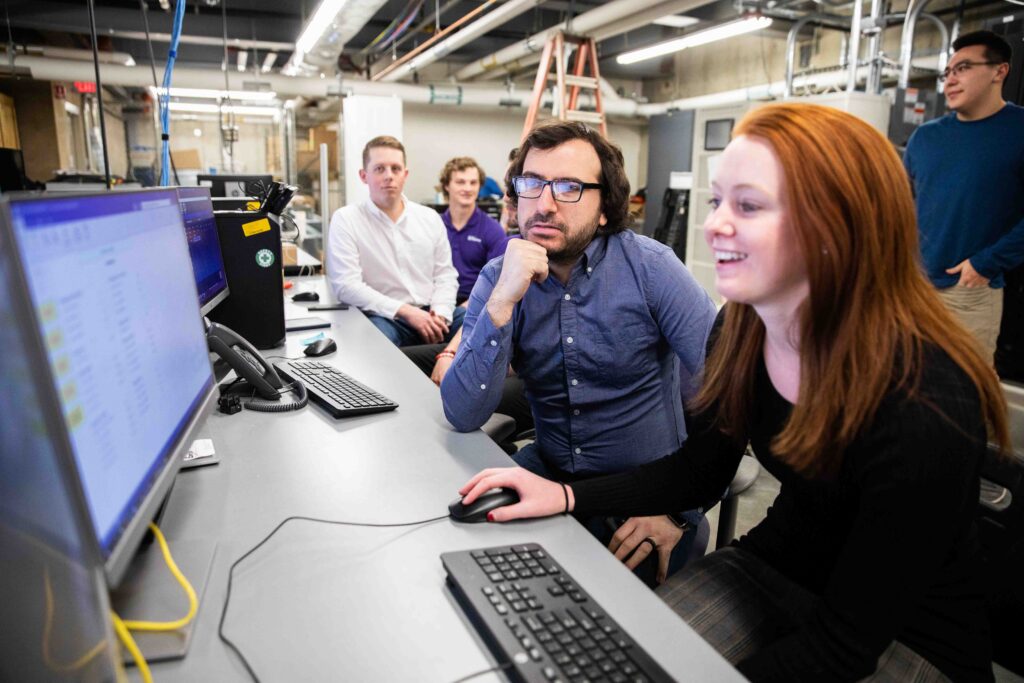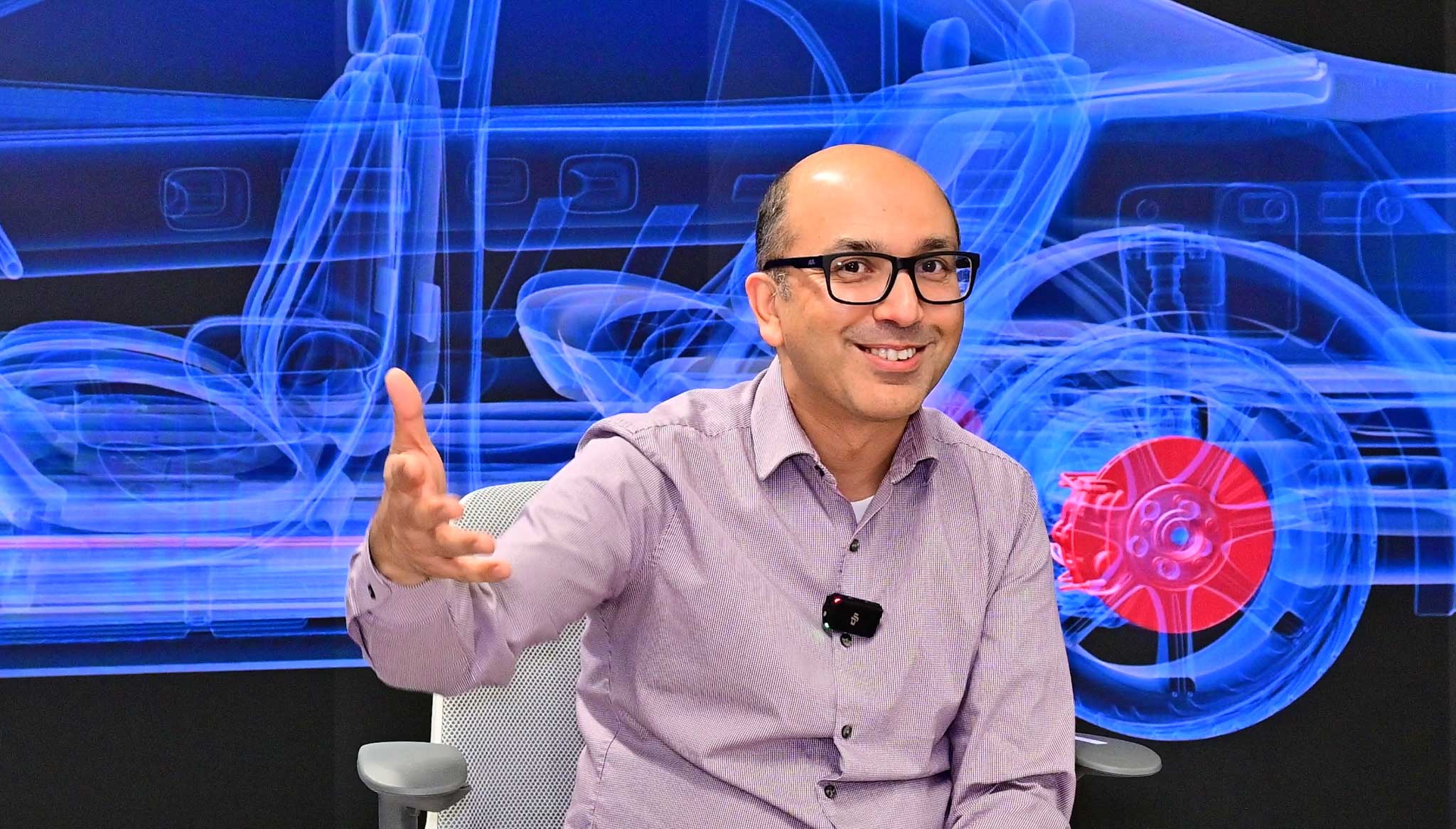
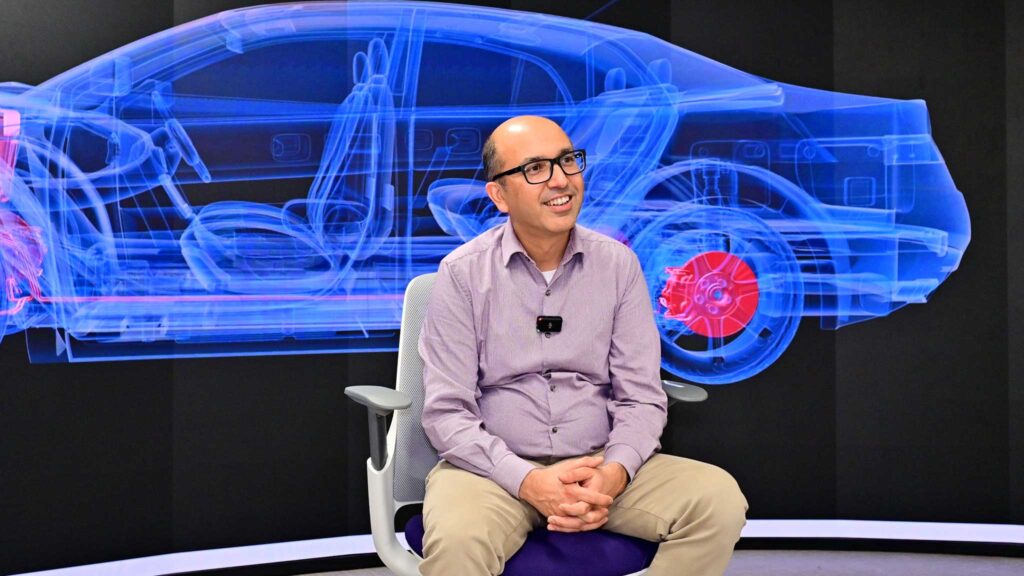
School of Engineering Professor Kundan Nepal sits in the data visualization studio by a 32-foot curved LCD panel that displays 3-D graphics. His students at the University of St. Thomas don goggles to immerse themselves with interactive images, examining engineering structures as if they were right in front of them. Dr. Nepal said watching students collaborate in these spaces gives him a source of energy.
“What excites me most is when students realize their ideas don’t have to stay in the classroom,” said Nepal, who teaches in the Department of Electrical and Computer Engineering. “Their ideas can become something much bigger.”
How local innovation scales nationally is reflected in a number of Nepal’s externally funded projects that expand the university's footprint beyond campus.
For one, St. Thomas, through the School of Engineering, is among five universities in a consortium that was awarded $2 million from the National Science Foundation (NSF) to bolster industry-academic partnerships.
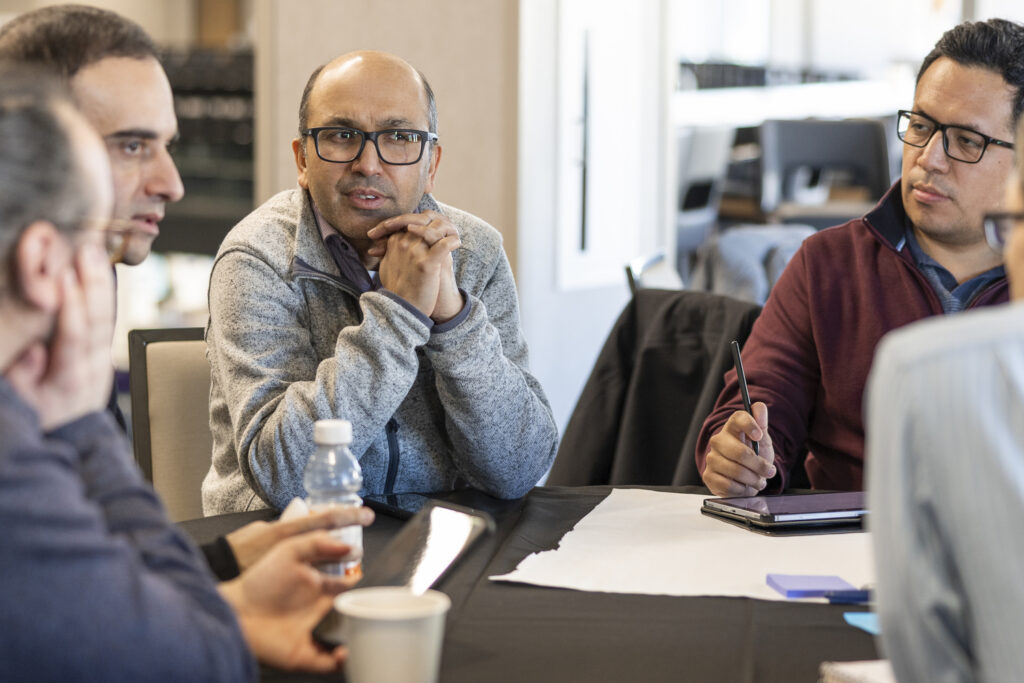
“We are not just working within our own institutions, we are creating a network that allows us to share resources and insights across universities,” said Nepal, whose primary research focuses on power-efficient testing to make computer chips more reliable. “This collaborative approach will significantly enhance our ability to build meaningful, lasting partnerships with the industry.”
Engineering beyond the classroom
Nepal has increased partnerships in a way that touches student innovators, clean-tech entrepreneurs and national research partners through his roles as the director of the St. Thomas Applied and Renewable Technologies (START) Center and head of the New Product Tech Ventures (NPTV). The latter is a 15-month fellowship program for graduate students pursuing a master's degree in engineering, software, data science or information technology.
Through the START Center, Nepal collaborates with government labs and local companies on clean technologies with an expressed goal of “taking innovation happening in Minnesota … beyond Minnesota” to national labs and federal agencies.
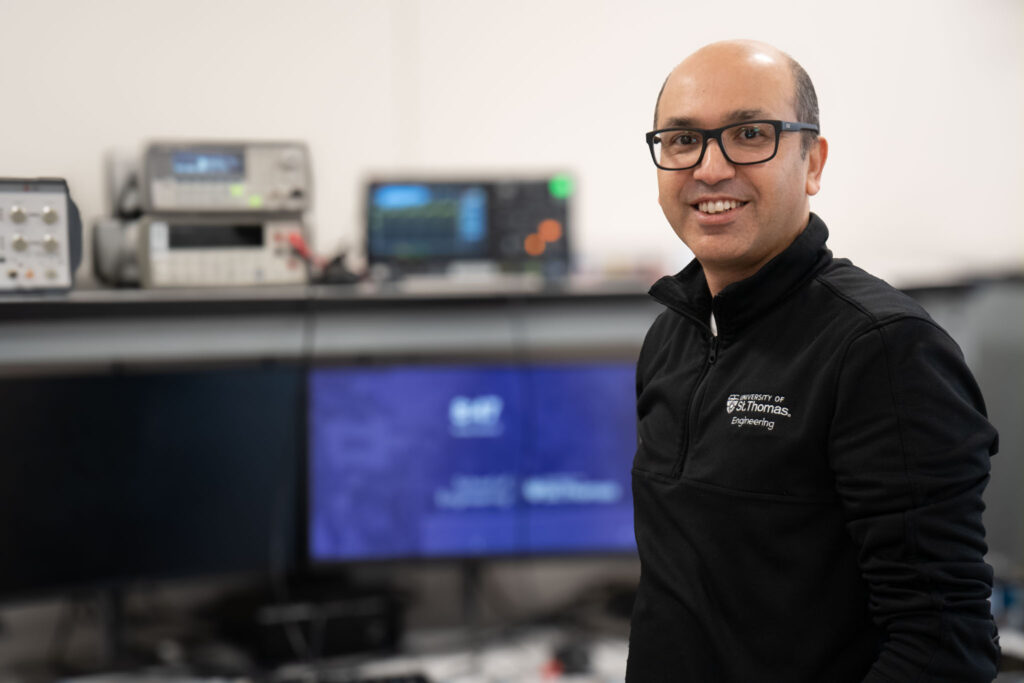
Established in 2023 after securing $6 million in federal funding, START is now guiding emerging companies to develop clean energy technology alongside the university’s students and faculty.
His team, which includes faculty members Dr. Cheol-Hong Min and Dr. Hassan Salamy, partner with fluid technology company Ascentek on next-generation sodium-ion battery research. Graduate student Evelyn Truong ’23, ’24 MS, is working on the Ascentek project to analyze thermal behavior that would optimize battery-pack performance.
“Innovation doesn’t stop at graduation,” said Truong, who was also in an earlier NPTV cohort.
With NPTV, Nepal said, “We saw a chance to take our engineers' strong design, prototyping and problem-solving skills a step further by teaching them the business side of innovation.”
The fellowship program, which partners with the Schulze School of Entrepreneurship, helps prepare graduate engineering students for careers as entrepreneurial leaders with a unique lens into what it takes to bring a product to market.
“At the end of the day, even if you’re an engineer, you have to build things to get it out in the market,” said NPTV fellow Tidiane Kone ’24, who’s on track to earn a Master of Science in electrical engineering in 2026 while maintaining an internship at a local energy equipment and solutions company.
Kone is one of 15 students enrolled in the third cohort for the NPTV program. Before entering the program, he gained practical experience through his senior capstone project where his team built an automated jet engine carrier for an industry partner.
“When I heard about the NPTV program, I knew that was perfect for me,” said Kone, a native of Côte d'Ivoire in West Africa. “When I look at issues in my country with things like electricity and power production, I really thought I could do what I like and help my country as well.”
Kone’s global outlook is one Nepal recognizes. He sees engineering not just as a discipline, but as a tool for solving problems beyond national borders.
From curiosity to community
Nepal grew up in the South Asian country Nepal, where his parents worked at a university; his mother was a professor and his father was an administrator. Like them, he valued education.
“I really found math and science fascinating, but I wanted to know how to use it,” Nepal said.
His curiosity led him to enroll in an undergraduate engineering course, principles of flight. He vividly remembers a project where he had to build and fly an airplane in Microsoft Flight Simulator. He loved writing the scripts and designing the aircraft based on the restrictions.
"That's when I discovered the joy of engineering and building something from scratch using math and science," he said. "I then wanted to figure out how to make things smarter and more scalable."
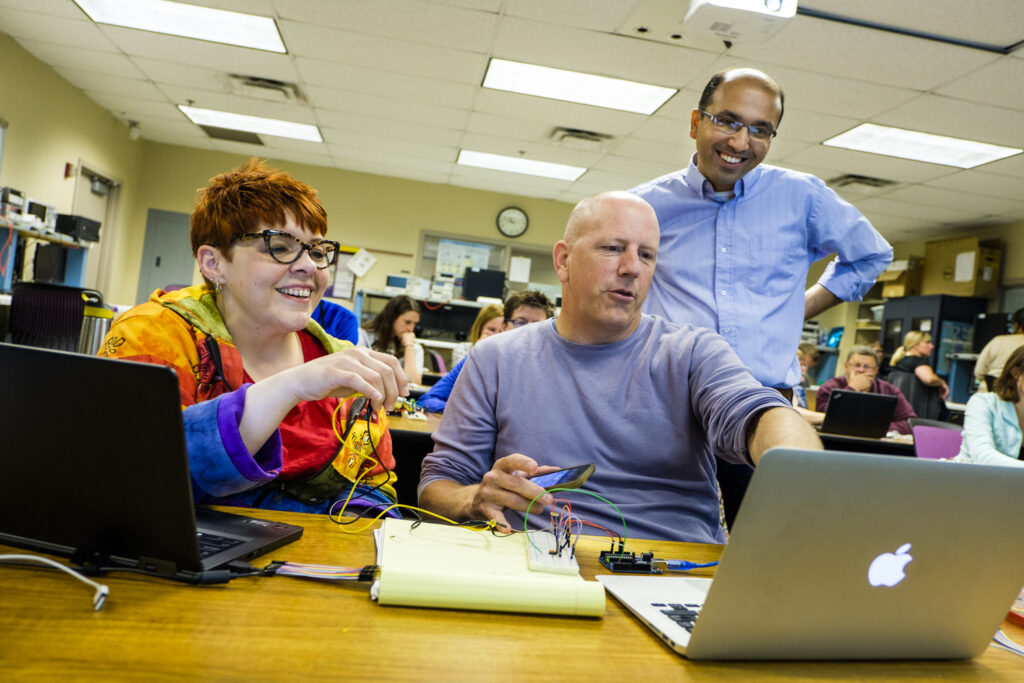
Since his arrival at St. Thomas in 2011, Nepal has seen the School of Engineering grow from about eight full-time faculty members to nearly 40; two undergraduate programs to four and an expansion of the graduate programs. U.S. News & World Report now ranks the school #29 among the nation’s top engineering programs for undergraduates and #1 in Minnesota for engineering schools without a doctoral program.
“As one of the younger engineering programs in the nation, being recognized as a top school is a testament to our innovative spirit and intentionality,” said Dr. Don Weinkauf, dean of the School of Engineering. “Here in Minnesota, we’re not just building a program; we’re cultivating an exceptional engineering experience for our students.”
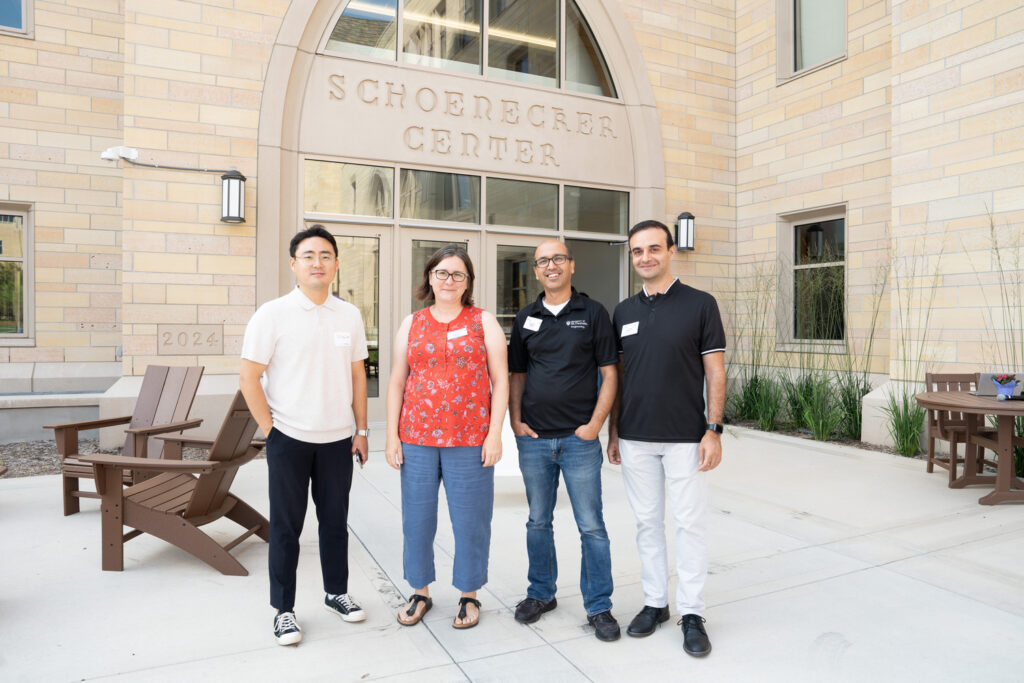
The technological advances have also come a long way since Nepal taught his first course at St. Thomas covering digital circuits. Then, there were only two electrical engineering labs. Today, the new 130,000-square-foot Schoenecker Center houses state-of-the-art facilities, which connects to the data visualization studio inside O'Shaughnessy Science Hall that provides immersive study experiences for students. The 3-D data studio was funded through a grant from the Army Research Lab as part of a broader effort to strengthen research infrastructure and industry partnerships.
Beyond the infrastructure improvements, Nepal noticed something on campus that he hadn’t elsewhere: Nontraditional students interested in engineering.
Among the students enrolled in his first course, he has had a retired Catholic priest recovering from heart surgery and a few veterans who had served in Iraq.
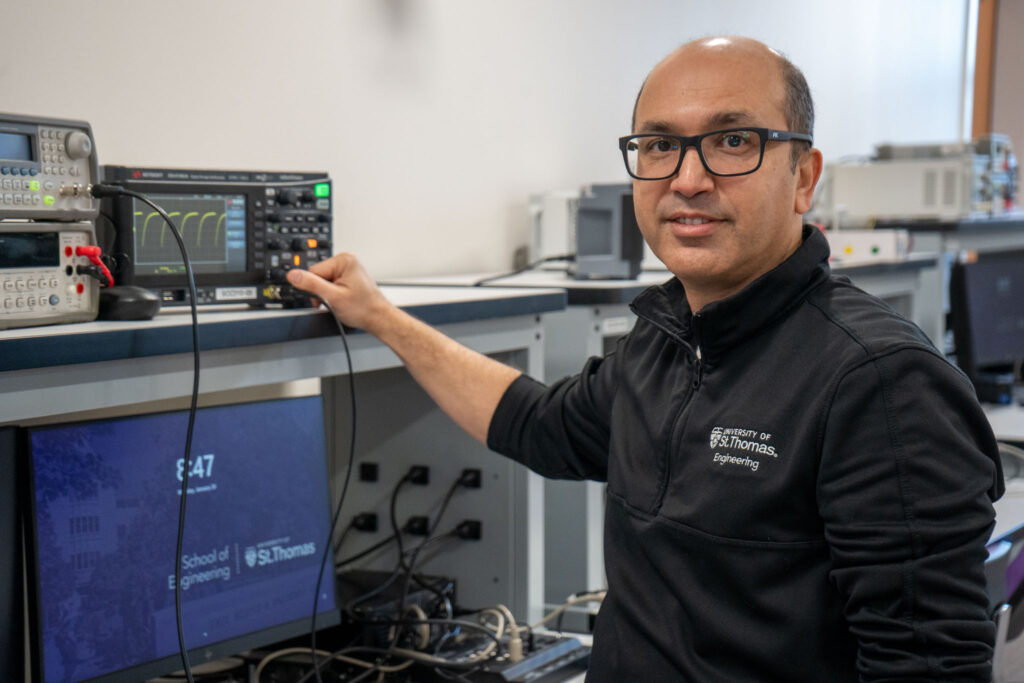
“The diversity of the experiences people brought was a completely new experience for me,” said Nepal, who received his Bachelor of Science in electrical engineering from Trinity College. “I had never seen that in my own classes when I was an undergraduate.”
With a master’s degree from the University of Southern California and PhD from Brown University, his student experience was one where his college professors were more than teachers. He called them mentors. He desired to do the same for his students.
“It was an impactful moment for me when my family met him and got to know the person who helped me through my journey and mentored me,” said Kone, whose family flew to the U.S. for his undergrad graduation. "That was the best moment.”
In 2024, Nepal won the St. Thomas student-nominated Excellence in Advising Award.
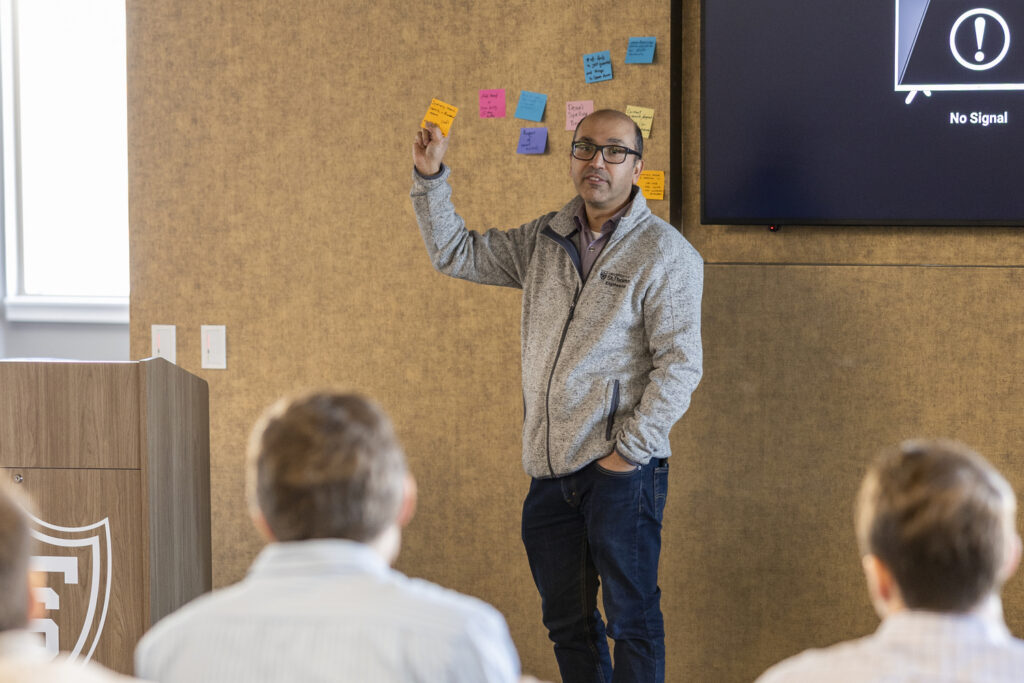
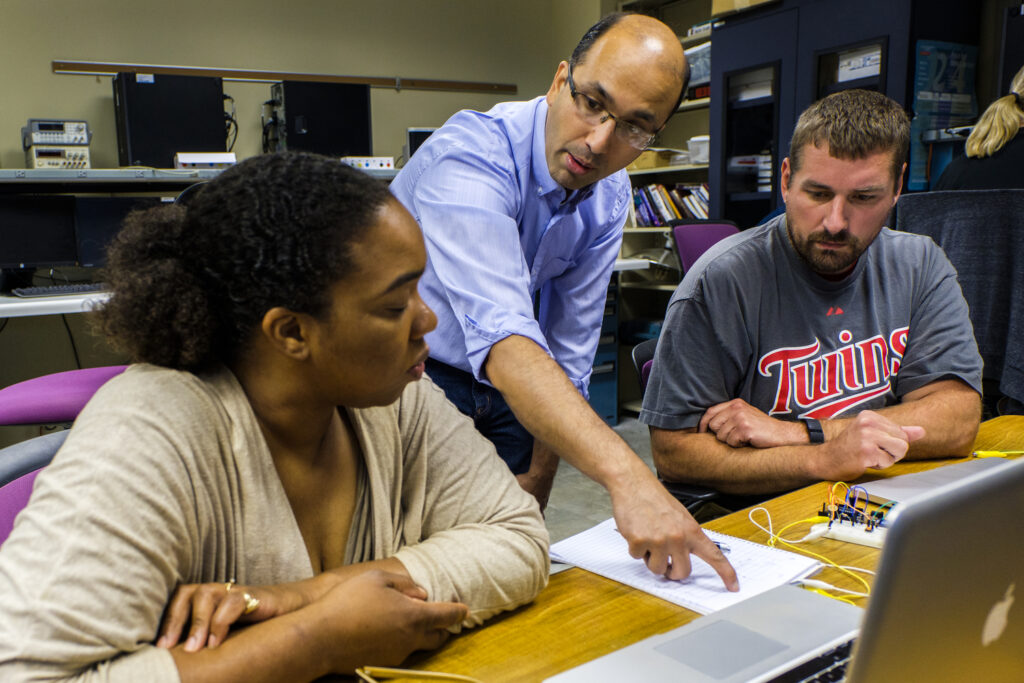
“He’s very personable and he’s fantastic to work with,” said colleague Travis Welt, an associate professor and the civil engineering chair. “All of us are here because we care about teaching and care about our students growing into what they become when they graduate.”
Nepal is motivated by seeing students express excitement for learning something new and being a part of their journey.
“I love the decision I made to go into teaching,” he said, “because I get to watch students learn how engineering serves the world."