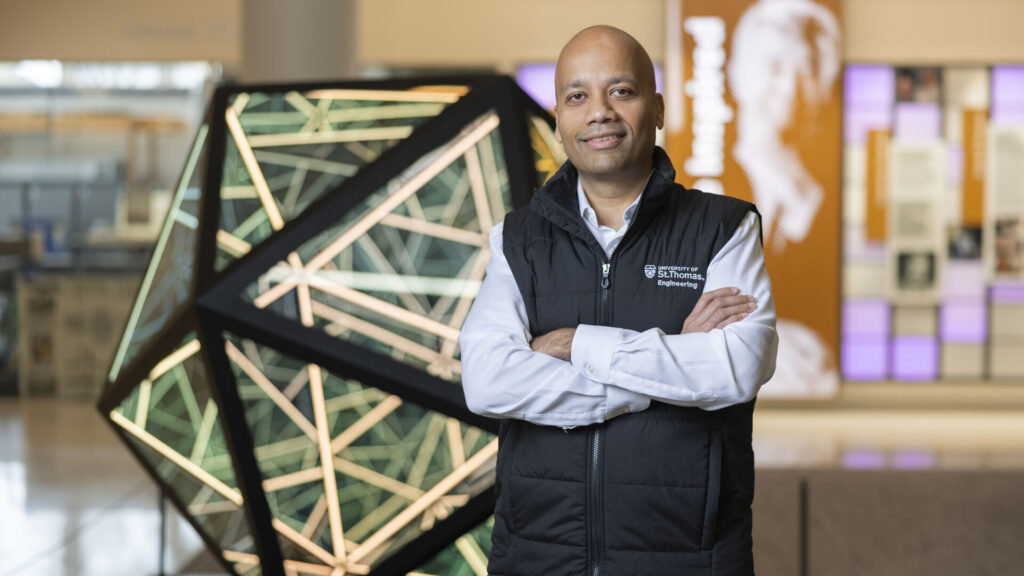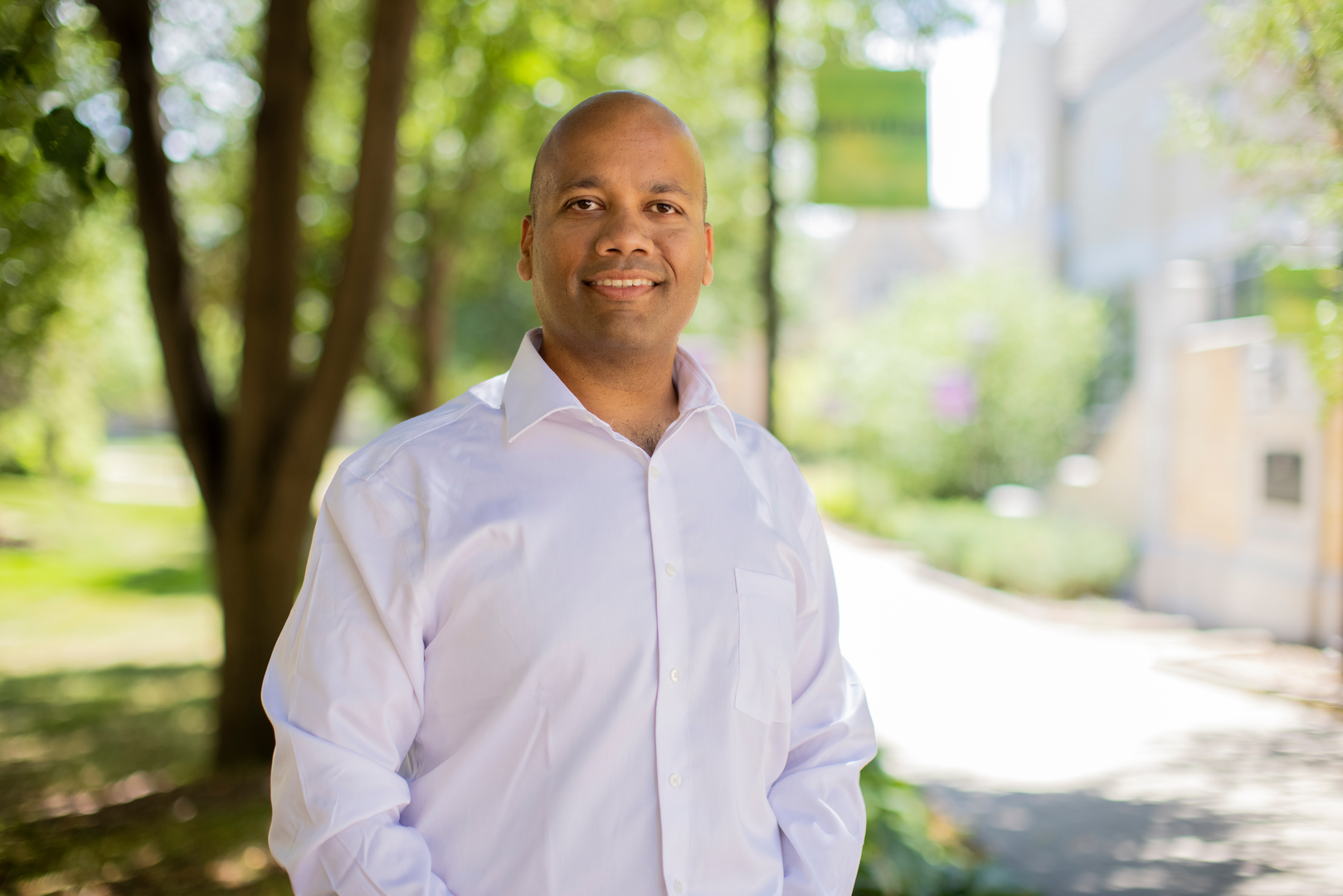
Manjeet Rege, professor and chair of the Department of Software Engineering and Data Science at the University of St. Thomas, spoke with FOX 9 and WCCO-TV to discuss a new report on the impact of generative AI on Minnesota’s workforce. Rege emphasized the difference between exposure and displacement, encouraging workers and students to build AI literacy and adapt to evolving tools, while highlighting the importance of ethics and responsible implementation as AI reshapes industries.

From WCCO-TV:
Rege: We’re looking at the impact of generative AI on jobs in Minnesota. The report we just released this week shows that among all the states in the Midwest, jobs in Minnesota have the highest exposure. Employees in Minnesota can have about half of their daily job tasks automated with generative AI.
Erin Hassanzadeh: That’s concerning for people to hear, and we’re all navigating this. Dr. Rosenthal, you’re with North Star Policy Action. What were the findings of the study?
Aaron Rosenthal: The primary finding was that about 800,000 Minnesota workers are in a place where generative AI could do half or more of their jobs. That’s one in three Minnesota workers. Another finding is that workers are increasingly anxious about AI taking on tasks in their jobs and want to see regulation happen in the state.
Hassanzadeh: You’re the experts. Do you think that’s a reasonable fear?
Rosenthal: I do think it’s reasonable. We’re just starting to see job layoffs and announcements from companies about investing more in AI. We’re at a point where there are two possible paths. One is a lot of job displacement. The other is workers feeling more productive and finding AI makes their jobs more meaningful. The difference between those two paths will likely come down to legislation and the extent to which workers have a voice in how AI is implemented in their workplace.
Jeff Wagner: Dr. Rege, you created a dashboard that tracks Minnesota workers’ exposure to AI. Is there a particular industry that’s been most impacted, and why is it important for people to know if it’s the industry they’re in?
Rege: The report lays out the data, but people naturally want to know how generative AI will impact them personally. We found that jobs in fields such as finance, management, and customer service have extremely high exposure. With the interactive dashboard, people can stay informed. They can look at the overall average exposure for a particular occupational group and then drill down to see how specific tasks are affected.

From FOX 9:
Rege: In our report, we talk about AI exposure. There is an important distinction between being exposed to AI and being displaced by AI. Some jobs may be displaced. Some may be transformed. Transformation is key. One in three Minnesotans, about 33%, have jobs where half of their tasks could be automated with generative AI. That may mean instead of having five software developers, you might have one or two. But you have to stay ahead. The software engineering field has changed. There are many AI coding tools you can embrace.
As a professional, you need to recognize which tasks you perform regularly and which of those you can do with AI. It’s about embracing AI and doing your job better and faster with it.
Rosenthal: We’re at a critical juncture. There are two possible pathways. One is a pathway with a lot of job displacement, where people lose their jobs because AI can do the work better or more cheaply. The other is a pathway where workers are more fulfilled and productive because they have AI helping them complete tasks.
The difference between those scenarios may come down to what regulations are put in place and what kind of worker voice is allowed at the table as AI is rolled out in workplaces.
Adam Llorens: Are either of you nervous that AI could displace you from your own job?
Rege: Not really. At St Thomas, I do research in AI and teach AI courses. We have a master’s program in AI. In education, there is a human element to learning and teaching. That applies to every profession. If you can identify the human element that makes the experience different, I think you’ll be in safe hands.
Rosenthal: It depends on the day. I utilize AI in my job. As its capacity grows, I bring it more into my work. If you’re in a job where AI can do some of your work, it’s important to figure out how to make it part of your daily tasks. ...