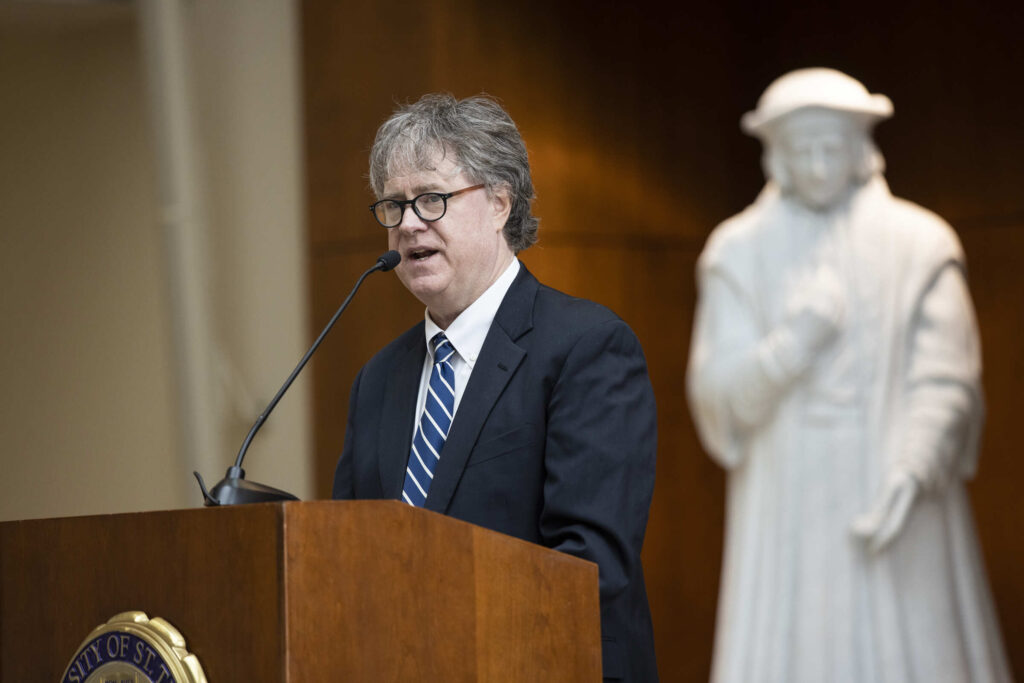
Virgil Wiebe, a professor at the University of St. Thomas School of Law, spoke on WBUR’s “On Point” about the growing number of legal challenges facing the Trump administration. Wiebe explained that recent court actions reflect increasing tension between the executive branch and the judiciary, highlighting concerns about compliance with court orders and the long-term implications for checks and balances.

From the conversation:
Deborah Becker: Today, On Point, we’re talking about this battle over the judiciary and what it means for checks and balances and for our democracy. I want to start the conversation by talking with Virgil Wiebe, a professor of law at the University of St. Thomas in St. Paul, Minnesota. Virgil, we just heard a little bit about the order earlier this year from Chief Judge Schiltz.
I wonder what was your impression there of that order?
Wiebe: I, along with other immigration attorneys here in the Twin Cities rejoiced. I’m on a listserv with other immigration attorneys and there must have been two dozen congratulatory emails to Graham and his colleague Morgan about that case.
One attorney said this is a Whitman sampler of contempt.
Becker: But I wonder what really, were you so excited that a judge was standing up to the administration? What was the main reason for the rejoicing?
Wiebe: The rejoicing was at the time, as you recalled it was the heart of Metro Surge.
In hindsight, we know that it went on for another three or four weeks.
Becker: And so we should say this was when the federal government put thousands of agents or sent thousands of agents to Minneapolis, and that was what Metro Surge was at that time.
Wiebe: That’s right. And they were unlawfully detaining hundreds of people, hundreds and hundreds of people.
And because the Supreme Court in its wisdom had done away with universal injunctions. And because class actions are difficult when you’re trying to do habeas petitions. So that was the way to fight back, was the local bar really came together and began filing individual habeas corpus petitions on behalf of people being detained.
And so that was the method of fighting back in that context.
Becker: And so Schiltz issues this ruling, saying, I want the head of ICE to come in here and tell me why the government’s not following my orders. And that was something that was eventually resolved when ICE released the man in custody.
But do you think it had a long-standing message here?
Wiebe: It took a while for the message to sink in. The response of the government. So as part of his January order there, Judge Schiltz had his clerks review other court orders in the District of Minnesota, and he found that something like 96 violations of court orders in over 70 cases.
And in response to that, the U.S. attorney for Minnesota responded that he had his numbers wrong and his clerks had looked at the numbers and they weren’t anything like that. Judge Schiltz is not one to take kindly to essentially being called either incompetent or dishonest. And he went back and he said, yeah, we made a few mistakes.
But then he found over 113 violations of court order. And then he said the government would be brought into line one way or another. We’ll start issuing contempt orders and we’ll consider criminal contempt which can lead to jail time for government attorneys or government officials.
So he was very frustrated. There wasn’t quick response to his concerns. And this has bled over into other parts of the government. ...