Chip Small, a biology professor at the University of St. Thomas, and several St. Thomas student researchers were featured in coverage of a collaborative study examining water quality at 17 Twin Cities lakes. The project combines scientific water quality monitoring with public surveys to better understand how people perceive urban lakes and how those insights can inform future water management and restoration efforts.
From WCCO-TV:
“I’m studying data analytics at the university,” said Logan Sorsveen, a University of St. Thomas junior working on the project. “It’s cool to work with numbers and to actually enter them into a spreadsheet and to know that they’ll be used later on in an analysis in order to just show that lakes in Minnesota are special and that they need care.”
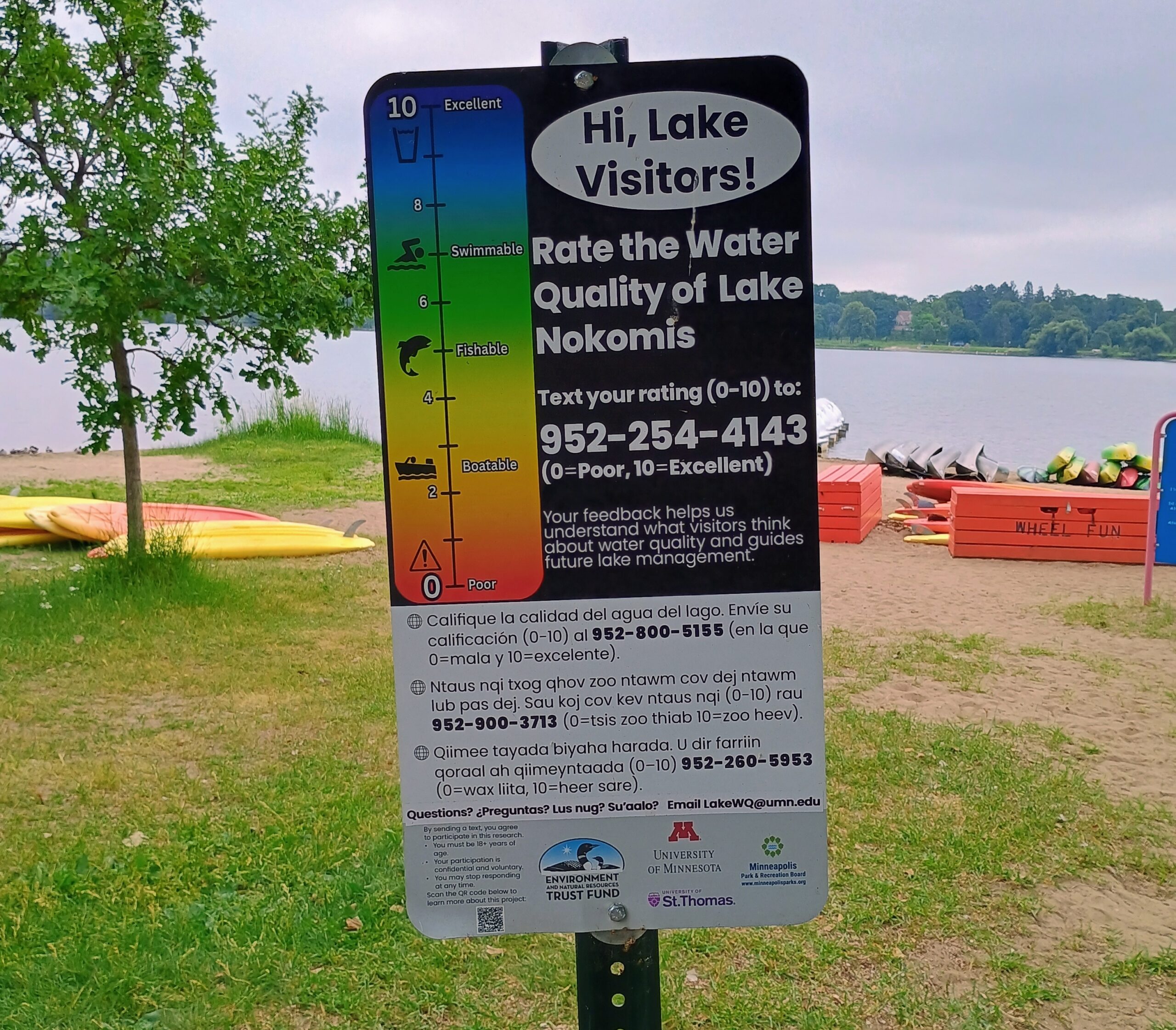
The signs are posted around the 17 different lakes across nine counties included in the study, asking you to rank your thoughts about the water on a scale of 0-10.
“They ask you to rate the water quality of the lake. You send a text message to a phone number that’s on the sign and then you interact with a chatbot. So you’re responding back and forth via text message with this short survey,” Keeler said.
Keeler is one of the scientists overseeing the study. She said we’ve spent hundreds of millions of dollars each year to improve water quality, but we know very little about how people actually perceive and value those improvements.
“This is providing a key piece of missing information that’s going to help lake managers better understand how to manage our lakes for what people really care about,” Keeler said.

From the Sahan Journal:
University of St. Thomas biology professor Chip Small and University of Minnesota researcher Becky Forgrave are leading a project tracking water quality and visitors’ perceptions of water quality at urban lakes across the Twin Cities.
“One piece there’s not been much data on is how this investment impacts how people are experiencing water quality,” Small said.
They are collecting data at 17 lakes in the Twin Cities. Students help Small and Forgrave collect weekly water samples measuring levels of phosphorus, E. coli and other variables that affect water quality. The project is also soliciting opinions from guests to gauge their thoughts on the waters they visit.
The survey is advertised on multiple signs posted around each of the 17 lakes. It asks visitors to evaluate the lake’s water quality on a scale of 1 through 10. People can text four numbers that offer an automated questionnaire in different languages: English, Hmong, Spanish and Somali.
The first question, asking for a 1 through 10 grade, is the most important, but the researchers have programmed 11 follow-up questions seeking more detailed assessments about what factors influence perspective on water quality. There are questions about how frequently people visit the lake and why; if the lake seems good for fishing and whether they would eat fish caught there; and if they’ve visited the lake frequently and noticed changes in the water quality.

From Mankato Free Press:
While researchers collected regular water samples, only seven people took the survey on Lake Washington last year, Forgrave reported, putting the lake in the bottom third of performers.
Despite the survey turnout, while St. Thomas undergraduate students Jack Sistrunk and Logan Sorsveen are out taking samples on Lake Washington, visitors approach them with curiosity.
“We probably get at least one person per day asking us, ‘What are you doing? Is that a water quality tester?’” Sorsveen said.
Sistrunk and Sorsveen drive to each of the lakes, using a handheld water sampling meter to assess the water’s makeup. As part of their data collection, they also take a standardized photo at each site, record the number of lake visitors and note the algae cover.
“It’s kind of nice to see people care about the lakes,” Sorsveen said. “They seem interested and satisfied that someone is actually taking the time to see if their lake is doing OK.”

From the Forest Lake Laker:
“This project is focusing on how visitors or residents perceive water quality, which may be similar to, but maybe a little different than the metrics that scientists or managers measure in terms of water quality,” Small said.
Minnesota lakes are already monitored and managed in many different ways. Agencies and watershed districts often track factors such as chlorophyll, total phosphorus and water clarity. Those measurements help tell whether a lake needs future management and whether past treatments have been successful or not.
But Small mentioned those numbers do not always explain how people feel when they are standing at the shoreline, launching a boat, swimming, fishing or walking near the water.
“That doesn’t always necessarily align with how people perceive the water quality,” Small said. “That’s what we’re interested in.”