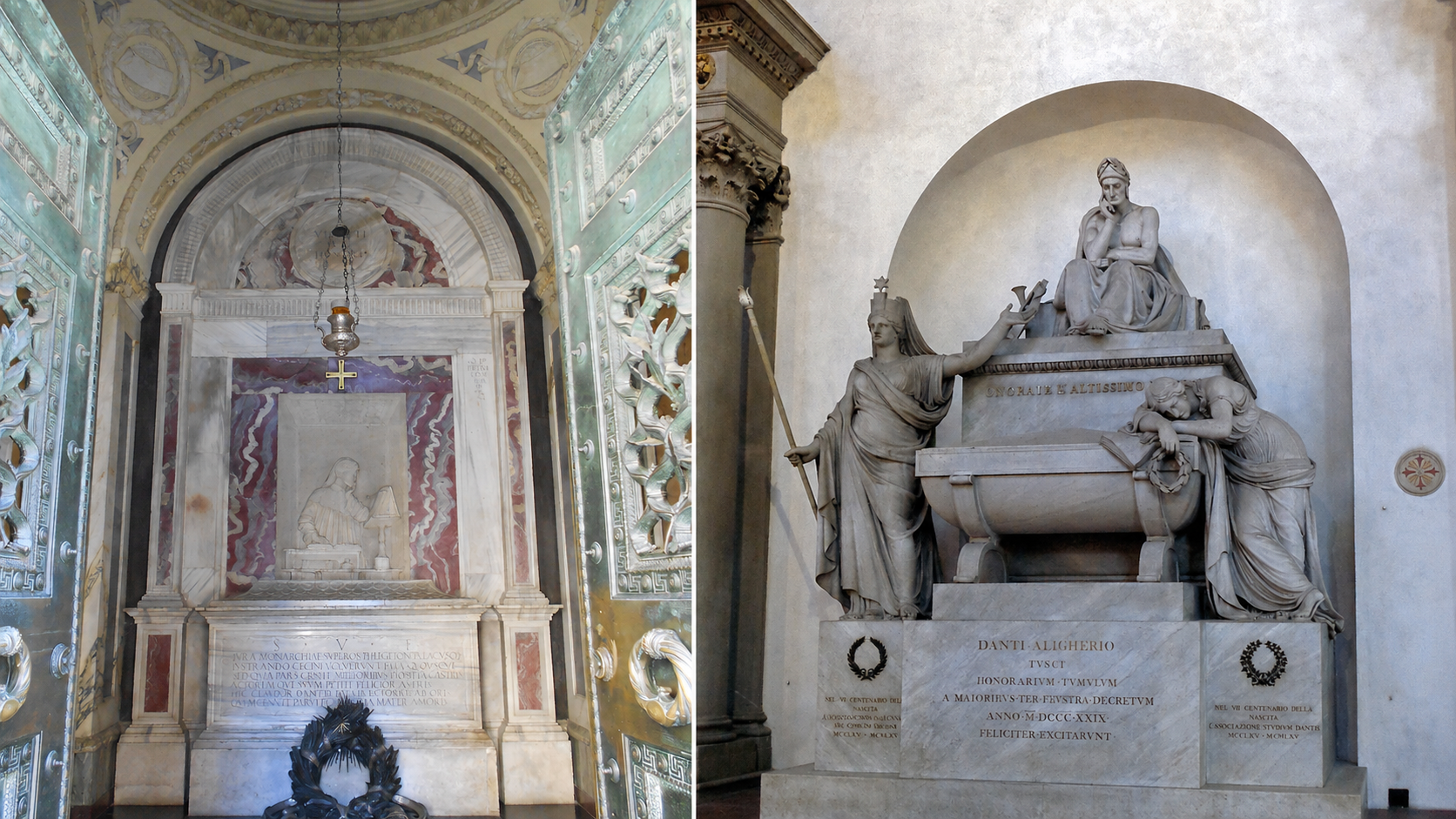
We often think of cemeteries and graves in terms of finality – the grave is our domus ultima, our “final resting place.” But the etymology of the word “cemetery” shows it was originally meant to suggest a sleeping place, a “dormitory,” as Jesus says of Lazarus, “Our friend Lazarus is asleep, but I am going to awaken him” (Jn 11:11).
The grave, then, can be understood as, on the one hand, the end of a person, or, on the other, as a site of transition. In the pagan world, the tomb is a monument to an irretrievable past, but for a Christian, the cemetery is a sleeping chamber oriented toward future awakening.
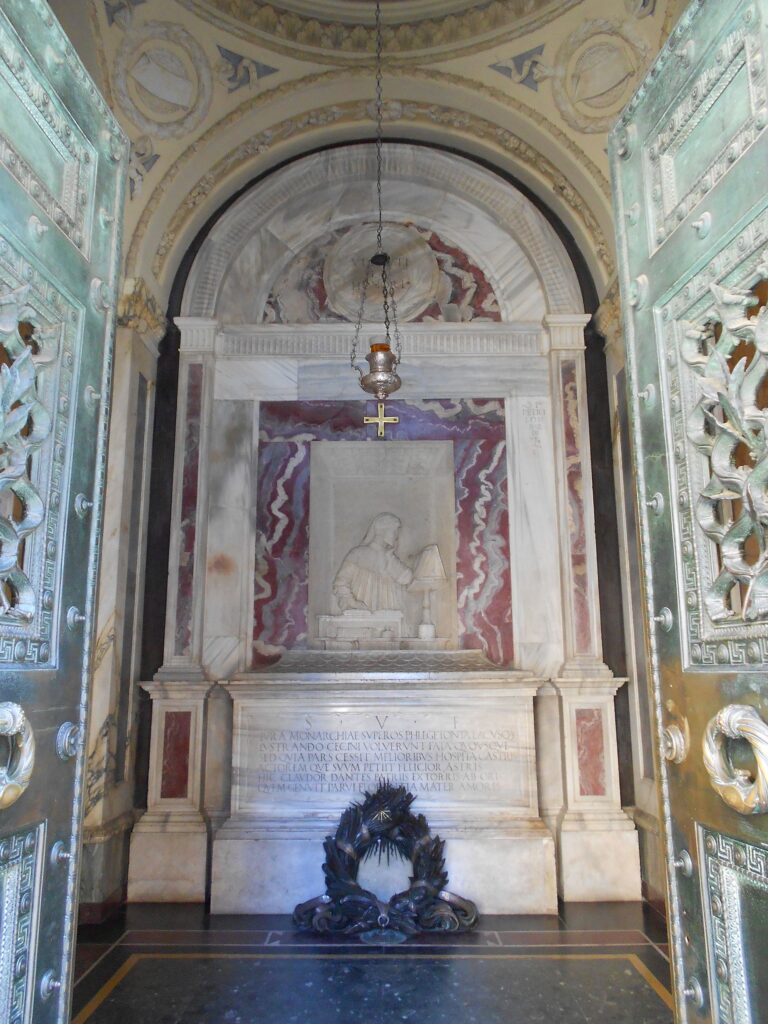
The great poet of Purgatory was, of course, Dante Alighieri, and it is in Ravenna, at the edge of a quiet courtyard close by the Basilica of San Francesco, that Dante’s remains lie. The surrounding Zona Dantesca, a deliberately hushed pocket of trees and paving stones, functions like a miniature cemetery of contemplation, a space set apart for memorializing and mourning Italy’s – and Catholicism’s – supreme poet.
Yet the history of the tomb tells a more unsettled story: Dante’s bones, originally housed in an ancient Roman sarcophagus, were repeatedly hidden, relocated, and rediscovered over centuries – acts of guardianship and secrecy that reveal a city determined to protect a poet whose very remains remained a matter of political contest. In this small, protected enclave, visitors encounter not only a grave, but a narrative of exile extended beyond death, a story written into the very soil that shelters him.
Dante died in Ravenna in 1321 and was buried there next to the Basilica of San Francesco. The neoclassical mausoleum that now houses Dante’s tomb was built in 1780, replacing earlier tomb structures on the same site. The remains themselves were – one can’t avoid the pun – bones of contention. In 1519, the city that had given him birth but that had also exiled him, Florence, tried to reclaim his bones. Franciscan friars in Ravenna secretly removed and hid the bones for centuries.
During restorations in 1865, workers accidentally discovered a wooden box buried in the wall of a nearby cloister. It bore the Latin inscription “Dantis ossa,” meaning “the bones of Dante.” The bones were later examined and were determined to be consistent with a male of Dante’s approximate age and period. They were placed in a new sarcophagus inside the 1780 mausoleum, where they remain.
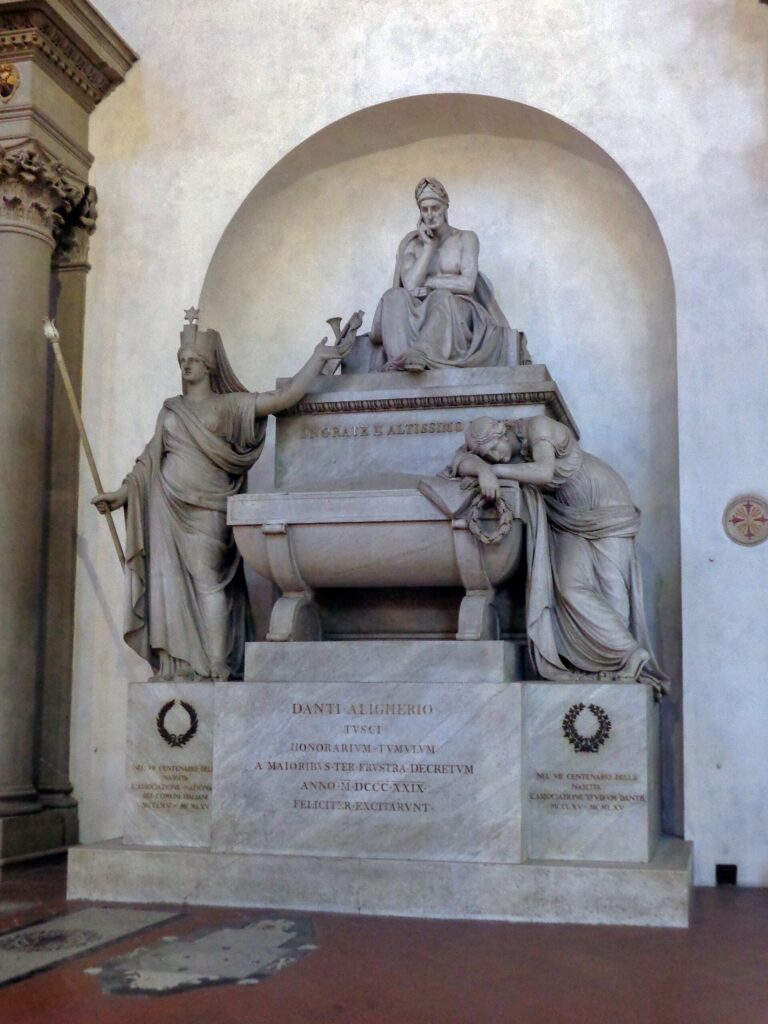
Meanwhile in Florence, an elaborate cenotaph rises within the Basilica of Santa Croce, a monumental tomb conspicuously empty. It shows Dante seated in classical garb above an allegorical tableau where Poetry herself drapes sorrowfully across a sarcophagus, mourning a body she does not possess. Outside the basilica, Enrico Pazzi’s 1865 statue of Dante towers, standing watch over the piazza, a stone sentinel placed before a church full of the illustrious dead, including Michelangelo and Machiavelli.
Taken together, Florence’s memorials form a symbolic necropolis rivaling Ravenna’s physical one – a city of monuments built to reclaim, in memory and marble, the poet whose actual bones it could never retrieve.
And so the modern literary pilgrim must move between the two cities: from Ravenna’s secluded Zona Dantesca to Florence’s grand, empty tomb, tracing a bifurcated afterlife in which Dante’s body and Dante’s legacy lie forever apart, and yet forever entwined.
Excerpted from Logos: A Journal of Catholic Thought and Culture 29, No. 2 (Spring 2026). The whole article or issue can be found here.