Generative AI is now part of how many marketing teams draft content, explore ideas, and test concepts. But the results aren’t always consistent. One marketer writes a great prompt and gets a useful output. Another asks the same tool a similar question and gets something vague, or off-brand or biased.
For example, a marketer asks an AI tool: “Describe a typical customer for a home fitness brand.” Without context, the AI generates a generic description based on patterns it has seen across the internet. It might assume the customer is young, affluent, urban, or highly athletic. None of those assumptions may match the brand’s real customer base.

As generative AI usage matures, prompt structure and brand context matter just as much as the AI technology itself.
Instead of relying on individual prompt-writing skills, companies are building shared prompt libraries. These typically include prompt templates, intended use cases, high quality example outputs, risks and limitations to consider, and guidance on when human oversight is needed.
Once the prompts are built, share them with your team and set expectations around how they should be used.
This approach helps teams move from isolated experimentation to more scalable and consistent AI workflows. By embedding guardrails directly into prompts, organizations can reinforce brand safety, reduce bias, and improve transparency.
Using the PACE Framework to Design Better Prompts
One prompt structure teams use is the PACE framework (Persona, Action, Context, Execution). PACE helps ensure prompts provide enough direction for the AI to generate useful, relevant outputs.
Persona states who the AI should act as.Defining the AI’s role improves reasoning and expertise. For example,“Act as a senior marketing strategist specializing in consumer fitness brands.”
Action outlines the task the AI should perform.Clear instruction reduces ambiguity and helps the AI tool focus.For example, “Describe three core customer segments for a home fitness brand.”
Context is the most important part of the prompt and provides the marketing information the AI tool needs to succeed. It could include brand voice, audience demographics, product details and campaign goals.
This is also where teams can set boundaries. Detailed guardrails help support responsible and ethical AI outputs. Teams can specify risk and legal considerations, avoid stereotypes and align outputs with brand guidelines. Treat context like the rules of the road you’d give a new marketer joining your team. For example, a home fitness brand may say: “Avoid using language that promises weight loss results in 30 days.”
Execution defines how the output should be structured, whether that is bullet points, tables, short summaries, campaign outlines, or file size. These instructions make outputs easier to evaluate and implement.
Along with the PACE framework, ask the AI to explain its assumptions and rationale for any output or decisions it makes. This confirms the AI tool followed your stated constraints.
Three Reusable Prompt Templates for Marketing Teams (using PACE)
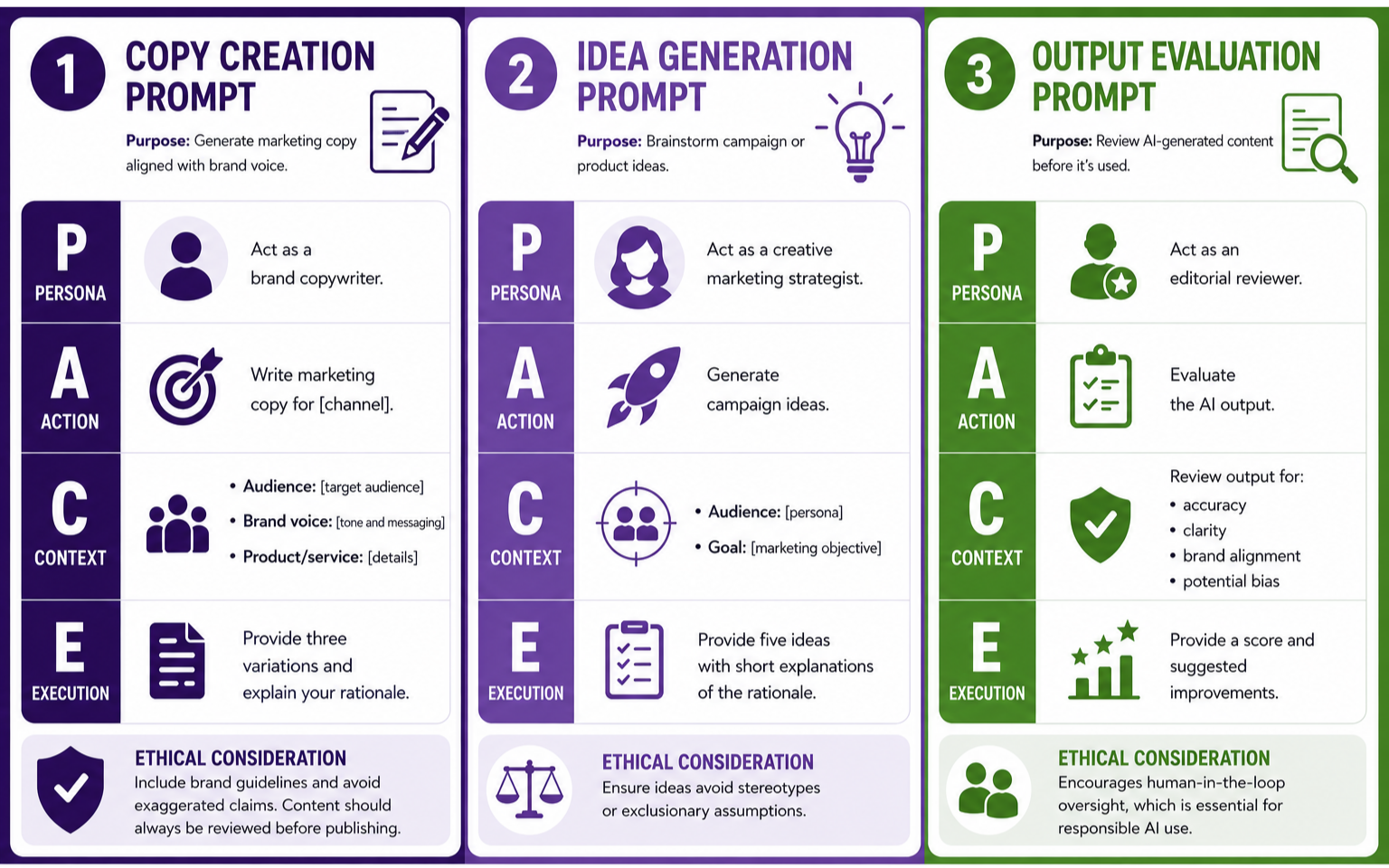
Scaling Through Templates
Frameworks like PACE and reusable prompt templates can help marketing teams consistently generate higher-quality outputs while supporting responsible AI use.
Organizations that treat prompts not as one-off instructions, but as strategic assets, are better positioned to reduce bias and integrate ethical considerations into AI outputs.