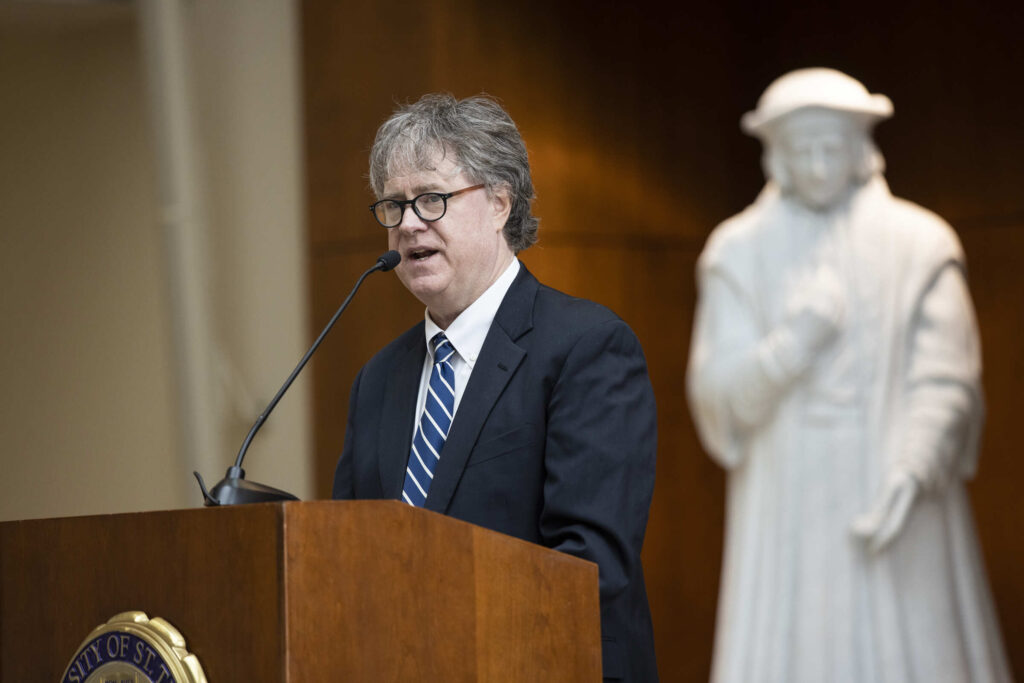
Thomas Hickson, a geology professor at the University of St. Thomas, appeared on “Minnesota Live” to discuss the unique geological landscape of Minnesota and how it can be connected to the surface of Mars, demonstrating what microbes are capable of during the interview.

From the conversation:
Chris Egert: Can I rewind a little bit and get back to the Mars thing, do we know for sure that these exist in Mars? Because if we did, then you would know that there had been life there.
Thomas Hickson: The assumption is it probably is. And actually, the rovers, they have started to find that there’s evidence for water on Mars. NASA’s goal is follow the water, and find the water. Because if you can find water, you can probably find life. We already know that there was water, flowing water, standing water. ...
I work in ancient lake deposits that were really hostile environments, places that you’re not going to find a bunch of fish. You’re going to find a bunch of microbes that can survive because microbes can survive in crazy conditions. So Mars, crazy conditions, terrible place to live. The only thing that’s probably going to survive is a microbe. So the idea is that they’re looking for evidence for this, and then what we do is we look for evidence for these on early Earth, when the Earth was also really hostile.
And we look at what their chemistry was like, what their shapes are like, what their textures are like under a microscope. We use those to understand what we expect to find on Mars, or what comes back from Mars.