The year 2025 marks the 1700th anniversary of a momentous event in the history of Christianity: the Council of Nicaea. In the year 325, Emperor Constantine invited over 300 bishops from around the Roman Empire to attend a church council in a small town called Nicaea in western Asia Minor—known today as Iznik in the country of Türkiye. This was the first “ecumenical” or “world-wide” gathering of bishops in the history of Christianity.
Constantine convoked the bishops for the purpose of addressing two crises that were tearing the Church apart: (1) the aberrant understanding of the Christian God associated with an Egyptian priest named Arius; and (2) the practice of celebrating Easter, the most important Christian festival, on different days.
If you have heard of the Council of Nicaea at all, you have probably heard of the Nicene Creed. This creed is simply a brief summary of Christian belief in God that is carefully worded to exclude the views of Arius as permissible. A lesser-known result of the Council of Nicaea was the decision to employ the same method of calculating the date of Easter throughout the Roman Empire.
Neither the Nicene Creed nor the Easter decision immediately resolved the issues then facing the church. In fact, tensions over these issues were only exacerbated in the decades following the Council of Nicaea.
In time, however, the Nicene Creed became recognized throughout the Christian world as the touchstone of Christian belief in God. In many denominations even today, such as the Catholic and Orthodox Churches, the Nicene Creed is recited or sung at the Sunday liturgy. But Christians around the world today still celebrate Easter on different dates. But it is not for the reasons that caused the divergence in celebrations in the early fourth century. Rather, some Orthodox Churches continue to use the older Julian Calendar to calculate the date of Easter, whereas Western Churches (including Roman Catholics and Protestants) use the more recent Gregorian Calendar.
The Nicene Creed, the date of Easter, and related topics were very much on the mind of the participants in a recent international conference commemorating the 1700th anniversary of the Council of Nicaea. Entitled “Nicaea and the Church of the Third Millenium: Towards Catholic-Orthodox Unity,” the conference was held from June 4 to 7 at the Pontifical University of St. Thomas Aquinas in Rome, also known as the Angelicum.
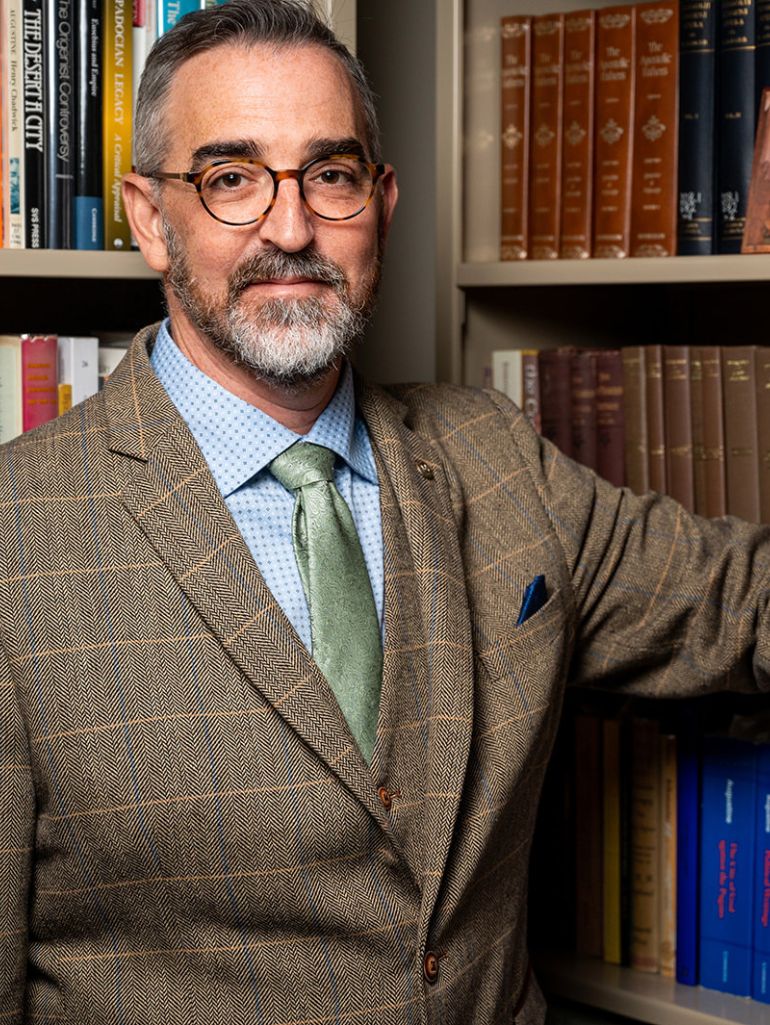
This conference was a joint venture undertaken by the Institute for Ecumenical Studies at the Angelicum and the International Orthodox Theological Association (IOTA), whose founding president is Dr. Paul Gavrilyuk, the Aquinas Chair in Theology and Philosophy at the University of St. Thomas. Gavrilyuk is also the director of the Theology Department’s Encountering Orthodoxy Initiative, whose mission is to foster mutual understanding between the Catholic and Orthodox Churches. Gavrilyuk’s work with IOTA is supported in part by the Encountering Orthodoxy Initiative.
 Courtesy of IOTA
The conference’s premise was that the Council of Nicaea is foundational for Orthodox-Catholic unity, inaugurating a synodal way of addressing theological and canonical issues at the universal level, and that the Nicene Creed provided a theological vision of the triune God that continues to guide the common faith of Christians. The overall focus of the conference was therefore the articulation of the common faith shared by the Orthodox and Catholic Churches with a view to moving the two churches closer to full communion.
The gathering brought together over 250 participants from around the world representing the Catholic Church (both the Latin rite and Eastern rites), the various Eastern Orthodox Churches, the Oriental Orthodox Churches (the Coptic, Syriac, and Armenian traditions), and various Protestant Churches. There were over 100 presentations, including opening plenary addresses by Archbishop Rowan Williams of the Anglican Communion, Cardinal Kurt Koch, Prefect of the Dicastery for Promoting Christian Unity, and Metropolitan Job of Pisidia (Ecumenical Patriarchate), Co-Chairman of the Joint Commission for Theological Dialogue between the Catholic Church and the Orthodox Church.
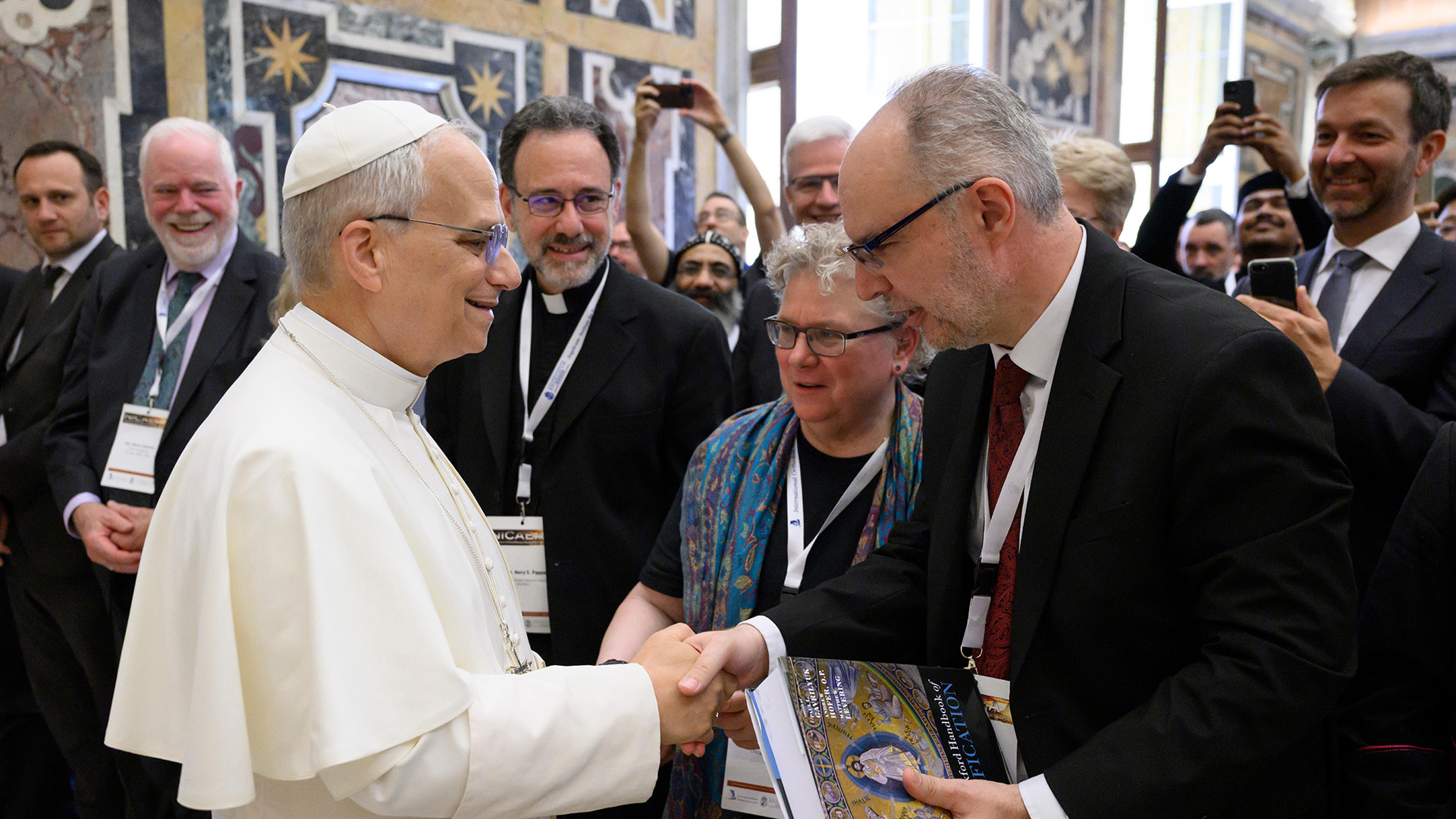
On Saturday, June 7, the conference concluded with a private audience with Pope Leo XIV at the Apostolic Palace . At the audience Pope Leo personally greeted Gavrilyuk. In their brief conversation, Gavrilyuk was able to present the work of IOTA and express his desire that Orthodox and Catholic collaborate on joint statement about a common vision of salvation known as “deification.” This is the teaching that we participate in the life of God and become by God’s grace what God is by nature.
Deification is a tenet on which the Orthodox and Catholic Churches already have substantial agreement. Pope Leo also delivered a brief address to the conference participants. He stressed how the Nicene Creed remains today an impetus to unity for the Orthodox and Catholic Churches and indicated the openness of the Catholic Church to pursue an ecumenical solution for a common celebration of Easter.
Through Gavrilyuk’s efforts as the director of the Encountering Orthodoxy Initiative and president of IOTA, the University of St. Thomas is in the vanguard of ecumenical efforts to unite the Orthodox and Catholic Churches, healing a rift that is nearly one thousand years old.
Mark DelCogliano is a professor of Theology at the University of St. Thomas, where he also serves as department chair.