When he was 4 years old, Marc Lore didn’t say he wanted to be a CEO. He said he wanted to be a farmer. That was because “they grow stuff from nothing.”
It was a child’s answer, but also, in hindsight, a blueprint for the person who would become the serial entrepreneur who founded the e-commerce company Jet.com, which was later acquired by Walmart. He now co-owns the Minnesota Timberwolves with Alex Rodriguez while simultaneously reimagining food delivery through his company Wonder and designing a holistic, planned city called Telosa in which citizens have an economic stake in the city’s land and its progress.
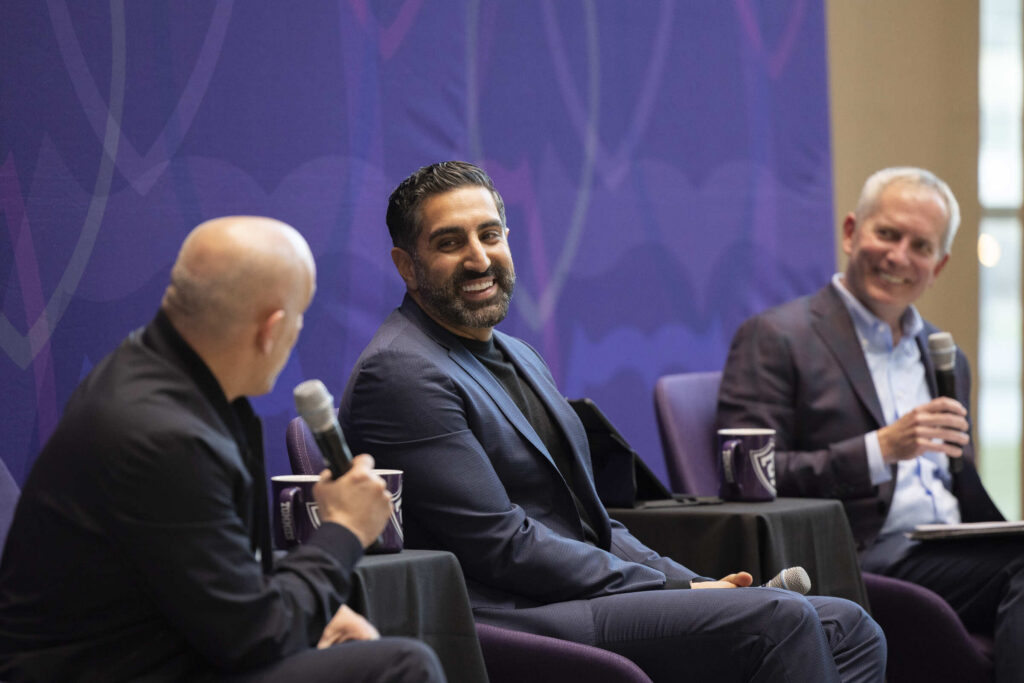
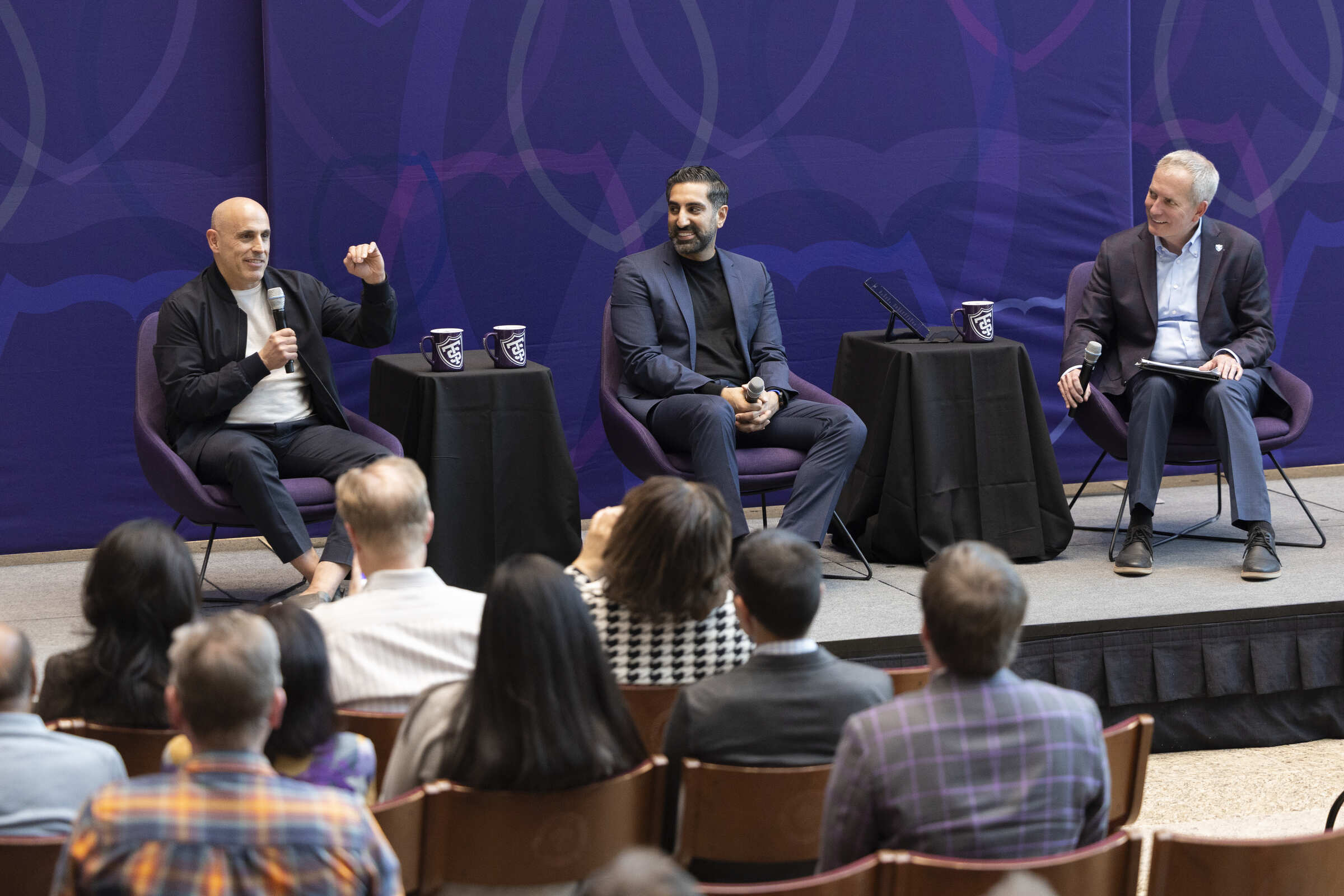
“I just loved building stuff,” Lore told a packed audience at the University of St. Thomas School of Law during a Finding Forward conversation. Lore was joined by investment executive and St. Thomas alumnus Vik Uppal ’06 in the conversation moderated by President Rob Vischer.
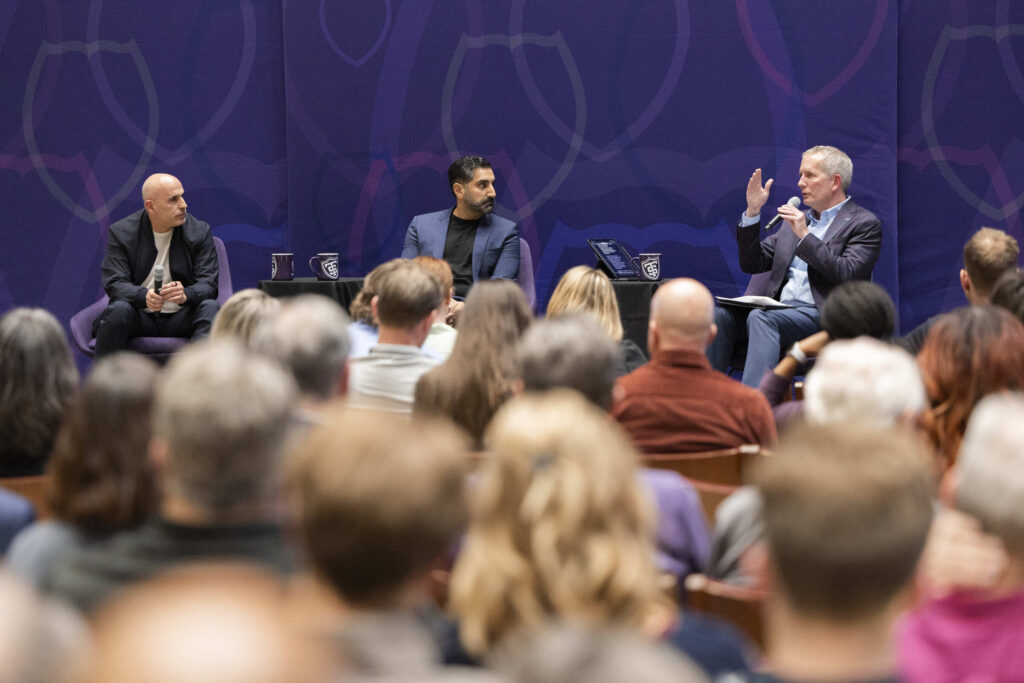
As Vischer noted in opening the conversation, entrepreneurship is often about recognizing that “what is now, is not forever.”
Lore and Uppal discussed their shared identity, both describing themselves as “born entrepreneurs.” And along the way, they both have had to pivot their business based on market conditions.
Given that people need to have the courage to rethink situations, Vischer framed the discussion around a central question: how individuals connect their gifts and passions with the needs of the world. It’s a concept that underpins the university’s emphasis on purpose and vocation.
That idea of connecting purpose to action showed up most clearly when the two entrepreneurs discussed how they approach risk and opportunity. Uppal said his investment style is measured and long-term. Lore, by contrast, embraces uncertainty.
“I find that the best opportunities have the lowest probability of success,” Lore said. “If it has a high probability, there’s a lot of competition.”
That mindset traces back to a lesson from his father, who pushed him to apply to a top business school despite long odds. Lore didn’t get in and joked that it would be a great story if he had. But the experience reshaped how he thinks about effort and opportunity.
“If you’re willing to put the work in on something with a low probability of success and a big outcome, once in a while you’re going to hit it,” he said. “Not doing anything is often the riskiest path.”
That philosophy has guided decisions across his ventures, including moments when bold ideas required equally bold pivots. An early version of his company Wonder, an app that offers food delivery from celebrity chef menus in a single order, originally focused on mobile kitchens preparing meals outside customers’ homes. He said the concept generated excitement but proved difficult to sustain.
Rather than continuing to invest in a flawed model, he made a rapid and costly decision. “We sold 450 trucks, lost $90 million and started over,” he said. In business, “you’re wrong more than you’re right. The key is not being stubborn.”
While some entrepreneurs move quickly to build, Uppal, who is founder and chief investment officer of his own firm, describes his approach as patient, disciplined and deliberately long-term. “You have to be willing to sit with the bat on your shoulder,” he said, borrowing a baseball analogy, “and wait for the right opportunity. It’s a marathon. A get-rich-slow mentality.”
However, his patience is paired with a willingness to adapt as new information emerges. “I’m changing my mind all the time,” he said. “And I think that’s a strength.”
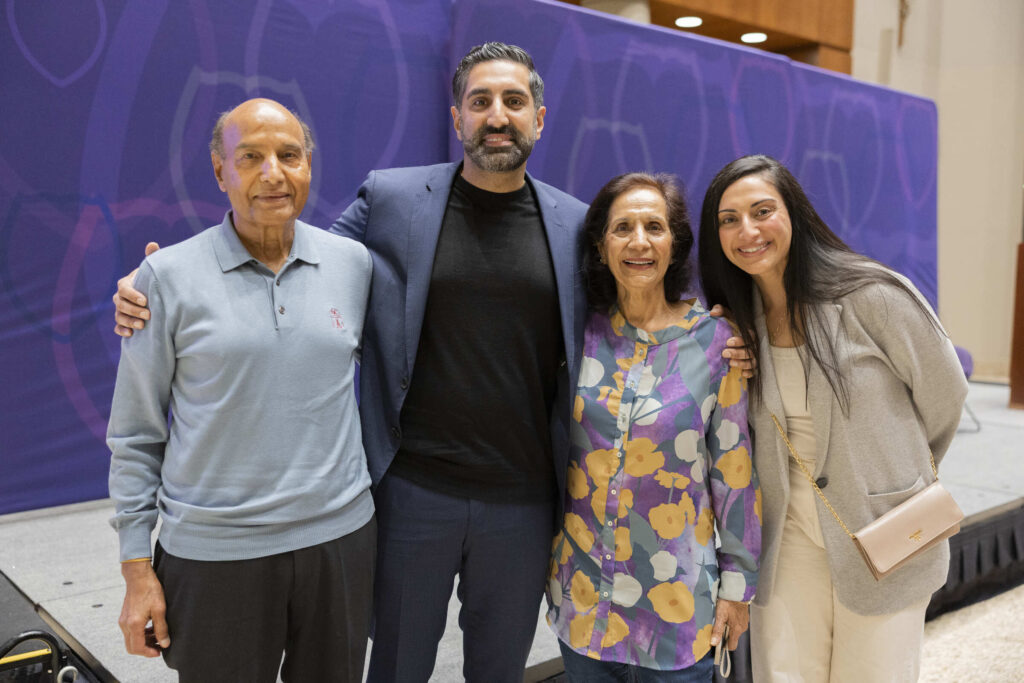
That instinct traces back to his parents, immigrants from India who built their lives through hard work and persistence.
“I would say I was born an entrepreneur,” Uppal said. “It’s in my DNA.”
Early in his professional life, he began working alongside his father in real estate development. It was a hands-on education that included both early wins and, eventually, significant setbacks.
During the 2008 financial crisis when the real estate market tumbled, a major development project in downtown Minneapolis also collapsed. The experience was difficult, but formative.
“You go through something like that,” Uppal said, “and it changes how you see the world.”
Despite different roles — one building companies, the other investing in them — Lore and Uppal converged on several core ideas, both had several pieces of advice for students.
One piece of advice from Lore is “Ask what you can give… not just what you can get” and another “When you’re choosing your first job… focus on who you’re working for.”
Uppal agreed, adding that alignment with investors is equally critical. “Who you partner with matters,” he said. “It shapes the trajectory of what you build.”
Through his firm, Uppal has helped support philanthropic efforts and create opportunities for employees to engage in causes they care about, reinforcing a culture that values both performance and purpose. It’s a philosophy that echoes what he first encountered at St. Thomas.
“I’m not Catholic,” Uppal said, “but the values I learned here have stayed with me.”