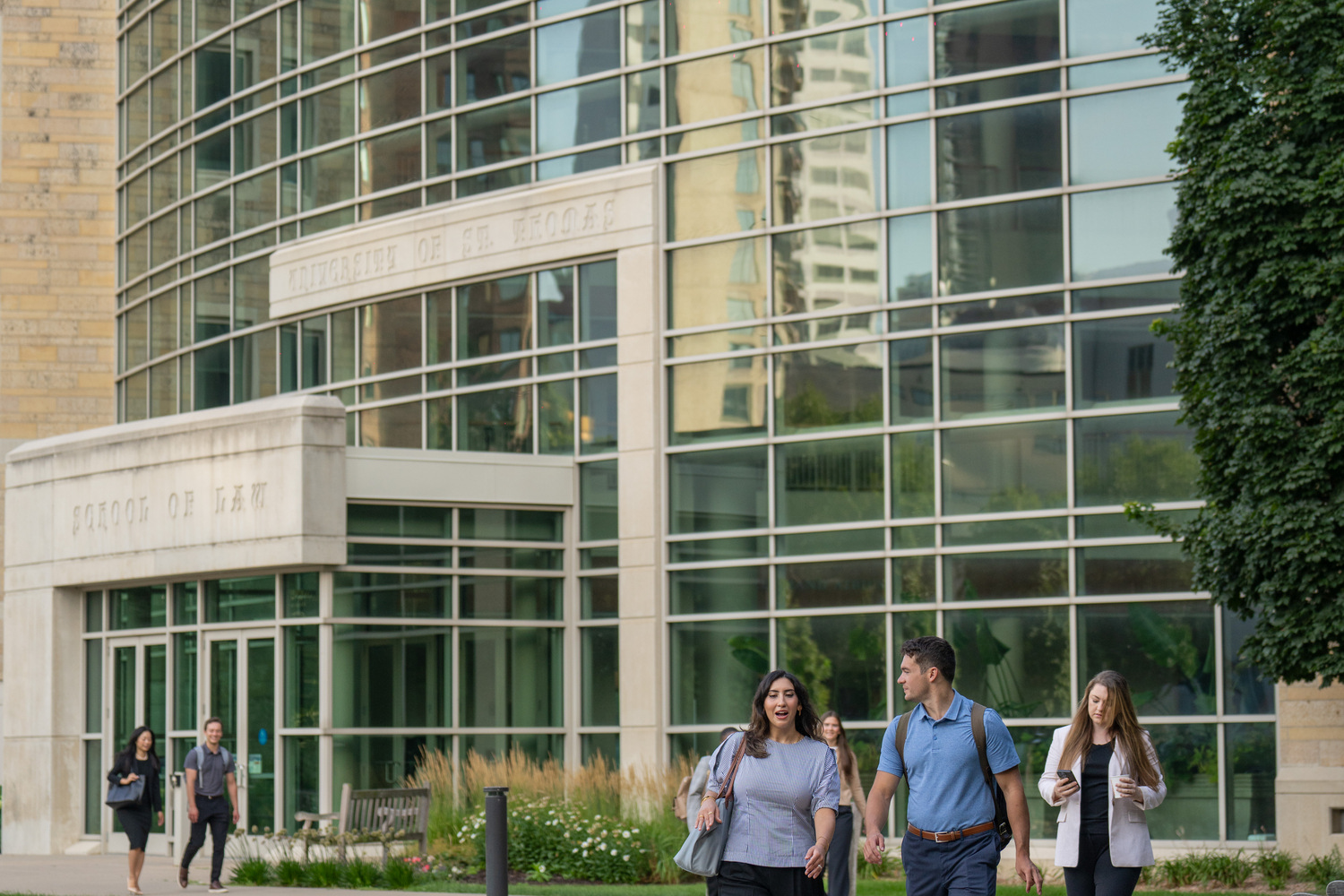
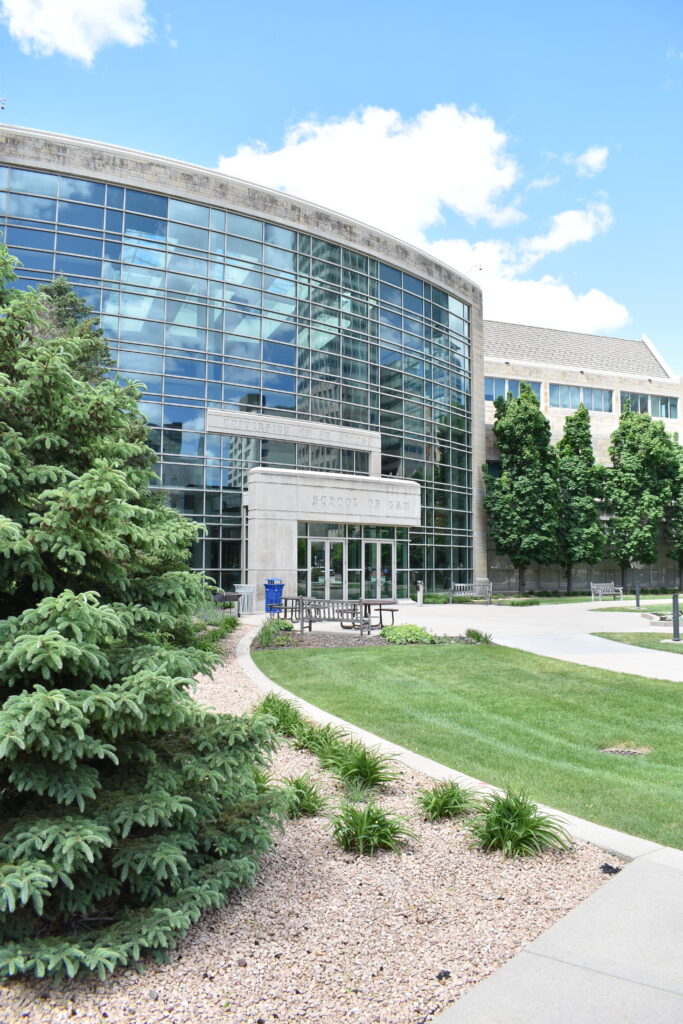
When the University of St. Thomas School of Law opened its doors in 2001, the founders had "high aspirations and a deep mission." What they didn't have was any idea what would happen, not even knowing how many students would show up for the first day of class.
Turns out 120 students came, and the mission resonated. Those high aspirations? They weren't unfounded. Fast forward 25 years, and St. Thomas Law now has more than 3,000 graduates. Faculty ranked 23rd nationally for scholarly impact. A top school nationally for practical training. Recent rankings in the U.S. News top 100 law schools. And a mission that has kept the school grounded in its faith.
"The law school's market position has never been stronger," former law school dean and current University of St. Thomas President Rob Vischer said. "Our entering class has never been better and stellar new faculty members and staff professionals with many career options are embracing our mission and choosing to join our community."

A lot has happened in the world since the opening—9/11, the financial crisis of the late 2000s, COVID, George Floyd's murder and the racial reckoning that followed, concerns about the rile of law, and the law school is currently in search of its next dean. However, now is the time to "think big," Vischer said. This means expanding St. Thomas Law's national reach in recruiting students, faculty and scholarship recipients while standing firm in its mission.
"The law school passed each of these challenges with flying colors," he said. "With each new obstacle, we emerged as a stronger law school on the other side. If we keep the school's mission front and center no matter the circumstances, St. Thomas Law will thrive."
A Foundation Built to Last
St. Thomas was steadfast in its mission from the beginning. As one of the law school's first associate deans Patrick Schiltz, who is now the chief judge of the United States District Court for the District of Minnesota, wrote in 2004, the vision was "to graduate lawyers who would integrate their religious and moral values into their professional identities and who would have a passion for using their legal training to serve God and their fellow human beings."

But the mission never meant compromising on quality. "Our distinctive mission can never be an excuse for anything short of excellence," said Vischer in 2022. "If we want to have a meaningful impact on our world, a St. Thomas legal education has to be as good as, or better than, the education offered by every other law school."
While some schools chose between prestige and purpose, St. Thomas proved you could do both by pursuing excellence in teaching, scholarship that matters and the formation of the whole person. The faculty landed on the top 25 for scholarly impact. The school earned national recognition for its mentor externship, professional formation and work in criminal justice reform and religious liberty. Alumni moved into positions of influence.
The strategy worked. Results of the 2022 Law School Survey of Student Engagement (LSSSE) showed that 93 percent of that year's first-year students said they would still attend St. Thomas for law school if they had to choose again.
"St. Thomas gave me not just the tools, but the moral and intellectual inheritance that shows up years later," said Iowa Court of Appeals Judge John Sandy '07, '10 J.D., former president of St. Thomas Law's alumni board. "Most law schools teach you what the law is. St. Thomas teaches you why the law matters."
Why Now Matters
Legal education continues to face challenges, with traditional law Schools struggling with questions about cost and value, bar exam changes, employment concerns and threats to the rule of law.
"That's one of the things that St. Thomas is going to shape its students—respect for the rule of law and the courage to stand up for the rule of law," said former Minnesota Supreme Court Justice Margaret Chutich, who chaired the St. Thomas Law Board of Governors. "It's going to take courage from these law students to go out into the world and practice their convictions."
The mission that seemed "niche" in 2001 has become what students want. Chutich, a former Minnesota Supreme Court Justice whose mentor was Judge Diana Murphy, who was involved in the creation of St. Thomas Law, said this moment needs what St. Thomas offers.
"There is an unease about our institutions," said Chutich. "We need principled leadership. St. Thomas is talking about these laws, talking about morality. That is essential to our democracy."
Sandy said employers notice the difference in St. Thomas graduates.
"St. Thomas graduates feel ready and confident earlier than their peers," said Sandy, who has hired alumni in the past. "They have a strong internal compass; confidence rooted in preparation and purpose. Success comes not just from knowing the law but from being trusted. Trust comes from understanding the big picture, from a commitment to the why."
The Proof is in the People
Sandy's story shows what a St. Thomas education produces. He worked as a public defender, did civil rights litigation and now sits on the bench in Iowa.
"When I was counseling defendants facing life imprisonment, they needed to know I knew the law," he said. "But just as important was that i was there to hear what they had to say, even when it had nothing to do with their case and everything to do with how they were feeling, St. Thomas prepared me precisely for that daily work of what justice entails."
The breadth of careers proves the models' flexibility. Jessica Drewiske '15 J.D./MBA built a career in compliance at major tech companies and now works at Google. Her path is one she says she couldn't have imagines as a 1L. She credits her St. Thomas education for getting her to where she is today.
"St. Thomas taught me more HOW to think than WHAT to think," she said. "It taught me to find information and perspective in dialogue, in community and in reflection."
That distinction shows up in how employers view St. Thomas graduates. Drewiske, who has hired lawyers from many schools, sees it clearly.
"They bring experience and a 'can do' attitude," she said. "They also bring an underlying foundation of values, which I find so important—especially in my profession."
St. Thomas lawyers also support one another and invest in the alumni network. Sandy's classmate Matt Wilcox '10 J.D. LL.M. recently became a Hennepin County judge. Sandy drove up to swear him in.
"There is this camaraderie, this common experience that unites us," Sandy said. "It is grounded in stewardship, not just nostalgia."

It is not uncommon to hear about stories of alumni, across graduation years, who make special efforts to support a fellow alum's job search or refer a client. Around half of the law school's current mentors are graduates like Drewiske who stay engage.
"The Tommie Network is real," she said. "I've met some of the coolest, most influential people as a result of staying plugged in."
Looking Ahead
The law school looks toward the 50th anniversary with a clear vision — a school that has not changed its mission of integrating faith and reason, pursuing justice and forming the whole person. But the impact expands, methods evolve and influence grows. Graduates continue to prove that excellence and mission go hand in hand.
Added Sandy: "Real progress isn't about changing your vision to fit the moment. It's about changing the world to fit the vision. That's a St. Thomas' core, its ethos."
Chutich says the question is no longer "can a faith-based law school succeed?"
"It is now 'how will the St. Thomas model shape legal education?'" she said.
Now comes the opportunity, innovation and responsibility of the next 25 years.