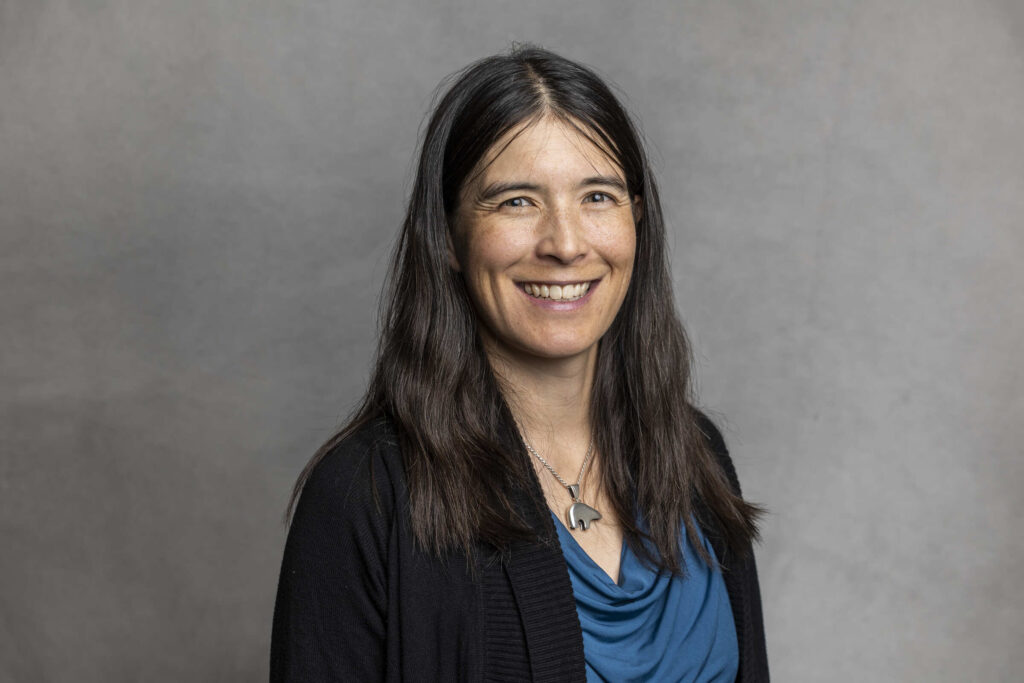
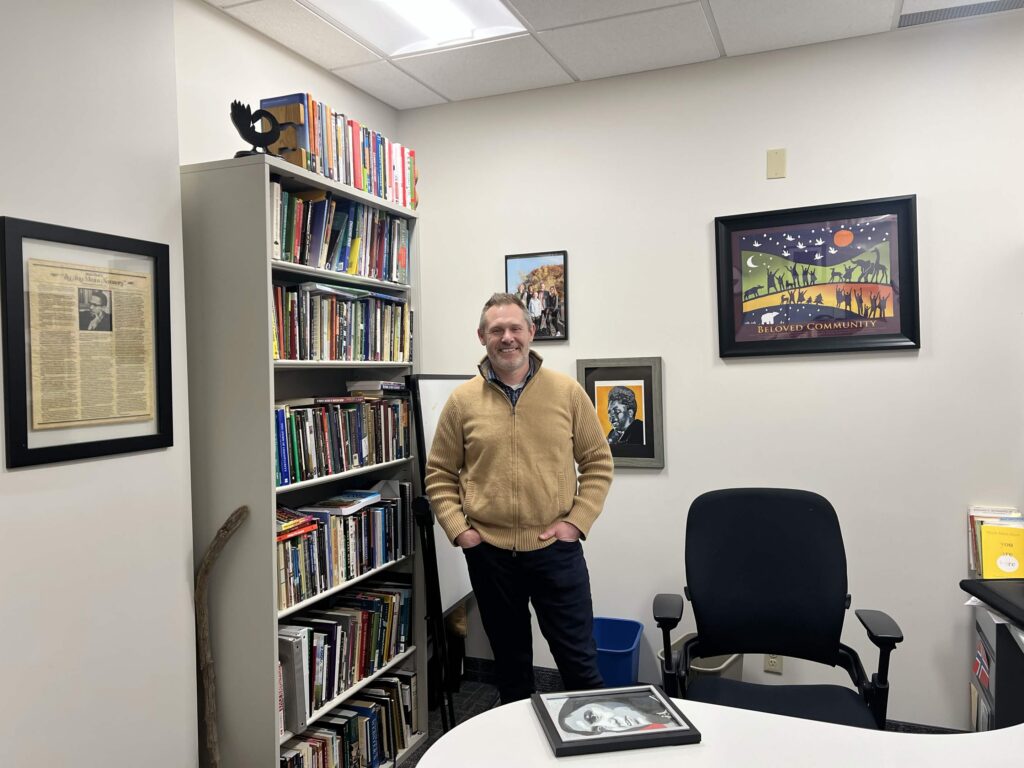
Portraits displayed on the walls of Dr. Tanden Brekke’s office show his family and civil rights activists, including Dolores Huerta, Ella Baker, Gandhi, Fannie Lou Hamer, Howard Thurman, Martin Luther King Jr. and Malcolm X.
“They’re all people who did really, really powerful things, believed in themselves, believed in the people around them, understood the world from the way it was. They believed in a different future,” said Brekke who teaches justice and peace at Dougherty Family College, a two-year college at the University of St. Thomas. “I surround myself with them because that’s what I strive to do with my own life.”
Brekke believes that access to education is a fundamental positive. That belief does not only define how he sees the world, but it also influences the kind of students he works to support.
From a working-class upbringing to a calling in education
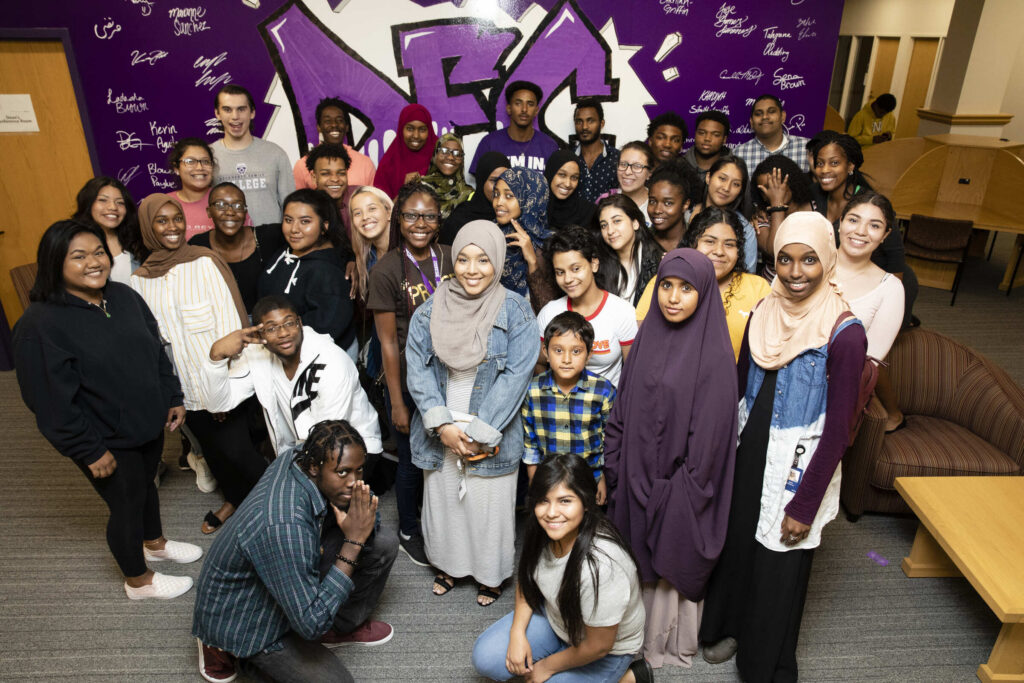
He was drawn to DFC’s mission to serve students of color, first-generation students and students with strong financial need. DFC scholars are guided toward a liberal arts degree, which is something Brekke said was transformative for him when he was a first-generation college student.
Raised on a farm in Iowa, Brekke saw how much his parents were struggling to make ends meet despite their hard work.
“I grew up in a working-class family and, very early on in my life, I realized ‘Man, there has to be an easier way to make a living,’” he said.
Brekke, who attended Christian schools growing up, realized that higher education could carry him toward social change. After enrolling in college for a bachelor's degree, he felt called toward ministry work. This led him to a pastoral studies degree. Through his experience of being a pastor, he found the passion for education and pursued a Doctor of Education.
“I thought that religion was more about social good, social change and social transformation because that’s how I had experienced it growing up,” Brekke said. “But once I became a pastor, I realized that this isn’t so much about social change or challenging the status quo. It’s more about maintaining the status quo.”
To Brekke, education is a fundamental element to positive social change. If people could have the time and access to educational opportunities, he said, it could change the course of individual lives and the course of society.
Through his written pieces like “From Charity Towards a Social Justice Paradigm,” “Breaking Bread in Communities of Learners” and “Right Now The Best,” Brekke found that the need for young people with critical skills, difficult conversations, and a cultivation of community sustains his work.
Brekke is currently anticipating the release of “Culturally Sustaining Pedagogies in Practice,” a co-edited book with Dr. Carla Gonzalez, a literacy specialist and co-coordinator of the Scholars Resource Center at the Dougherty Family College.
A classroom built on community and vulnerability
In his course, Introduction to Justice and Peace Studies (JPST250), the goal is to create a community at DFC.
“This educational experience is a communal place where you all come with knowledge. You’re not empty vessels,” Brekke tells his students. “You have life experiences, you know things. And I want you to bring that into the classroom.”
In the conversation-focused class, Brekke is an active participant, taking the first step to let students know who he is and where his thoughts are.
“I really connected with how vulnerable professor Brekke was in sharing his story and his background. You don’t often see your professor tearing up because of the experiences they went through,” said Kristel Hernandez-Batres, a second-year DFC scholar. “It made me realize, you know, that we are real people and a way you can make an impact is by showing how you feel.”
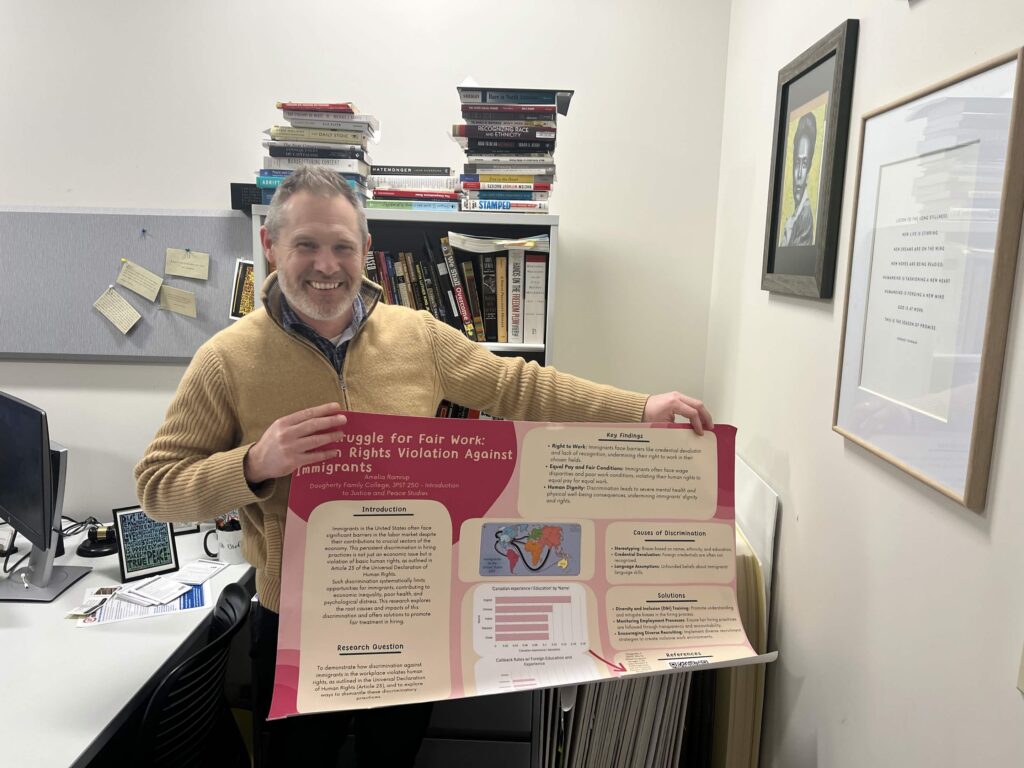
The scholars participate in class discussions and work on social action projects, identifying an action they want to take throughout the semester. The course equips scholars with the skills to search for verified sources, write a research paper centered on social change, and put those plans into action.
From classroom learning to real-world impact
Hernandez-Batres' research focused on the health disparities in the Hispanic community, a topic that inspired her to pursue a bachelor’s degree in social work at the University of St. Thomas.
“Something that stuck with me from professor Brekke’s class was if you want somebody to hear you, you have to use your voice, you have to write it down, and you have to do it right,” said Hernandez-Batres, who took the course in the 2025 fall semester.
Brekke opened the floor for project topics and for second-year DFC scholar Yamilet Sandiero-Arroyo that meant taking more initiative toward women's rights.
“It was liberating,” she said. “Being able to choose what you’re talking about, what you’re representing, and what you’re advocating for definitely gave us freedom.”
Sandiero-Arroyo's research focused on the language of the law and how it impacts women, children and healthcare providers. She plans to pursue a bachelor’s degree in biology at the University of St. Thomas.
Throughout the course, Brekke helps students transform their final project ideas, educating himself alongside them. Without the care and support from Brekke, Sandiero-Arroyo said she would not have felt confident about pursuing her project.
Helping students find the passion and hope for acting on social change is exactly how Brekke wants to support his students.
“As we encourage young people to explore new things, to think and take action in the world, it’s embodied practice. It’s not just an idea you think about and teach others, but it’s something you need to be doing yourself,” Brekke said.
Teaching a complex topic like social justice leads Brekke to make sure he takes time for himself. He keeps himself grounded through food experiments with pizza ovens, mountain biking, connecting with a monthly men’s group, and talking to anyone and everyone about basketball.
“Learning to love yourself, learning to be a kinder coworker, learning to know how to navigate a violent political environment. All that, to me,” Brekke said, “is where the good life is.”