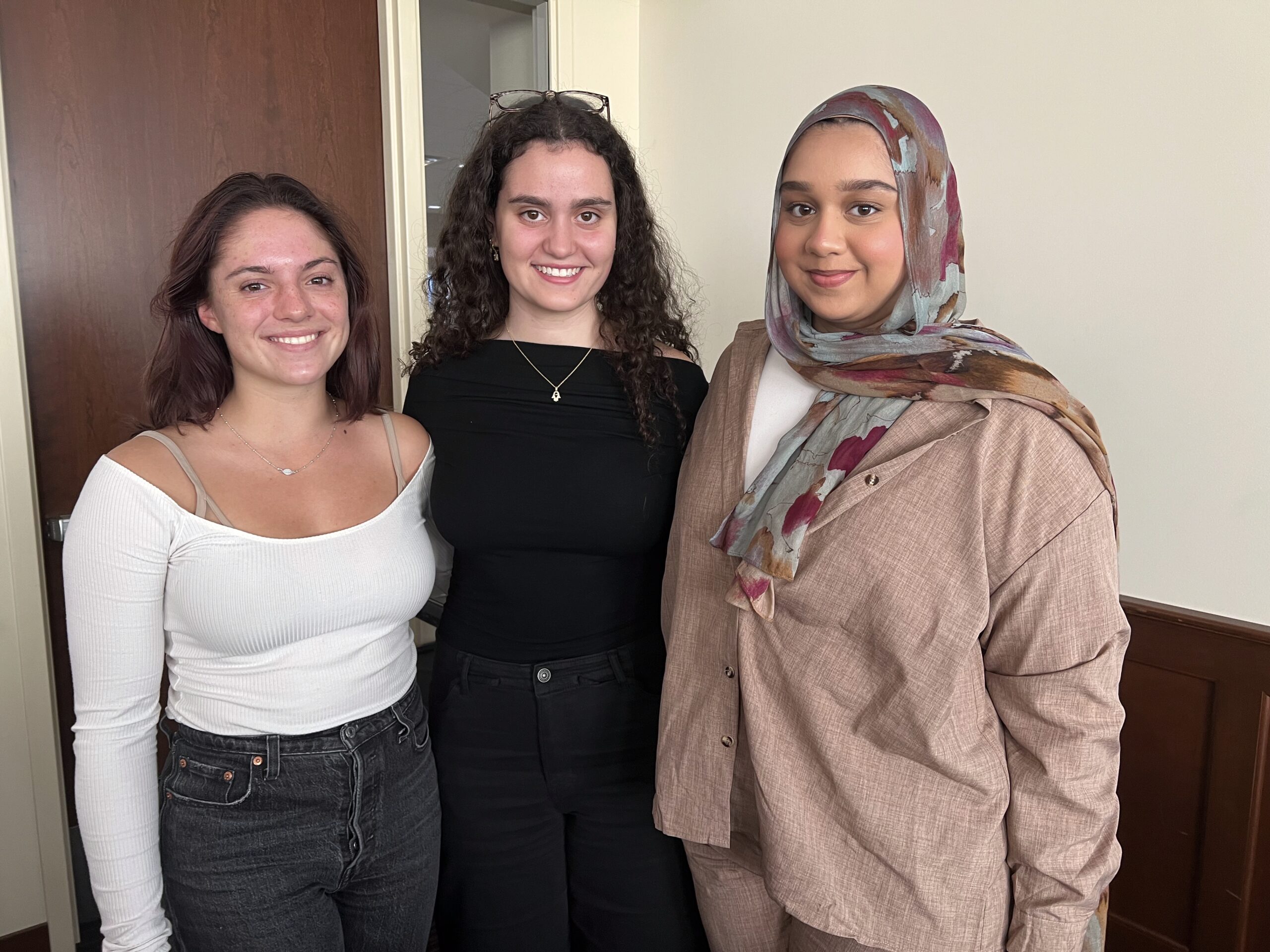
A nearly filled room at the University of St. Thomas buzzed with conversation as three students sat at a long table in the front. They took turns sharing similarities about the importance of religious diversity at a university rooted in Catholic social teaching. Their only difference was their faith. One was Catholic, one Jewish and the other Muslim.
Naomi Peters, May Zeroni and Soora Khan shared at the Interfaith Fellows meeting how their own faith journeys deepened at St. Thomas, in part because of how welcoming the university is to all students, whether they prescribe to a certain faith or are agnostic or atheist.
Interfaith Fellows Program is designed to encourage students to understand how religious diversity advances the common good, said theology faculty Mary Elmstrand, who is the managing director of the Interfaith Fellows program in the Jay Phillips Center or Interreligious Studies.
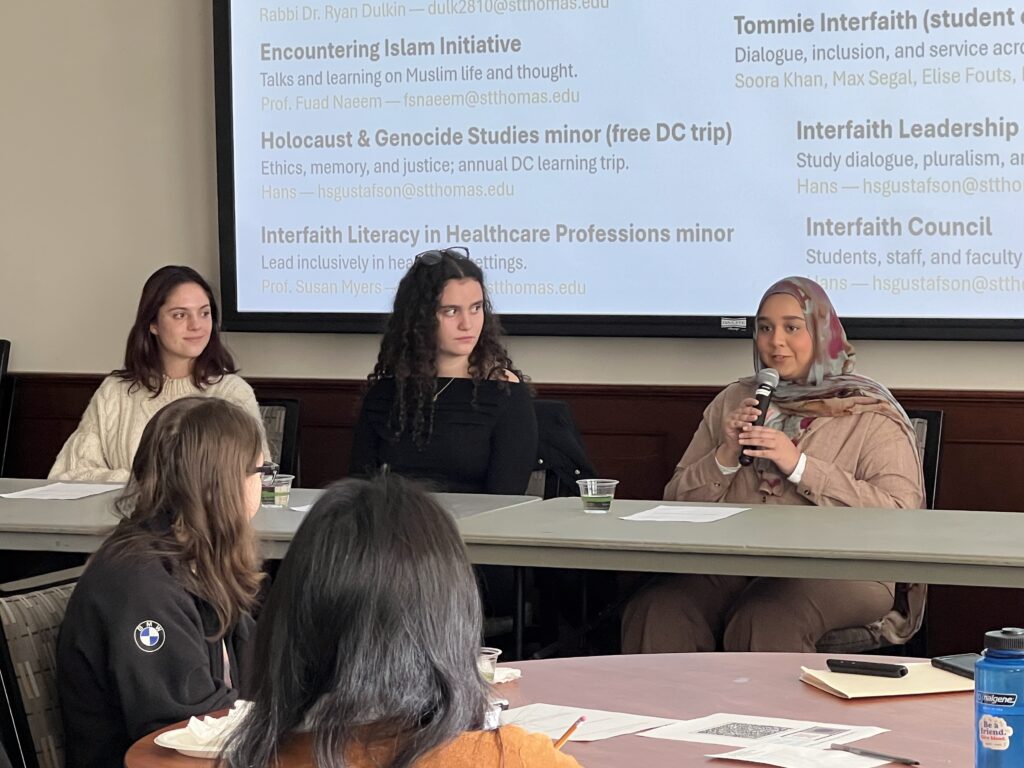
“We have been searching for an interfaith space for us to come together and explore our differences faith-wise,” said sophomore Soora Khan, an Interfaith Fellow ambassador and panelist at the “What Does It Mean to Be a Multifaith Catholic University?” event sponsored by the Jay Phillips Center.
Growing up, Khan had only attended Islamic schools, and she expected St. Thomas’ Catholic setting to feel vastly different. What she did not expect was how familiar it would be.
“My first impression was this is a very Catholic school,” Khan said. “I didn’t necessarily know what that meant because I grew up in a very Islamic environment my entire life, but I did know that Catholic identity and Muslim identity are kind of parallel to each other. We are driven by the Catholic school’s values and morals in the same way that my Islamic school was.”
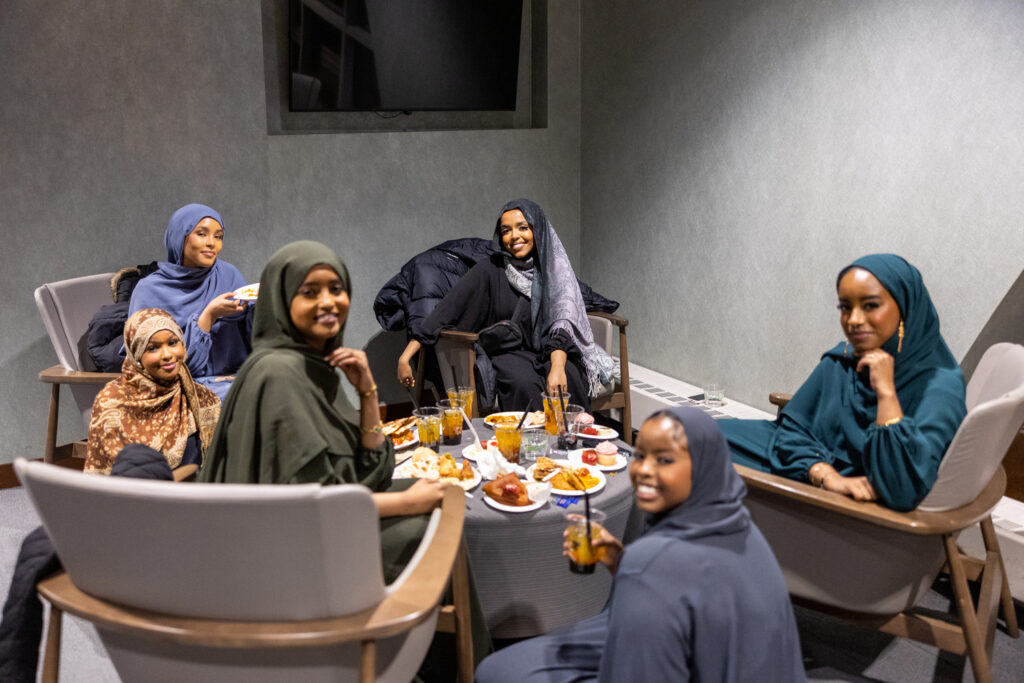
Now Khan serves as co-president of the Muslim Student Association and has been studying business law and management. Through her business courses, Khan met May Zeroni.
Zeroni studies finance and is a Hillel student leader for Jewish Student Life on campus. Her childhood was shaped by the Hebrew language, traditions of Judaism, and the identities of her relatives in Israel.
“I grew up going there every year. And so obviously I feel very connected to Israel.” Yet coming to a Catholic university and choosing a Muslim roommate, she added, “We come from very different backgrounds (and we) cherish our different religions and come together and speak about it all the time.”
Khan said her friendship with Zeroni is “one of my most cherished relationships that I have.”
Building bridges through interfaith dialogue
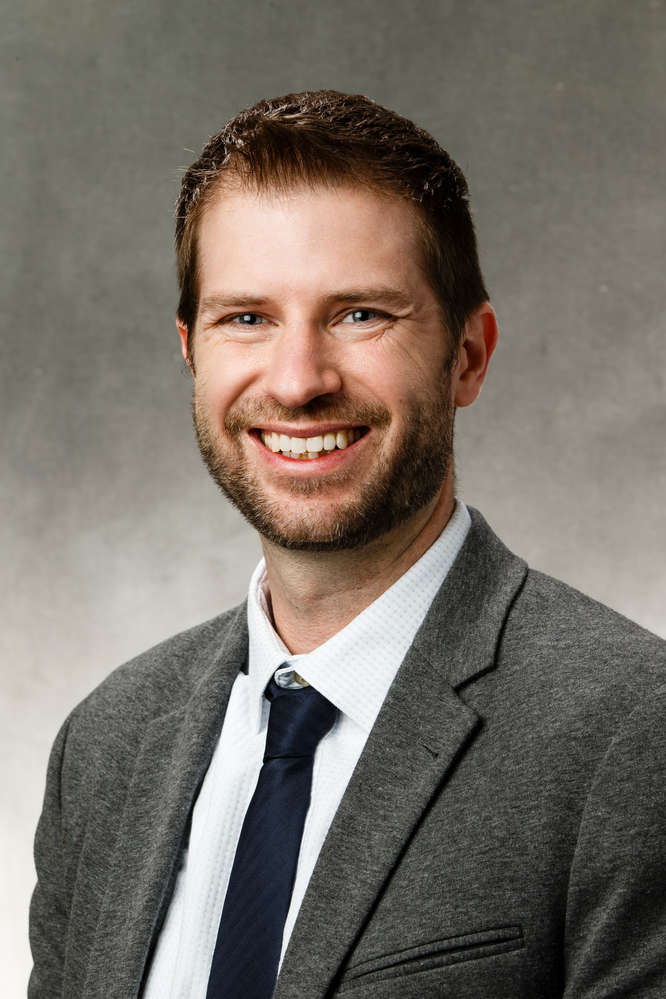
The Roman Catholic tradition calls for a “culture of encounter” and engaging in religious diversity. Hans Gustafson, director of the Jay Phillips Center for Interreligious Studies, knows that engaging with other religions does not erase Catholic identity on campus, but instead “refines and deepens it."
“St. Thomas engages religious diversity and welcomes it, not in spite of its Catholic mission and identity, but precisely because of its mission and identity,” he said.
On a mission to provide a welcoming space where rich religious and cultural diversity is cherished and valued, students have been leading the charge for interfaith spaces through Campus Ministry. Gustafson describes students as “the lifeblood of interreligious encounter and interfaith engagement on our campus.”
“When students build relationships and friendships across difference, whether through dialogue, service, or shared hobbies and learning, they create the kind of trust our wider society so often lacks,” Gustafson said.
Enriching a community of faith and culture
The Iverson Center for Faith doubles as the home for Campus Ministry and a hub for religious diversity. Most, if not all, events hosted there allow students to gather, reflect, and share in fellowship with one another.
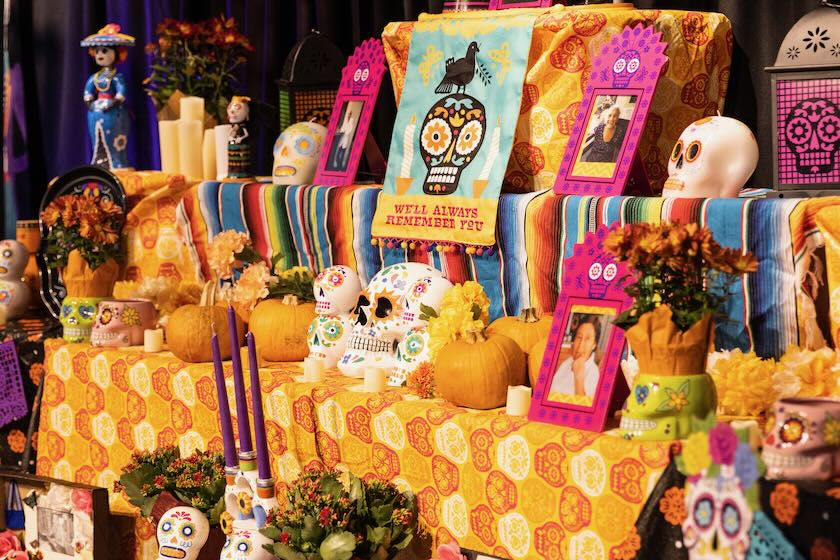
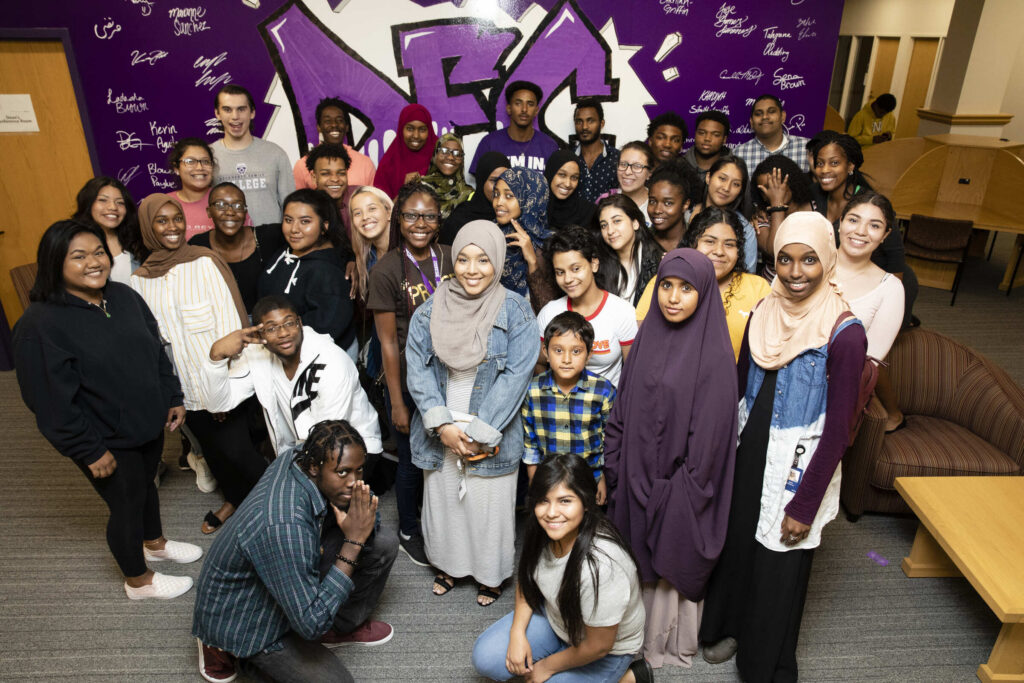
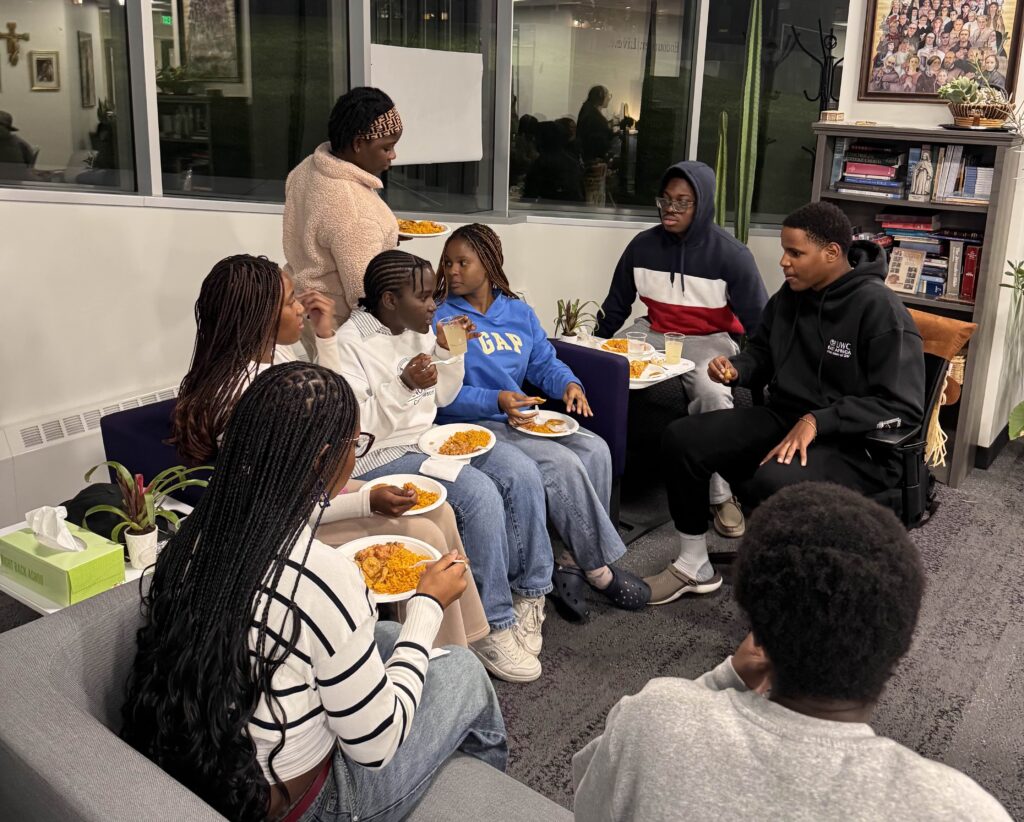
Two of the largest ethnically diverse faith groups meet at the Iversen Center for Faith: CaFE y Amigos and Afro Christian Fellowship.
In 2020, CaFE y Amigos started with eight to 12 students but exponentially grew to 65 students participating in the fellowship group. Afro Christian Fellowship did not exist, but experienced immediate engagement from St. Thomas in 2025.
Altogether the multicultural programs have seen over 100 students in fall 2025, the biggest engagement Pereira has ever seen in Campus Ministry.
This fall, Campus Ministry has experienced record levels of engagement across all programs. In 2025, the department has 36 student workers and more than 20 student volunteers, reflecting the rise in student interest.
Campus Ministers Marta Pereira and Sarah Chamseddine are excited that the levels of student engagement have peaked in fall 2025.
“I love seeing students of different traditions feel like this is a home for them,” Chamseddine said. “But St. Thomas has always been good about holding on to their Catholic identity, offering programs for students to dive into their faith as Catholic students.”
As St. Thomas continues to navigate the opportunities of religious and cultural diversity, the need for faith-based groups sprouts along with it. Pereira heavily relies on student feedback to ensure that each student feels like they can belong.
“Most of our students are children of immigrants and are still navigating what that means for them,” Pereira said. “So, it’s a reminder for the students that we want to walk with them and welcome them and support who they are in a community where they still have to struggle to feel that they belong.”