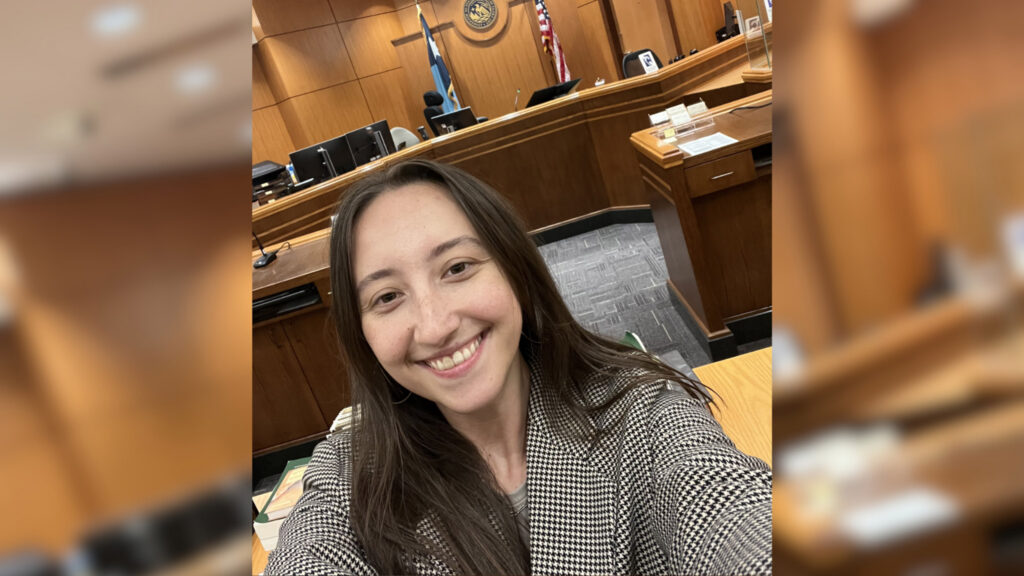
In her final year at the University of St. Thomas School of Law, Maria Landfried ’25 J.D. did much more than study law in a classroom. She worked across professions to define what justice can look like in Minnesota.
As part of a multi-disciplinary student team at the Interprofessional Center (IPC) at St. Thomas, Landfried and her colleagues took on the case of a client currently serving a life sentence. Together, they pursued reducing the client’s sentence under a new state law that allows judges to make adjustments.
Landfried, who wants to someday be a public defender, handled writing pieces of the petition and corresponding with the judge. As a shortened sentence looked within reach, the law student worked with her colleagues at the School of Social Work to plan for the client’s reentry.

“It was the perfect combination. I was able to handle the legal side of things, and then that allowed our case managers to really focus on what the client’s life was going to look like after the fact,” Landfried said.
Founded with a vision of uniting disciplines to address the multi-faceted needs of clients, the IPC is a joint effort between the School of Law and the Morrison Family College of Health’s Graduate School of Professional Psychology and School of Social Work. Students from all three areas come together, under intensive supervision, to serve underrepresented individuals, gaining hands-on experience while tackling legal, psychological, and social issues that often intersect in their clients’ lives.
Landfried joined the IPC through its Criminal and Juvenile Defense Clinic, which represents youth and adults in criminal cases who may otherwise be unable to afford representation. On day one, she had her first meeting with a client and was in charge of filing paperwork and attending future court hearings.
“I’m not here to get the wins in a courtroom. I’m here to fix the system and help people— this is how you do it,” Landfried said. “The chance to serve a client, while considering all of their complex needs—mental, spiritual and psychological, in addition to legal services—we really should be looking for more opportunities to do this.”
Breaking silos, building solutions
The IPC's interdisciplinary approach mirrors the evolving landscape of legal and public service professions, where teamwork across fields is increasingly vital. Students at the IPC don’t just learn to work with other disciplines—they learn to infuse collaborative work from the very beginning of their process.
“Ultimately, our students end up providing really solid care for their future clients or patients because they already have a leg up on knowing how to collaborate effectively with interprofessional colleagues,” said Amy Smith, director of social work services at the IPC.

The work across the IPC is vast and varied. Psychology students provide counseling to individuals, couples and families. Social work students partner with clients to address psycho-social issues, including housing, transportation barriers and employment. And law students serve clients through a variety of legal clinics focused on immigration, criminal defense, and special education.
Each expertise—psychology, social work, and law—is valued as a crucial pillar on its own. But the center and its students truly shine when the three pillars work collaboratively to serve a member of the community.
As Landfried petitioned a judge to shorten her client’s life sentence, Jenna Roubik ’25 ’26 MSW was also working the case. The future social worker was in the room during client meetings to learn more about their client’s wishes should he ever be released from prison. Roubik was charged with providing options for housing programs, potential jobs and health insurance.
“Learning how to provide for clients while working as part of an interdisciplinary team, I was able to build many different skills,” Roubik said. “Figuring out how to effectively communicate with attorneys and psychologists was great. And it really showed me that social workers can play an important role in many different settings.”
Leading through service to community
The IPC has been a trusted, no-cost, community resource for more than 20 years. Its mission always has been to advance social justice through service and advocacy for underserved individuals and communities, all while providing transformative educational experiences.
For Shenae Lundberg, who is pursuing her doctorate in counseling psychology at St. Thomas, therapy isn’t just a career, it’s a calling to help people. Lundberg said she was drawn to the IPC by its mission to serve clients who are uninsured, low-income, or facing complex legal and social barriers.
“I really liked the idea of providing support for people who need it most, especially as someone who’s still learning,” Lungberg said.
During a recent practicum at the IPC, Lundberg worked with about a dozen different patients, providing couple’s therapy and specialized support in an anxiety clinic. At every turn, she embraced the center’s collaborative nature, relying on her colleagues in law and social work to deliver holistic care.
In one case, she worked closely with a case manager to help a client struggling with housing and financial insecurity. “Having someone else in the system to focus on those social support needs allowed us to use the therapy space to really focus on the emotional work,” Lundberg said. “And it helped me see how essential that team approach is.”

The power of collaboration
As the Interprofessional Center moves into a new decade, leaders are working to incorporate more disciplines under the same roof. With its focus on whole person health, the Morrison Family College of Health would like to see nursing or public health students join the ranks. And as disciplines expand, so, too, do the number of partner organizations. The IPC is working with a growing list of community nonprofits to provide services, such as the Center for Victims of Torture and the Sisters of St. Joseph Ministries Foundation (now referred to as Accola).
“Every year we are looking at new ways to incorporate more students, more disciplines and to reach more people in the community,” Director of Psychological Services Ann Marie Winskowski said. “It’s here where the university’s mission, to serve the common good, is really lived out in a tangible way, and we’re always hoping to take it a step further.”
It’s the kind of interdisciplinary model that doesn’t just support clients, it transforms all involved.
“If you’re still figuring out what kind of impact you want to make on the world, the IPC is an incredible place to explore,” Lundberg said. “It’s highly supportive of its students and it’s doing something really special for our community.”