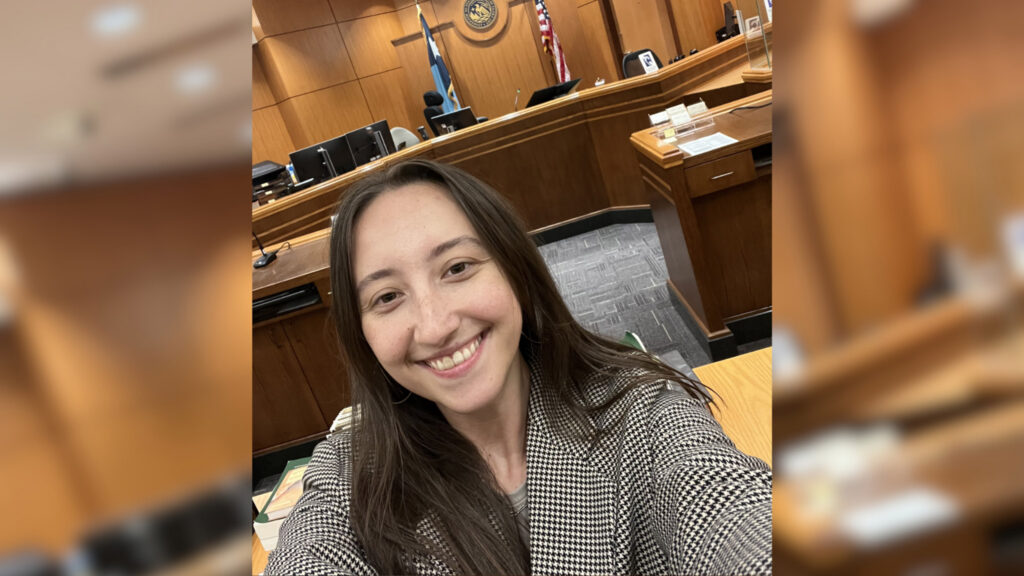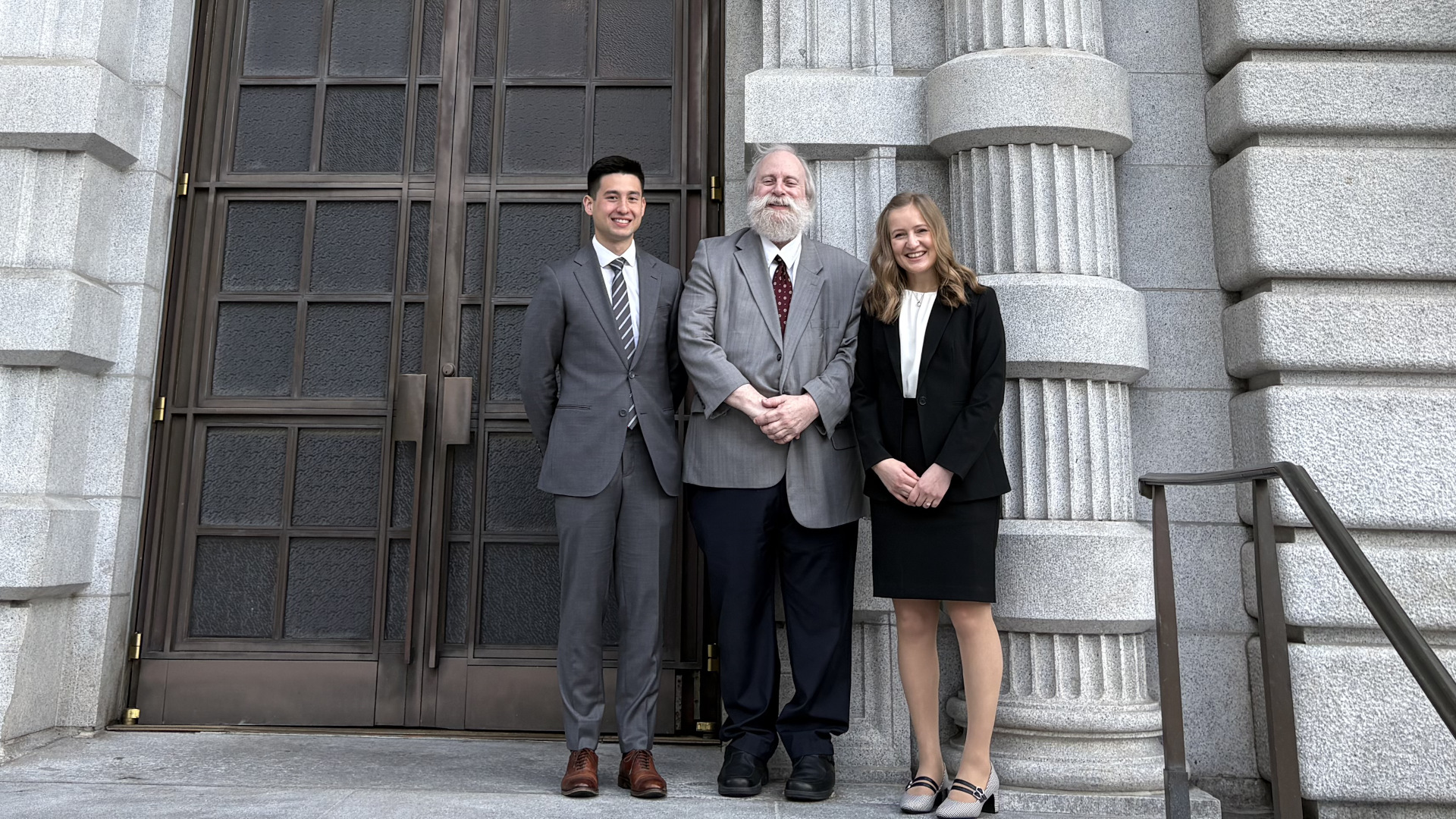
Third-year University of St. Thomas School of Law students Isaac Rillo and Gabrielle Tremblay argued a prisoner’s constitutional claim for medical treatment before the United States Court of Appeals for the Ninth Circuit in San Francisco.
Working in the Appellate Clinic, led by Professor Gregory Sisk, the students advocated for the Eighth Amendment rights of a California prisoner seeking access to prescribed medical eyewear.
“It was important to take this case because someone in Mr. Singleton’s situation can easily be dismissed or overlooked,” Rillo said.
“Not only does everyone deserve legal representation, but every client also deserves to have their story fully and effectively presented to the Court,” Tremblay added. “It was an honor to be his storyteller.”
The Appellate Clinic is a year-long course of study in written and oral advocacy, appellate courts, appellate jurisdiction and the rules of appellate procedure. Clinical students represent a client pro bono under faculty supervision, briefing and arguing appellate cases on their behalf.
This year’s case, Kelvin X. Singleton v. S. Gates, centered on “deliberate indifference” by prison officials to a prisoner’s serious medical needs. Singleton, who suffered an eye stroke and subsequent photophobia, was denied replacement transitional lenses by prison officials despite prescriptions from multiple specialists. The refusal left Singleton unable to exercise outdoors or navigate intense indoor lighting without debilitating migraines.
The team of Rillo, Tremblay and Sisk dedicated nearly a year to the case, beginning with an opening brief drafted last summer, continuing with a reply brief filed in January and then preparing for oral argument in April.
At the oral argument, a panel of three judges asked questions of both Rillo and Tremblay about factual disputes in the record. The questions focused on the existence of a prison policy categorically blocking transitional lenses and whether an optometrist who fitted Singleton for glasses offered a legitimate differing medical opinion from the two ophthalmologists who prescribed transitional lenses.
“I was definitely anxious but felt more comfortable as the judges began asking questions, and the argument became more conversational,” Rillo said. “Although the time flew by in a blur, it is an experience I will never forget and one that will serve me well as I begin my career.”
Tremblay said she was also nervous, but that her nerves quickly subsided.
“We had a welcoming panel of judges who were curious and prepared with great questions,” she said. “I could feel this from the moment they walked to the bench to the time we spent on the podium.”
A decision in Singleton v. Gates is expected in the next few months.
This is the fourteenth year of pro bono work by the Appellate Clinic, which has established a record of prevailing in more than 70 percent of the appeals it has taken.