Major Garrett still remembers what it felt like to walk into a newsroom and see the morning paper waiting on his desk.
“It’s about this thick,” he said, demonstrating with his fingers set apart. “Five sections. Pictures are great, the headlines are great, the story selection is amazing. And you look around the newsroom… and you say to yourself, we made this. Yesterday we made this thing.”
That sense of collective purpose, and the responsibility that came with it, has stayed with him across a career that has taken him from local reporting to the center of national politics as chief Washington correspondent for CBS News and host of “The Takeout.”
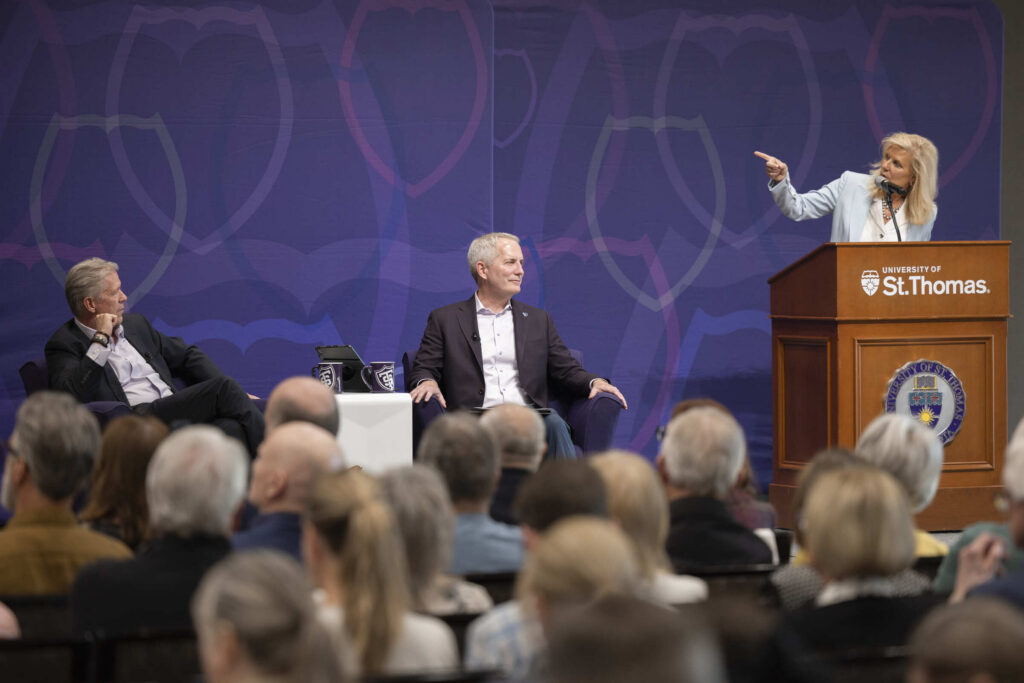
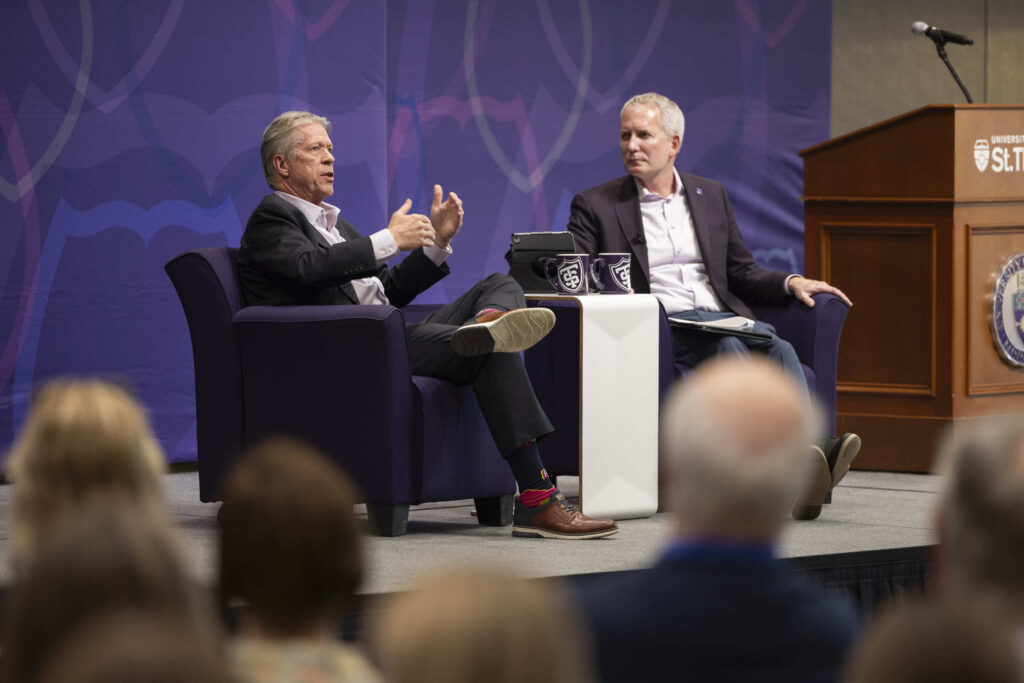
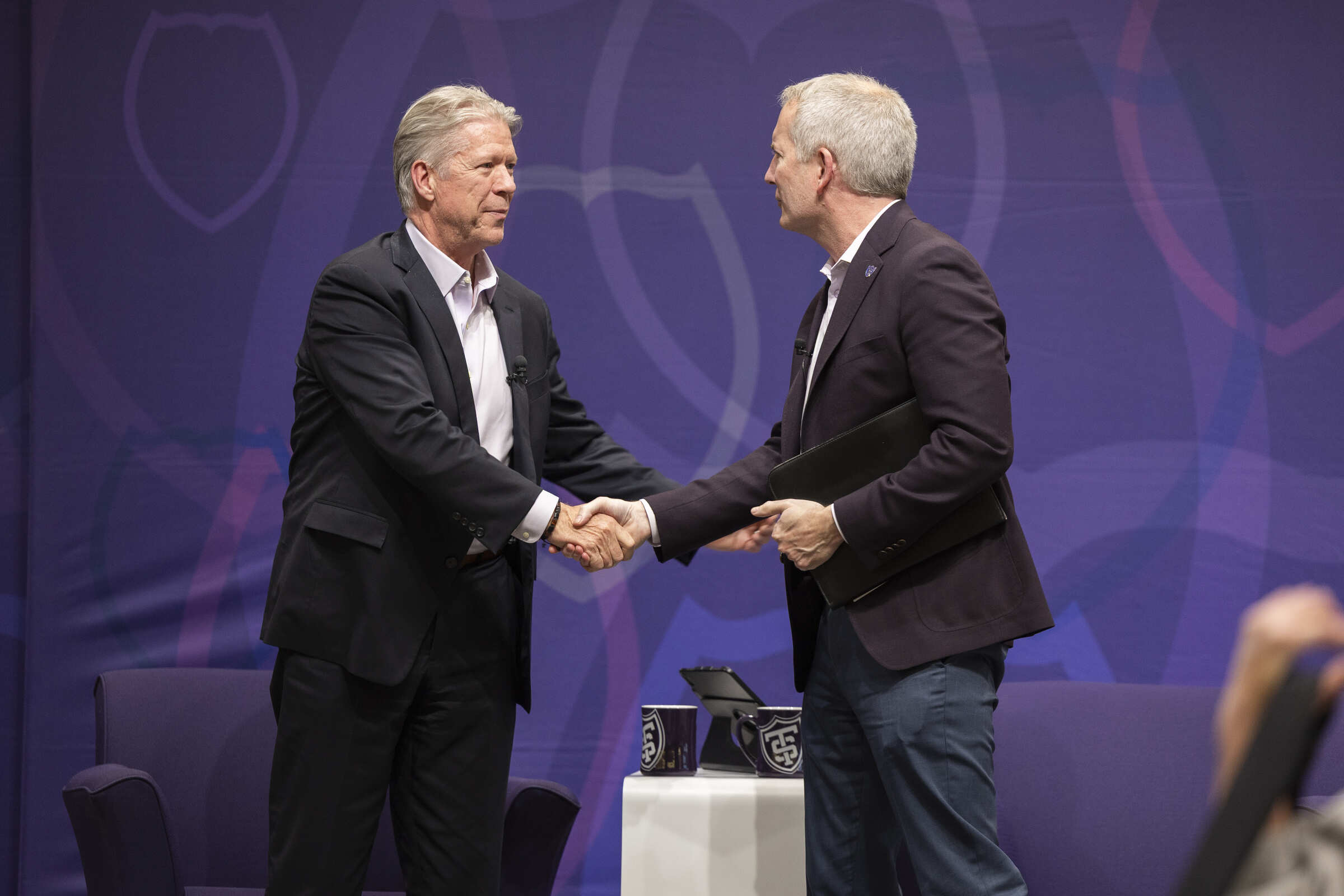
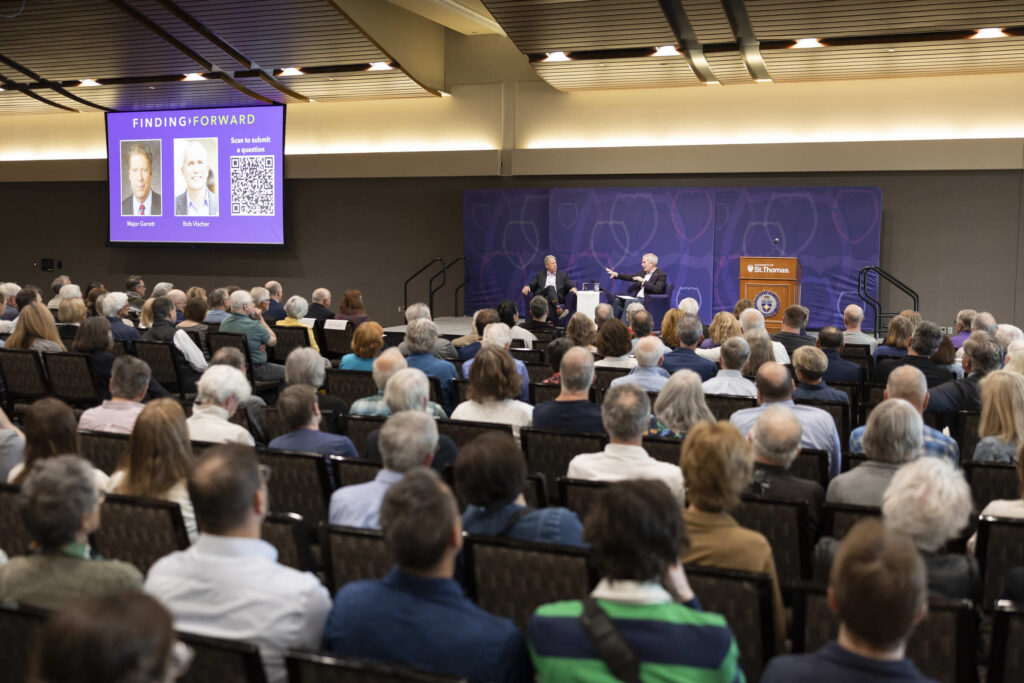
It also shaped the way he spoke about journalism during a full room at a recent visit to the University of St. Thomas, where he joined St. Thomas President Rob Vischer for a Finding Forward conversation.
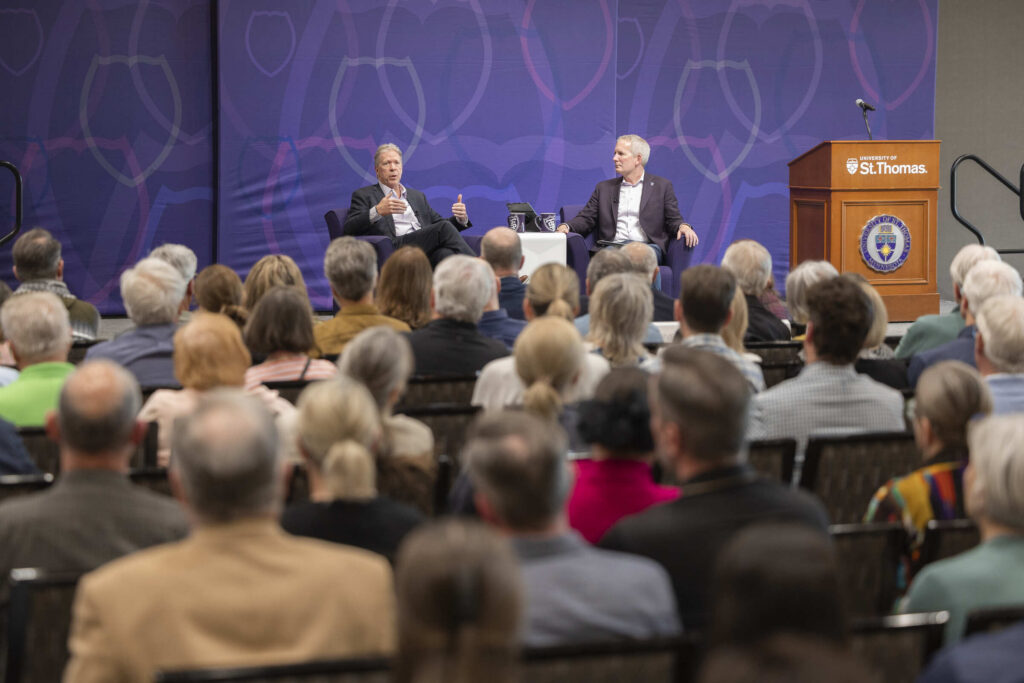
The event, the final Finding Forward of the 2025-26 academic year, was part of the inaugural Whalen Media Ethics Summit, which was sponsored by the Department of Emerging Media at St. Thomas’ College of Arts & Sciences.
Garrett, who has covered multiple presidential administrations and the evolving relationship between government, media and the public, did not romanticize the industry. When Vischer asked him what it is like to cover Washington today, Garrett described a profession under strain, where economic pressures, political hostility and the pace of digital news have fundamentally altered how journalism works. But he repeatedly returned to the foundation of traditional journalism.
“If I’ve done my career’s work the way I’ve tried to do it, you don’t know what I believe,” he said. “You shouldn’t. It’s not my job.”
AI and a writer’s role
But Garrett did express his views on artificial intelligence: He doesn’t use it.
“I don’t use AI at all because I’m a writer,” he said. “It’s kind of emotional for me because it’s all I ever wanted to be. So, I’m not interested in anything that someone else created that will write for me, that would essentially carve out my very being.”
Writing, he said, is the foundation of how journalists think, report and communicate.
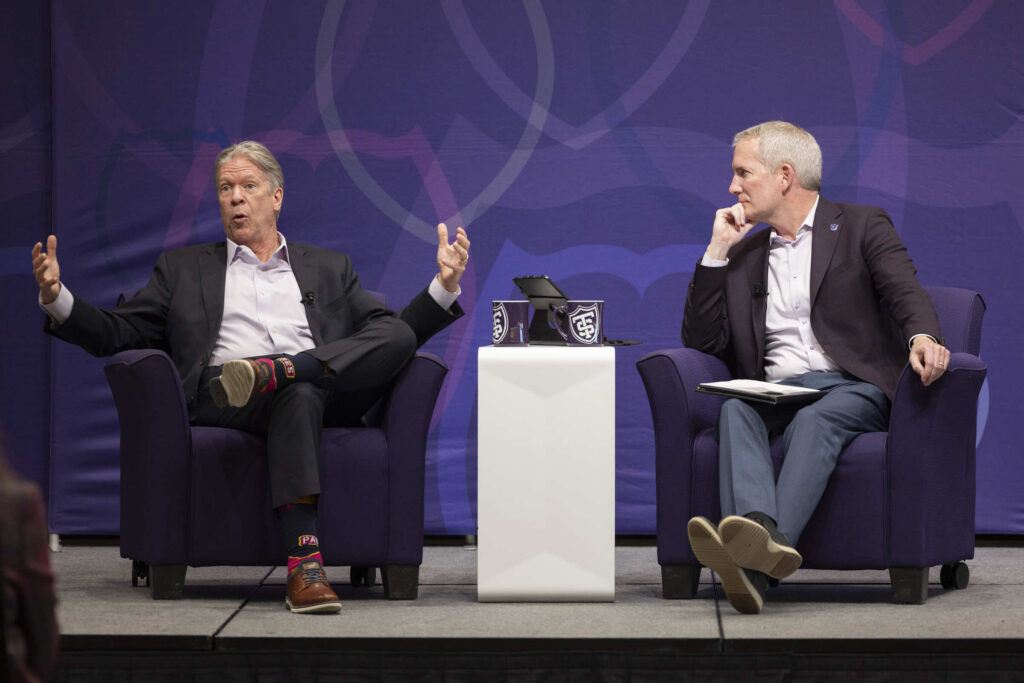
“Understand what it means to be a writer. Understand what words mean,” he said, invoking Mark Twain. “The difference between the right word and the almost right word is the difference between a bolt of lightning and a lightning bug.”
For Garrett, that precision cannot be outsourced. And neither can the work that comes before it.
“Go out and find facts. Use those facts as the armor for your writing and be a journalist,” he said. “An AI can process what other journalists have already done, but no AI ever invented will be a journalist. Ever.”
Today, he acknowledged, audiences are more fragmented than they were before. The lines between reporting and opinion are often blurred, and journalists are evaluated as individuals as much as representatives of a newsroom. Still, Garrett described his role in terms that have not shifted.
“My job is to tell you what I’ve learned, explain it as clearly as I possibly can, and then let you decide what to do with it,” he said. “I don’t have a cause. I don’t have a crusade. I’m not trying to change the world. I’m trying to witness the world. We will always need witnesses.”
Unfortunately, he noted, there are fewer of those witnesses today as declining revenues have shrunk newsroom staffs – especially at local newsrooms. The result is not just fewer stories, but fewer points of connection between institutions and the public.
“When there’s nobody there, what do you trust?”
Incentives, influence and need
In a media environment filled with competing voices, Garrett drew a distinction between journalism and other forms of content creation.
“An influencer profits by the methodology of the witnessing,” he said. Journalists, he argued, operate differently. “A journalist witnesses, chronicles, writes it down and produces it. Their profit is not tied to the way they witness something. An influencer has to witness a certain way because there is a market expectation. A journalist does not.”
Despite the disruption facing the industry, Garrett expressed confidence in the role journalism continues to play.
“The thing you’re Googling didn’t spring out of the ground by itself,” he said. “Somebody was someplace with a pad and a pen and a camera and recorded it, witnessed it, chronicled it and produced it.”
For Garrett, that act of witnessing remains essential, regardless of how news is delivered or consumed.
“We will always need witnesses. We will always need chroniclers.”