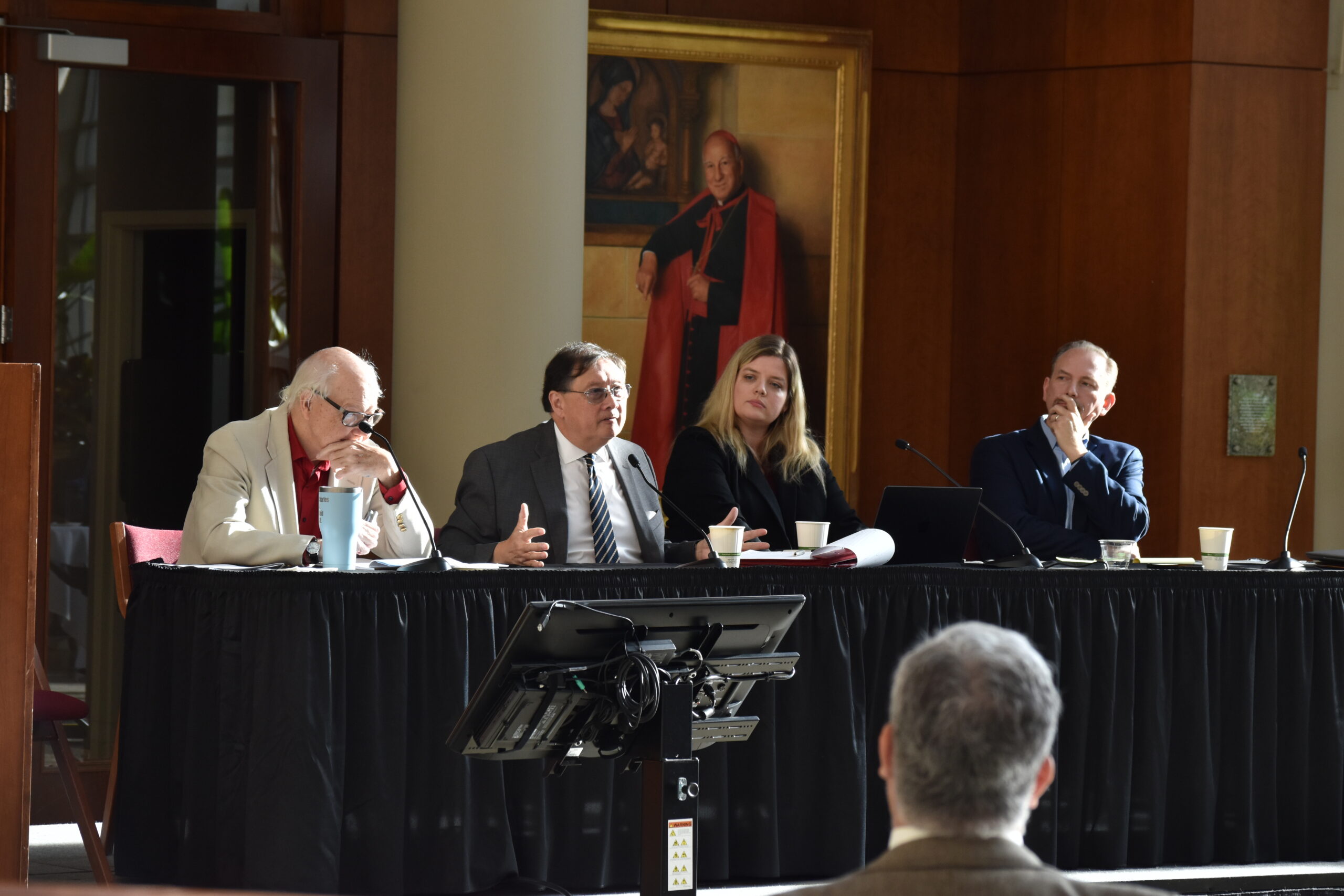
Through workshops and symposia coordinated by University of St. Thomas School of Law faculty this past fall, leading scholars, law school administrators, lawyers and judges convened to examine how current pressures on democratic institutions and constitutional order in the United States and around the world pose a threat to the rule of law—the foundational principle that law constrains power, protects rights and applies equally to all. They also explored how legal education and the legal profession can respond.
Professional identity formation and the rule of law
The work of the Holloran Center for Ethical Leadership in the Professions is focused on emphasizing within legal education nationally, the formation of each law student's ethical professional identity—a representation of self, achieved in stages over time, during which the characteristics, values and norms of the profession are internalized, resulting in an individual thinking, acting and feeling like a member of the profession.

One of the foundational norms on which professional identity is grounded is a deep responsibility and commitment to serving clients, the profession and the rule of law.
"Earlier this year, our team came to appreciate that just as professional identity formation has been underemphasized in legal education, the rule of law likewise has not received sufficient attention," said Professor Jerry Organ, co-director of the Holloran Center.
In response, a Rule of Law Working Group was created to generate teaching materials and resources to support legal educators around the country interested in helping students learn more about the rule of law and their special responsibility as lawyers to support the rule of law.
In October 2025, the Working Group's efforts culminated in a two-day workshop for law professors and law school administrators. Participants from nearly 30 law schools gathered to learn ways they can embed professional identity formation and the rule of law into their teaching and programming.
"Regardless of their roles at their law schools, participants found the materials full of opportunities to engage the rule of law in a way that brings students together to dialogue about foundational principles without being partisan or divisive," Organ said. "Participants recognized that being more intentional about engaging rule of law concepts in the context of professional identity formation reaffirms a collective commitment to justice, accountability and the common good."
An independent legal profession
The fall 2025 St. Thomas Law Journal symposium examined "The Constitutional Rights of Lawyers and Law Firms." The event brought together legal scholars and lawyers from across the nation and ideologies to discuss the role of lawyers in a democracy, professional independence, and the responsibility of lawyers to act ethically and uphold the rule of law.
In opening remarks, Professor Michael Paulsen explained that the symposium's topic stemmed from a series of executive orders issues by President Donald Trump in early 2025. They targeted specific law firms because of the attorneys they employ, clients they serve or causes they represent. The orders, among other things, limited attorney's access to government buildings, revoked security clearances, canceled government contracts, and prohibited federal government employees from interacting with the firms.
Over the course of three panels, speakers discussed the ways these actions by the executive branch were unconstitutional—including violations of the First, Fifth and Sixth Amendments—and represented an abuse of power. Speakers also said the orders go against long-held professional norms for lawyers regarding ethical practice and a duty, particularly for government lawyers, to serve the law and not the head of state.
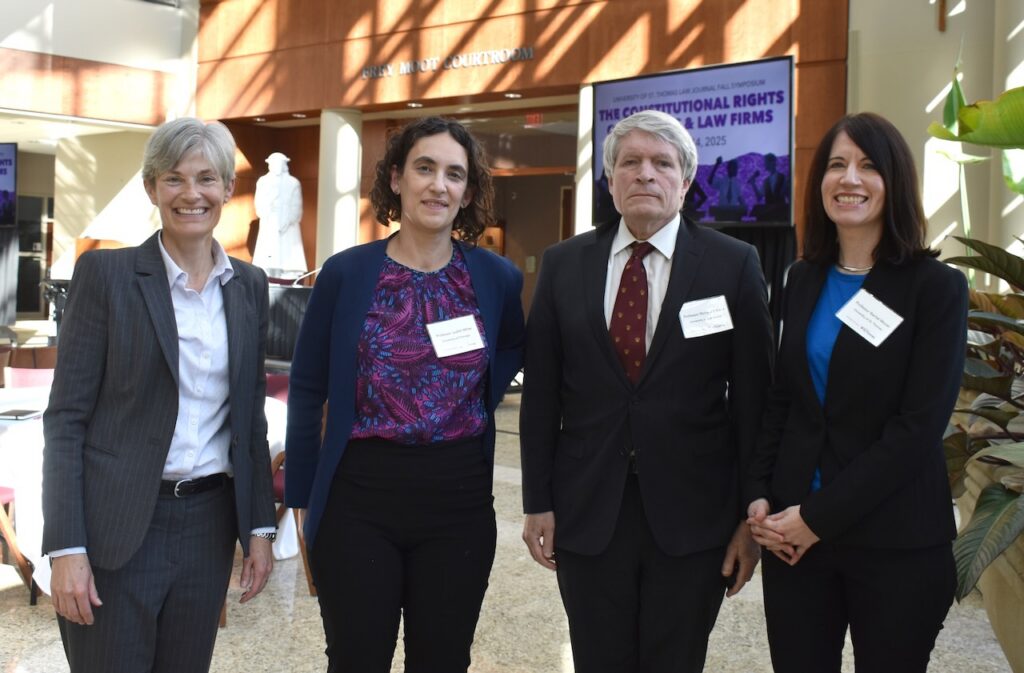
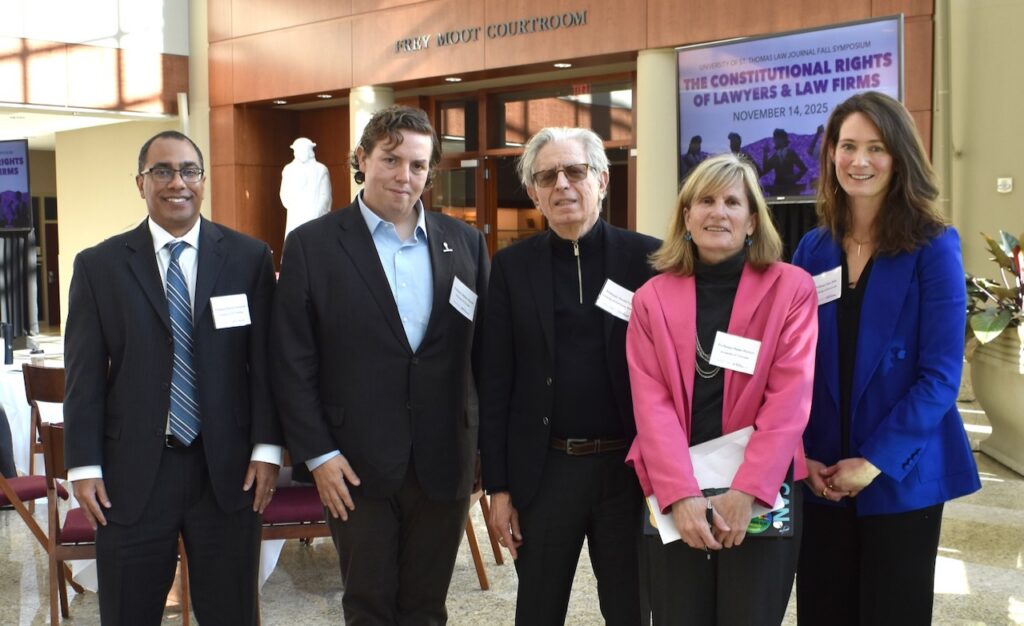
Several speakers talked about how the executive orders could have broad, long-term implications for our justice system such as less government oversight and fewer challenges to misconduct. Law firms, lawyers and legal clinics may start operating differently simply because of the potential that they could be named in a future order or federal investigation. Panelists said this undermines the integrity of the legal system and disrupts the constitutional separation of powers.
If the executive branch is allowed to infringe upon the independence of legal providers, they explained, firms, attorneys and even clients would be guided by rules set by the president instead of by laws established by Congress.
Power could also be shifted away from the courts, panelists said. Some of the targeted law firms accepted the government's terms, while others filed lawsuits to challenge what they asserted were unlawful orders. If they hadn't, the speaker at the symposium said, presidential power would go unchecked, and no legal remedy would be established for future cases.
The symposium features a discussion with attorney, prominent legal scholar and former United States Court of Appeals for the Fourth Circuit Judge J. Michael Luttig. He has written and spoken extensively about what he views as the United States' current "constitutional crisis" regarding the rule of law, elections, separation of powers and personal freedoms.
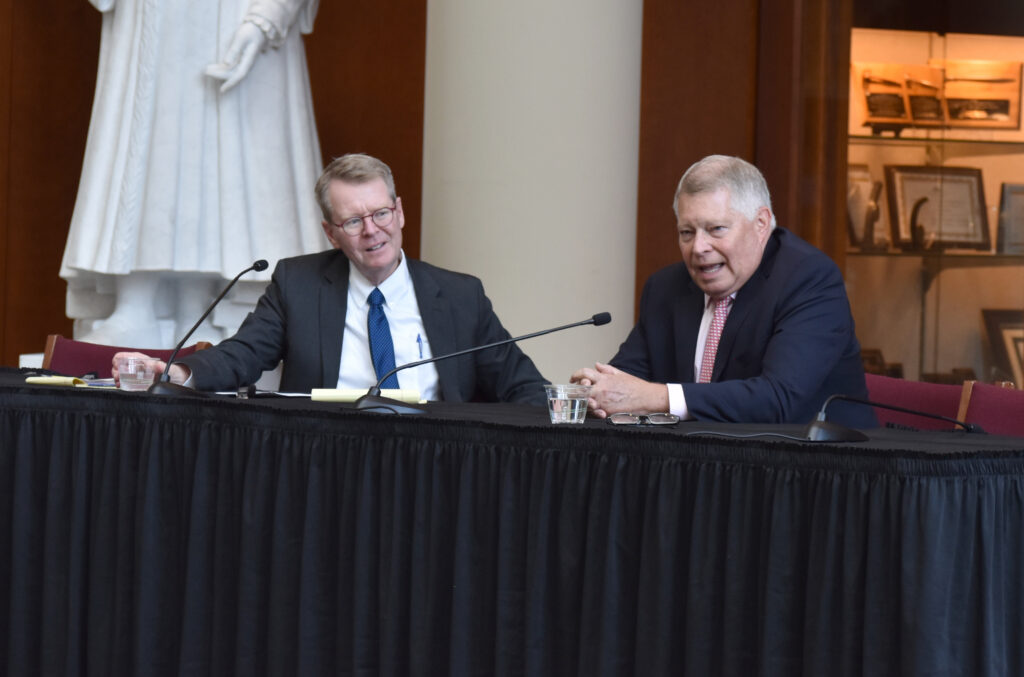
At the symposium, Luttig was critical of several recent U.S. Supreme Court decisions and lack of action in other cases—all, he said, resulting in damage to the Constitution.
During the final panel, Professor Paulsen urged lawyers not to compromise the independence of the legal profession.
"For American lawyers to fail to stand up to and challenge the beginnings and the burgeoning of a nascent authoritarian regime in the United State would be, well, already is, a failure of our duties as lawyers and a failure of our responsibilities to the rule of law as officers of the law and members of what should be a noble profession."
Watch a recording of the symposium:
The rule of law and global trends
The St. Thomas Journal of Law and Public Policy's fall "Rule of Law" symposium convened United States and International scholars from multiple disciplines to examine how government institutions are being tested by new technologies, an expansion of executive power, global politics and cultural changes.
Across three panels and a keynote address, speakers explored whether foundational rule of law principles—accountability, transparency, equality before the law and restraint of power—can endure.
Panelists examined the growth of algorithmic decision-making, the expanding use of emergency authority and the tension between judicial oversight and presidential discretion. Discussions ranged from defamation and digital "cheap speech" to the rise of authoritarian governance abroad, presidential immunity and the erosion of constitutional norms.
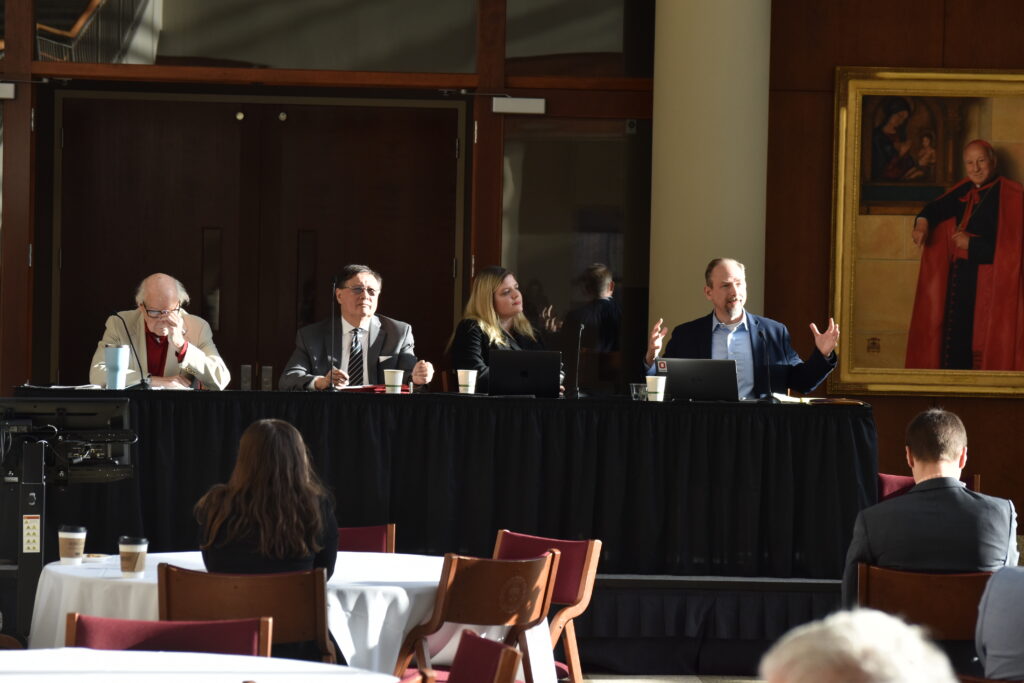
Other presentations analyzed how domestic legal developments shape international commitments and global accountability. Discussions also addressed the Citizenship Clause of the Fourteenth Amendment and the U.S. Supreme Court's reliance on "history and tradition" in recent decisions, highlighting the debate over how courts interpret fundamental rights.
Several speakers emphasized how legal frameworks and processes, many of which are rule of law safeguards, are increasingly strained by faster decision-making systems such as presidential executive orders that can have a broad reach and include concentrated executive discretion.
The keynote address from Raj Bhala, a distinguished professor at the University of Kansas School of Law, offered Shakespeare's play Measure for Measure as a lens for understanding enduring tensions between law, discretion, mercy and justice.
"Through their presentations, out speakers illustrated that the rule of law isn't static, self-executing or self-sustaining," said Professor Charles Reid. "It relies on continual scrutiny, engagement, accountability and a shared commitment to the constitutional structure and democratic governance."
Watch a recording of the symposium: