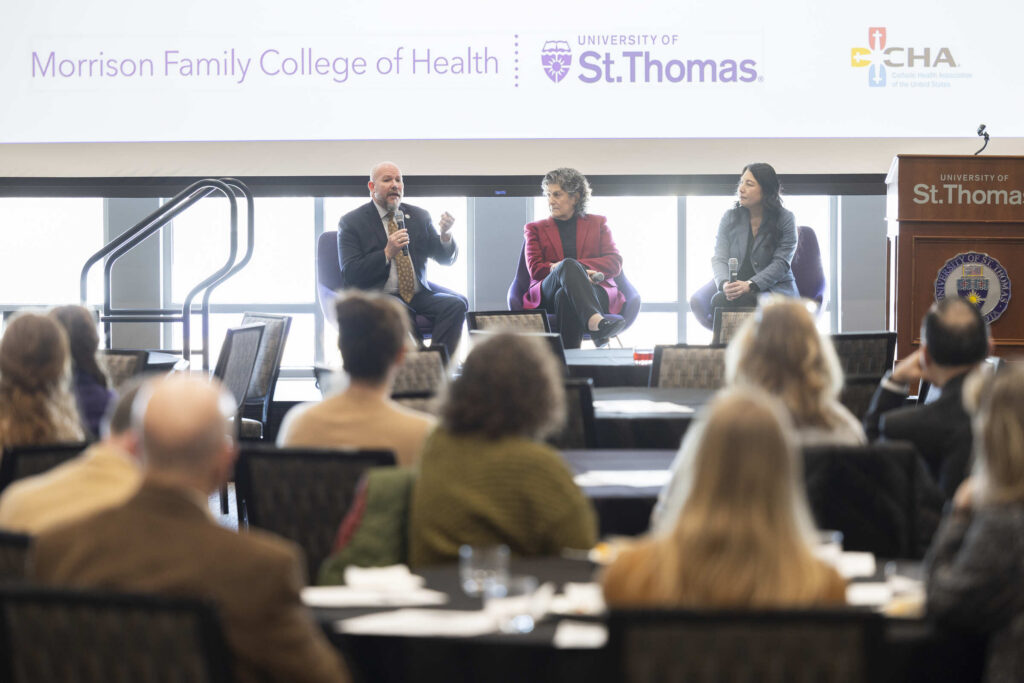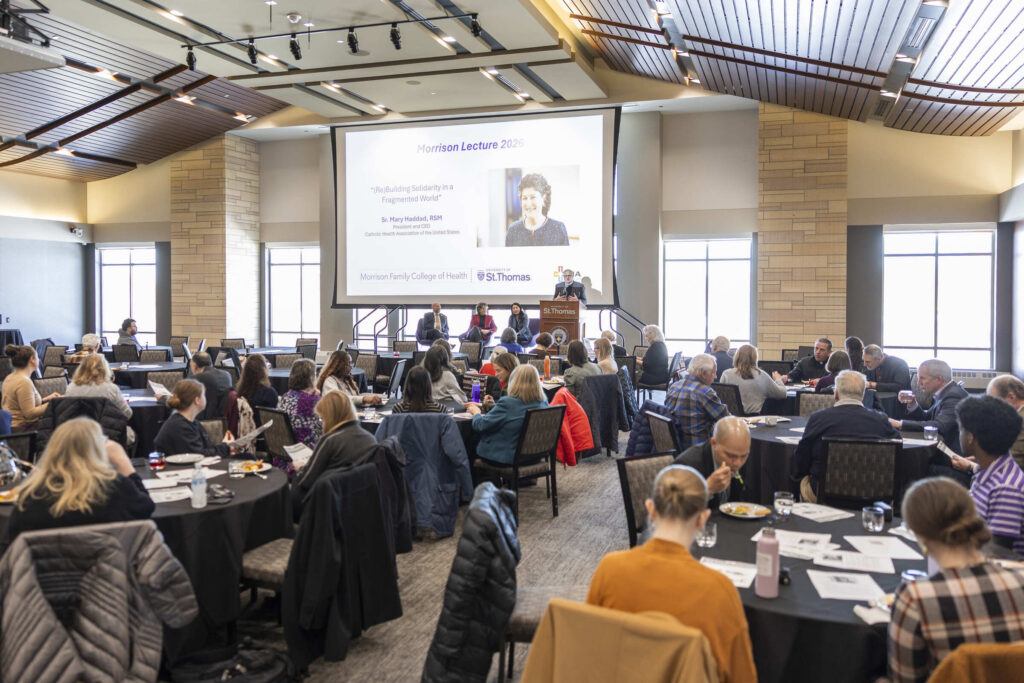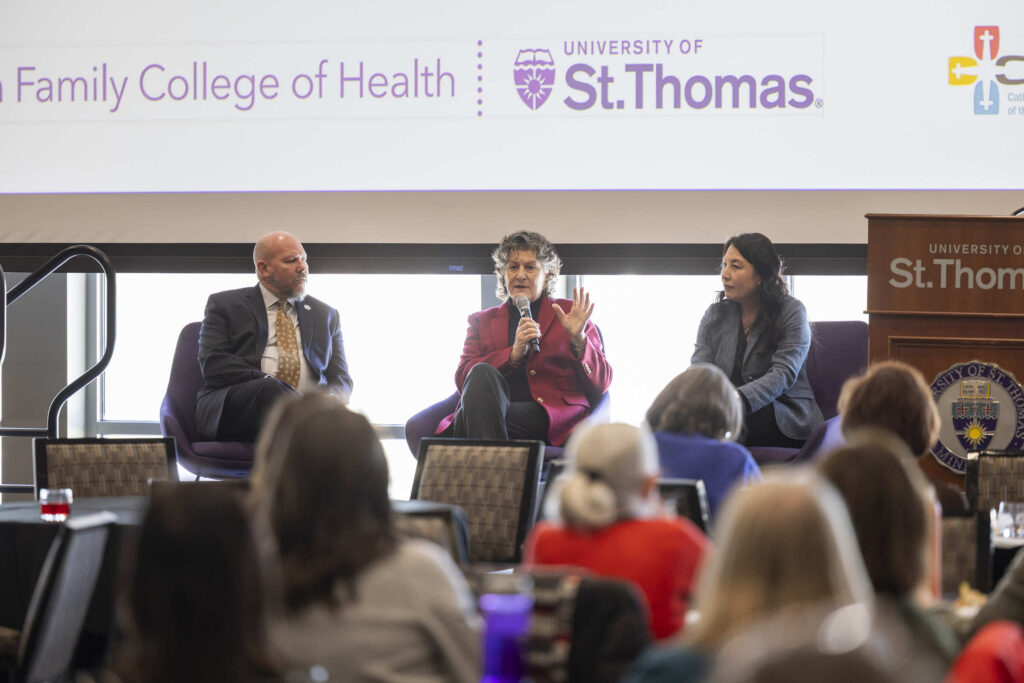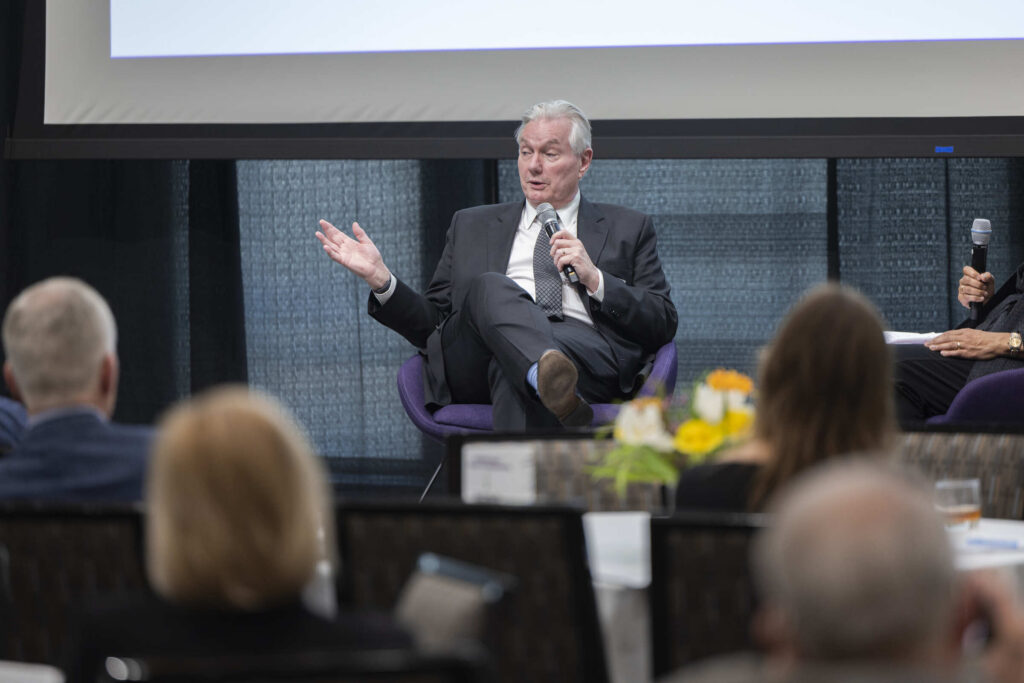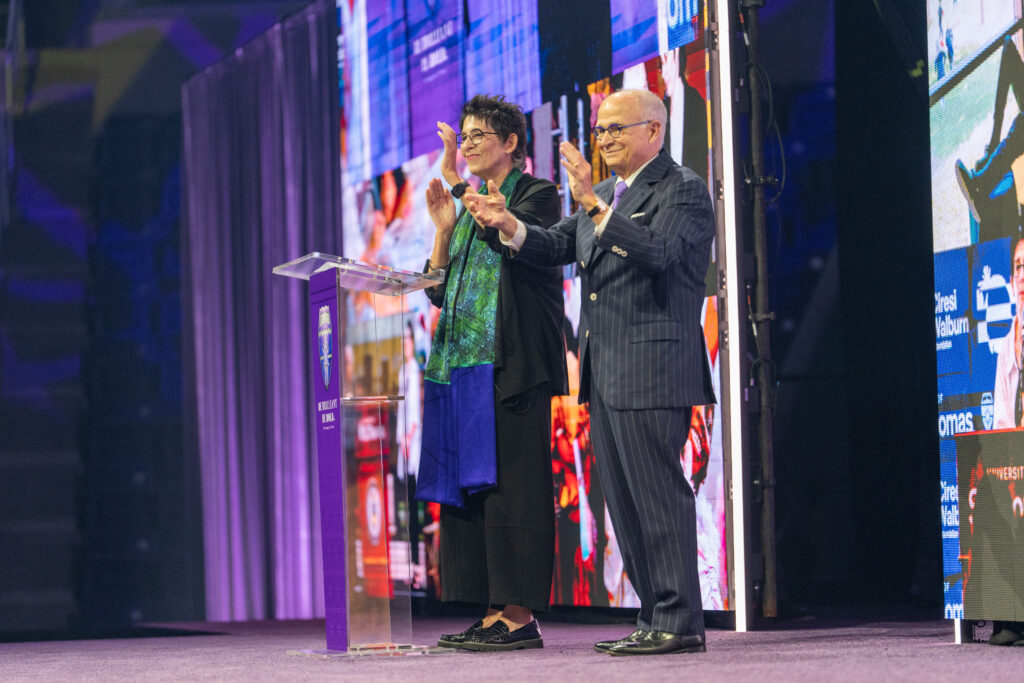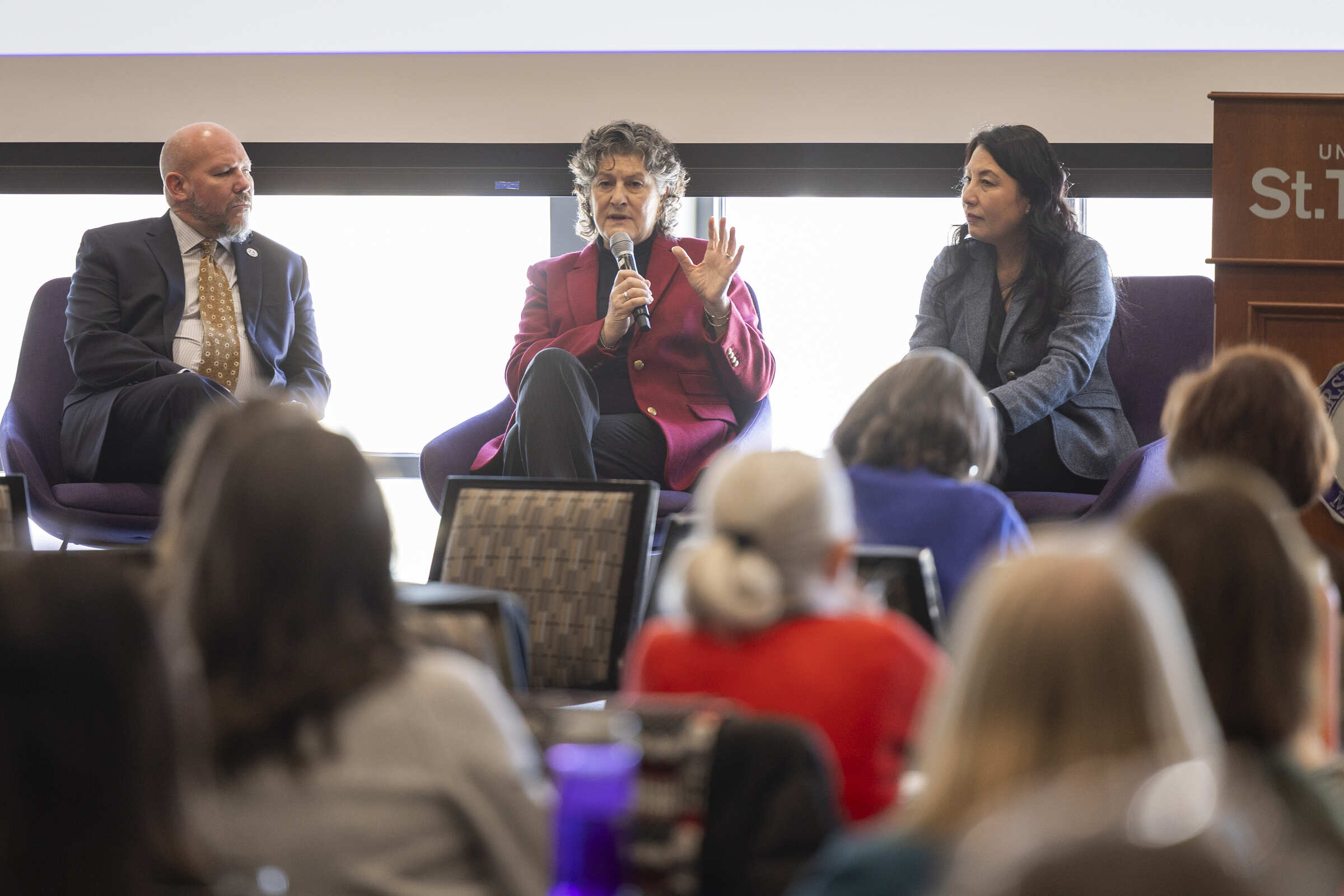
What does it mean to care for people in a fractured world? That was the question at hand during the inaugural Morrison Lecture held at the University of St. Thomas. The discussion brought together Sister Mary Haddad, RSM, president and CEO of the Catholic Health Association of the United States; Jamie Verbrugge, president and CEO of Catholic Charities Twin Cities; and MayKao Hang, founding dean of the Morrison Family College of Health, which sponsors the lecture series. The leaders discussed what it means to “(Re)Build Solidarity in a Fragmented World.”
Here are five memorable soundbites from the conversation.
“Our social needs impact our health. Our spiritual well-being impacts our health. Where we live, what we eat, what we drink, whether we are housed — all of that matters.”
Haddad used this line to underscore one of the afternoon’s central themes: healthcare is about more than what happens in a hospital or clinic. The conversation emphasized the concept of whole-person care: housing, food, transportation, safety and community support all shape a person’s well-being. Haddad noted this concept is deeply rooted in the history and mission of Catholic health care. For the audience, it was a reminder that rebuilding solidarity also means paying attention to conditions that allow people and communities to flourish.
“The Catholic health care primary focus is access to care for everyone. Anyone who shows up at our doors is going to be cared for.”
As the discussion turned to immigration enforcement, public fear and barriers to seeking care, Haddad stressed that Catholic health care means serving every person with dignity. She spoke of the challenges health systems face when people are afraid to seek primary care or even walk through the doors of a clinic or hospital. That fear, she noted, often leads to worse outcomes when people delay care. Her comments framed access to care not simply as a policy issue, but as a moral one.
“We serve without judgment, without question. We don’t ask to see people’s papers. We don’t ask them where they’re from. We ask them what they need.”
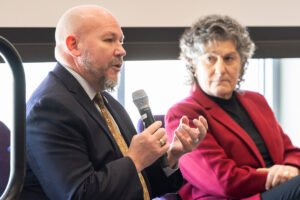
Verbrugge offered this reflection while describing Catholic Charities Twin Cities’ work, particularly when vulnerable families live with fear and uncertainty. This can lead to people avoiding meal programs, delaying services or becoming harder to reach when support is most needed. In that context, he said, solidarity becomes something concrete — showing up, creating trust and responding first to human need.
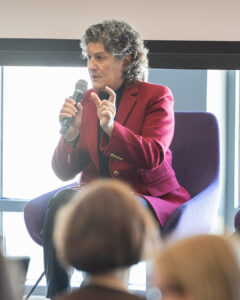
“Just doing good works of charity has to be coupled with our ability to influence policymakers in order to change the oppressive systems that impact people.”
Haddad shared this while reflecting on her advocacy work in Washington, D.C., and on the broader responsibility of Catholic institutions to do more than provide direct service. Caring for people in immediate need matters, she said, but so does addressing the policies and structures that create or deepen suffering in the first place. That distinction helped shift the conversation from charity alone to systemic change. It also reinforced one of the event’s major takeaways: solidarity calls not only for compassion, but for action.
“If every person had access to what they truly needed to be well and to do well, we would have advanced health equity.”
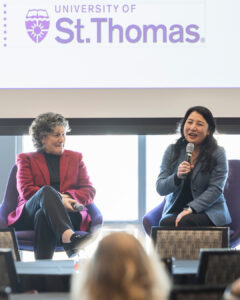
Hang connected the discussion to the Morrison Family College of Health’s mission. She argued whole-person health and health equity are not separate goals, but fundamentally linked. Educating future health professionals, she said, means preparing students to see patients as whole people and to understand systems that shape outcomes long before treatment begins. In that way, the Morrison Lecture also served as a reflection of the college’s broader purpose: forming leaders who can help build a more just and humane future of care.